Federal Lobbying by FanDuel, DraftKings Skyrockets Amid Struggles to Repeal Tax Changes
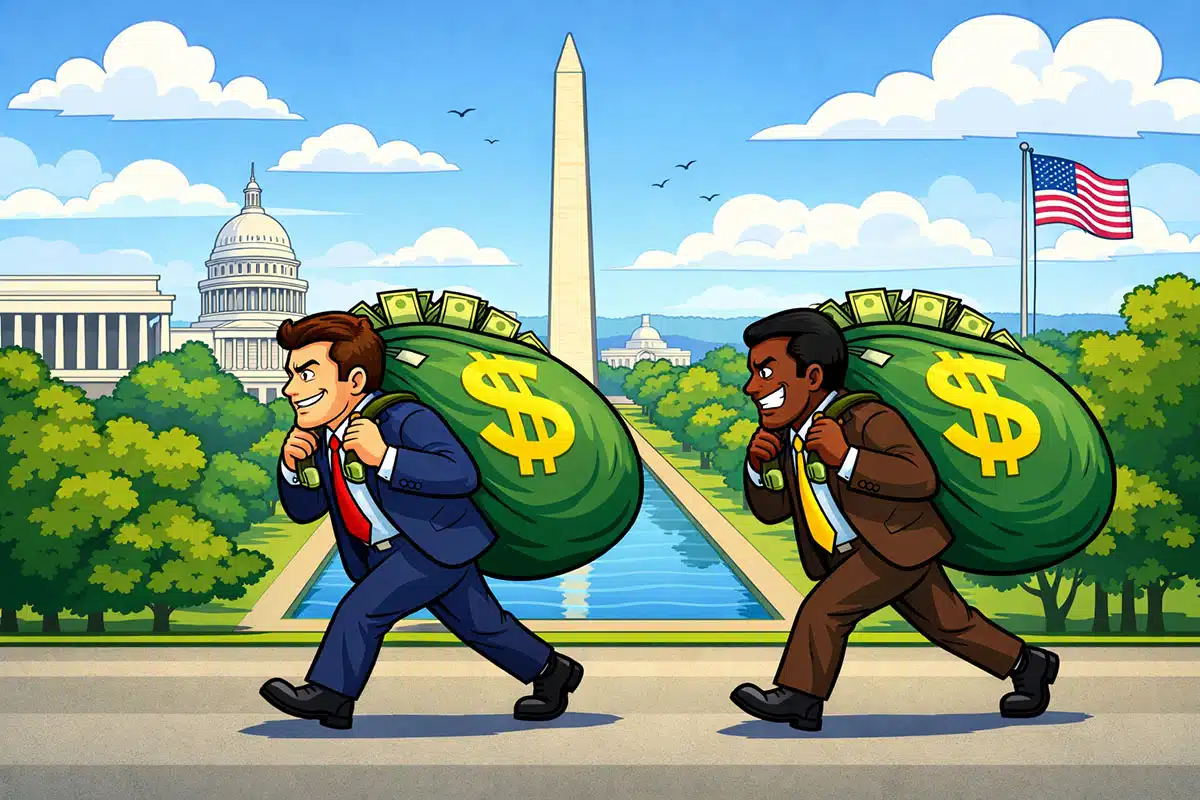
Sportsbook lobbying efforts move to D.C.
The top two U.S. sportsbooks more than tripled their combined federal lobbying spend last year, according to data from OpenSecrets.org.
In the years since the sports betting boom, DraftKings and FanDuel had been gradually reducing their political lobbying activities, which had been mostly at the state level. But in 2025, all of a sudden, their level of spending at the federal level shot up.
OpenSecrets reveals that FanDuel — ordinarily the more conservative of the two — spent $1.1 million on federal lobbying, roughly seven times its budget for 2024. DraftKings, meanwhile, doubled its spending to $900,000.
Such sums don’t amount to much for these multi-billion dollar corporations. Each has a monthly gross gaming revenue in the hundreds of millions. Some months, FanDuel even manages to make nine figures in a single state. However, the uptick and shift in spending are indicators of where the most important policies are suddenly being set.
The political landscape for gambling in 2026 looks very different from 2021.
Big Beautiful Bill, Prediction Markets Put Focus on Feds
Gambling is, for the most part, a state issue. After the Department of Justice finally abandoned its efforts to use the Wire Act to stymie online gambling, the federal government mostly stayed out of states’ business during the Biden presidency. Under the second Trump administration, however, there is suddenly much more attention being paid to gambling at the federal level.
The prospects of the federal government interfering in state-regulated gambling remain slim. Some Democrat lawmakers — most notably Sen. Richard Blumenthal — have paid lip service to the idea of imposing new constraints on the industry. However, few pundits see much chance of bills like the FAIR BET Act passing, especially with Republicans in charge.
However, two important things happened that explain these companies’ sudden interest in federal politics.
First, Republican lawmakers passed a version of Trump’s “Big Beautiful” budget bill that included a controversial change to how gambling losses are treated in income tax filings. Second, the Commodity Futures Trading Commission adopted a hands-off attitude toward prediction markets, creating both new competition and new opportunities for sports betting companies.
Repealing Tax Changes Proves Difficult
The gambling tax change in the Big Beautiful Bill took almost everyone by surprise. Even many federal Republican lawmakers, faced with backlash over the change, admitted that they didn’t know where it came from.
Ultimately, it turned out to have originated with Sen. Mike Crapo of Idaho, who heads the Senate Finance Committee.
Typically, gamblers owe income tax on net winnings in a year. However, under the new law, they can only offset 90% of gross losses against their gross winnings. There are two problems with this. Firstly, it means that players who broke even or even lost a little money could end up owing taxes on non-existent winnings. Secondly, the implementation will be complicated because the calculation now changes depending on what is considered a single gambling “session,” and the law doesn’t clarify that.
Several politicians, most notably Rep. Dina Titus of Nevada, have been campaigning to revert the change. It will first apply to 2026 taxes, payable in 2027. Many assumed that the problems with the law were sufficiently obvious that it would be repealed before taking effect. So far, however, that hasn’t happened.
It’s likely that most of FanDuel and DraftKings’ federal lobbying has come in response to this change. Although all parts of the gambling industry are affected, it will be particularly problematic for online gamblers and the companies that serve them.
In a live casino environment, the IRS withholds taxes only on wins above a certain threshold. It’s then up to players to account for their overall winnings and losses if they want to reclaim some of the withheld money. Online, it’s a different story, as operators keep a detailed account of every bet and every win. Depending on how the IRS decides to approach session accounting, there could be an unpleasant surprise for online players come tax time, and the operators may lose customers in the aftermath.
Prediction Markets Disrupt the Disruptors
The other seismic shift originating at the federal level last year was the rise of prediction markets. However, the policies in question arose from a shift in agency posture rather than legislation.
Attempts to push back against the markets’ intrusion in the sports betting space are happening mostly at the state level, in an inversion of the usual dynamic. However, some federal bills have appeared, mostly aimed at curbing specific problems like insider trading.
Unlike their peers in the retail gambling space, FanDuel and DraftKings have been willing to make their own forays into predictions. Because of that, it’s unlikely that much of their federal lobbying has been directed against prediction markets. However, they would likely have an interest in having a say in what this niche will look like going foward.
Prediction markets also intersect with the Big Beautiful Bill tax changes in an interesting way. Because they’re structured as financial exchanges, even their sports prediction contracts are not considered a gambling product. That means winnings are considered capital gains, not gambling profit, and can still be fully offset against capital losses — whether sustained through predictions or other, more traditional financial products.
Players trust our reporting due to our commitment to unbiased and professional evaluations of the iGaming sector. We track hundreds of platforms and industry updates daily to ensure our news feed and leaderboards reflect the most recent market shifts. With nearly two decades of experience within iGaming, our team provides a wealth of expert knowledge. This long-standing expertise enables us to deliver thorough, reliable news and guidance to our readers.
Latest News