DraftKings Sues Philadelphia to Block Consumer Protection Investigation as the Subpoena Asks About VIP Programs
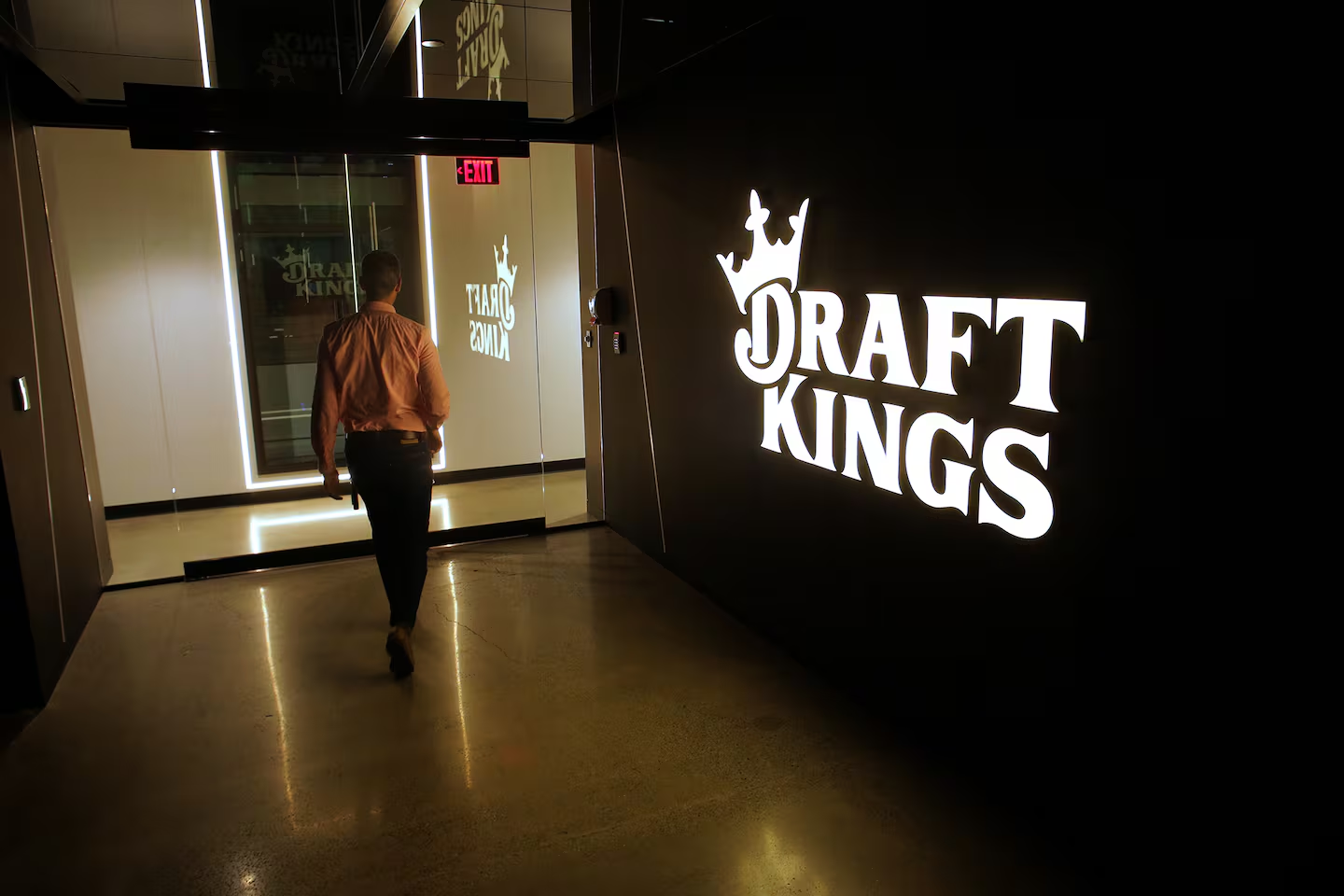
DraftKings filed suit in the Eastern District of Pennsylvania on July 16, seeking to block Philadelphia from enforcing a consumer protection ordinance against its online sportsbook and casino operations.
The complaint asks the court to declare the Philadelphia Consumer Protection Ordinance preempted by Pennsylvania state law and to enjoin the city from pursuing an investigation that began with a document subpoena issued in April.
The lawsuit is a preemption case on its surface. Underneath it is something more politically awkward: a major sportsbook using a regulatory shield to block an investigation that, based on the subpoena’s contents, was specifically targeting its VIP program. Sportsbook VIP programs have snatched headlines for all the wrong reasons lately, specifically in Philadelphia.
Philadelphia’s April subpoena asked for documents across five categories: user revenue and wagering metrics, user data collection and targeting practices, advertising and marketing, promotional terms and user experience, and what the subpoena specifically described as VIP programs and high-value users. That last category lands at an unusual moment. FanDuel’s VIP host program is currently the subject of a product liability lawsuit we covered last week, built around the allegation that VIP hosts were deployed to maximize the action of addicted customers rather than flag them for intervention. Massachusetts has had its own DraftKings VIP investigation running for months. The Bryce Harper Cameo/ FanDuel scandal drew the Pennsylvania Gaming Control Board’s attention. And now Philadelphia has been asking DraftKings for its VIP program documents since April, and DraftKings has responded by suing the city.
Draftking’s Preemption Arguments Are Legally Very Strong
DraftKings’ legal position is not trivial. The complaint makes three distinct preemption arguments, any one of which could defeat Philadelphia’s ordinance.
The first is that the Philadelphia Consumer Protection Ordinance duplicates Pennsylvania’s statewide Unfair Trade Practices and Consumer Protection Law while changing who can enforce it, how violations are calculated, and what penalties apply. The General Assembly deliberately excluded municipalities from the UTPCPL’s enforcement structure, considering and rejecting a proposal to give local authorities enforcement power in 1975. The PCPO creates exactly the parallel enforcement regime the legislature chose not to authorize.
The second is that the Gaming Act gives the Pennsylvania Gaming Control Board general and sole regulatory authority over licensed gaming activities, occupying the field and leaving no room for municipal intervention. Every element Philadelphia is investigating- advertising, promotions, VIP programs, responsible gaming practices, customer data- is already subject to PGCB oversight under comprehensive regulations at 58 Pa. Code chs. 1401a-1411a. The city is not filling a regulatory gap. It is trying to layer a second enforcement regime on top of one that already exists.
The third is that the First Class City Home Rule Act prohibits Philadelphia from exercising powers contrary to, or in enlargement of, the powers granted by statewide statutes. Creating a new enforcement mechanism with different penalties, different enforcers, and retroactive reach goes beyond what the Act permits.
DraftKings has a reasonable chance of winning on the first or second argument alone. That does not make the lawsuit a good look.
Prediction Markets and the Preemption Shield Playbook
The structural parallel to prediction markets is not coincidental. The prediction market platforms have used federal preemption to block state attorneys general from investigating whether their products constitute unlicensed sports betting. DraftKings is using state preemption to block a city from investigating whether its VIP program constitutes unfair or deceptive practices. In both cases, an operator with a regulatory license is arguing that the license creates a shield against a lower level of government trying to ask questions about its business practices.
The prediction market preemption argument is being contested in federal appellate courts right now, with the Sixth Circuit due to rule on July 30, and courts are pushing back hard. The Ninth Circuit grilled Kalshi’s attorneys last week. Multiple district courts have rejected the argument in its strongest form.
DraftKings’ state preemption argument is legally stronger on its merits because Pennsylvania gaming law explicitly grants the PGCB sole authority over licensed gaming activities. Whether Philadelphia’s ordinance survives that language is a genuine legal question. But the effect of the argument, if it succeeds, is to insulate VIP program practices from municipal consumer protection investigation by anyone other than the PGCB, which regulates DraftKings as a licensee rather than as an adversary.
Philadelphia Has Become a Unique Preemption Battleground
Philadelphia’s decision to create its own consumer protection ordinance rather than route its concerns through the state attorney general or the PGCB reflects a reasonable institutional judgment. The PGCB’s role is to ensure licensed operators comply with gaming regulations, not to evaluate whether marketing practices targeting high-value gamblers constitute unfair or deceptive acts under consumer protection law. Those are different legal frameworks applied by different agencies with different objectives. The PGCB is not a consumer protection enforcer.
The state attorney general has consumer protection authority under the UTPCPL, but that office must make its own enforcement prioritization decisions across the entire Commonwealth. A city of 1.6 million people, representing a significant share of DraftKings’ Pennsylvania user base, has legitimate interests in how a major gaming operator treats its residents that are not automatically addressed through statewide enforcement.
DraftKings is not wrong that Philadelphia’s ordinance may be legally preempted. It is also not wrong that the PGCB oversees its operations comprehensively. What DraftKings cannot easily explain is why it filed a lawsuit to block an investigation rather than producing documents and contesting any eventual enforcement action on the merits. A company confident that its VIP practices comply with consumer protection standards should probably welcome scrutiny. A company that files a preemption lawsuit before the city has even brought an enforcement action is telling the court, and the public, something about its preference for where this fight happens, and under whose rules.
That preference, for the regulator rather than the investigator, for the licensing body rather than the consumer protection enforcer, is not unique to DraftKings. It is a consistent feature of how the gaming industry engages with oversight. The preemption argument is real, and so is what it is protecting.
Players trust our reporting due to our commitment to unbiased and professional evaluations of the iGaming sector. We track hundreds of platforms and industry updates daily to ensure our news feed and leaderboards reflect the most recent market shifts. With nearly two decades of experience within iGaming, our team provides a wealth of expert knowledge. This long-standing expertise enables us to deliver thorough, reliable news and guidance to our readers.
Latest News