

Trump Administration Backs Kalshi, Polymarket as States Move to Ban Prediction Markets
The Trump administration is supporting prediction markets Kalshi and Polymarket as states seek to ban their sports-linked event contracts.
The Trump administration has publicly thrown its support behind the prediction market platforms Kalshi and Polymarket as multiple states work to block the platforms, arguing they function as unlicensed gambling.
In a key shift in federal policy, the Commodity Futures Trading Commission (CFTC) under Chairman Michael Selig has taken steps to defend prediction markets as federally regulated financial products, even as states such as Nevada and Massachusetts pursue legal bans.
Federal Backing vs. State Enforcement
The CFTC’s position is built on the argument that prediction markets, platforms where users trade contracts tied to the outcome of real-world events, fall under federal derivatives law rather than state gambling statutes.
In a Wall Street Journal opinion, Selig wrote that the agency “will no longer sit idly by while overzealous state governments undermine the agency’s exclusive jurisdiction” by trying to ban these products.
Under that legal theory, contracts on Kalshi, Polymarket, and similar platforms qualify as federally regulated event contracts, akin to futures, allowing them to operate nationwide, even in states that prohibit traditional sports betting.
Legal Challenges From States
Several states have taken aggressive action against prediction markets, arguing the platforms function like sportsbooks and should require state gaming licenses:
- Nevada regulators have sued Kalshi and Polymarket, claiming they are operating unlicensed gambling services.
- Massachusetts courts issued a preliminary injunction barring Kalshi from offering sports-linked contracts without restrictions.
- Other states have filed enforcement actions, cease-and-desist orders or lawsuits against the platforms for alleged violations of state gambling law.
The central legal dispute centers on whether federal commodities law preempts state gambling regulation, a question many legal experts expect will be decided by appellate courts.
How Prediction Markets Work
Prediction markets operate by allowing participants to buy and sell binary event contracts, “yes” or “no” on whether an event will occur, which are priced based on collective predictions. When an event resolves, winning contract holders receive a payout.
While these platforms can cover everything from weather and elections to entertainment, sports events now dominate activity, with roughly 90% of Kalshi’s trading volume tied to sports outcomes.
Critics argue that despite the structural differences from sportsbooks, e.g., no “house” setting odds, the economic effect is similar to gambling and should fall under state gaming laws.
Federal Policy and Political Context
The Trump administration’s backing represents a stark shift from prior regulatory uncertainty. The CFTC historically regulated financial derivatives and futures markets, but prediction markets have only recently gained mainstream attention.
The federal position comes as some Republican leaders, including Utah’s governor, publicly criticize the logic of federal oversight here, arguing sports-linked prediction markets are effectively gambling and should be regulated by states.
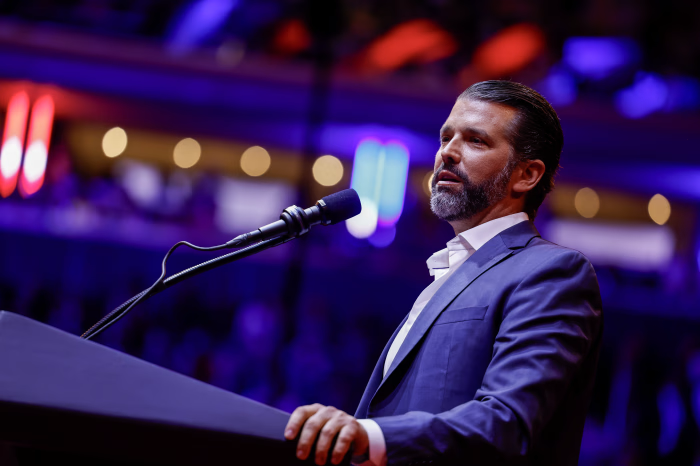
Federal involvement also occurs against a backdrop of political and investment ties: Donald Trump Jr. serves as an advisor to Polymarket and has invested in prediction-market firms, raising scrutiny about potential conflicts of interest, though no wrongdoing has been alleged.
Bigger Stakes for Legal and Regulatory Landscape
If federal courts uphold the CFTC’s stance, prediction markets could operate nationwide without state gaming licenses, potentially allowing them to compete directly with regulated sportsbooks even in states that prohibit traditional sports wagering.
States, tribes, and gaming interests counter that unchecked prediction markets circumvent local regulatory frameworks, consumer protections, age restrictions, and tax regimes.
The question of regulatory authority, federal vs. state, has become one of the most consequential legal battlegrounds in U.S. gambling and financial law.
Bottom Line
The Trump administration, through the CFTC, has publicly backed prediction market platforms Kalshi and Polymarket as they face a wave of state legal challenges. The outcome of this jurisdictional dispute could determine whether these platforms can operate nationwide under federal derivatives law, or must comply with state gambling regulations.
Players trust our reporting due to our commitment to unbiased and professional evaluations of the iGaming sector. We track hundreds of platforms and industry updates daily to ensure our news feed and leaderboards reflect the most recent market shifts. With nearly two decades of experience within iGaming, our team provides a wealth of expert knowledge. This long-standing expertise enables us to deliver thorough, reliable news and guidance to our readers.
Latest News