Adam Silver Tanking Crackdown: Are Sportsbooks Forcing the NBA’s Hand With Fourth Quarter Rotations?
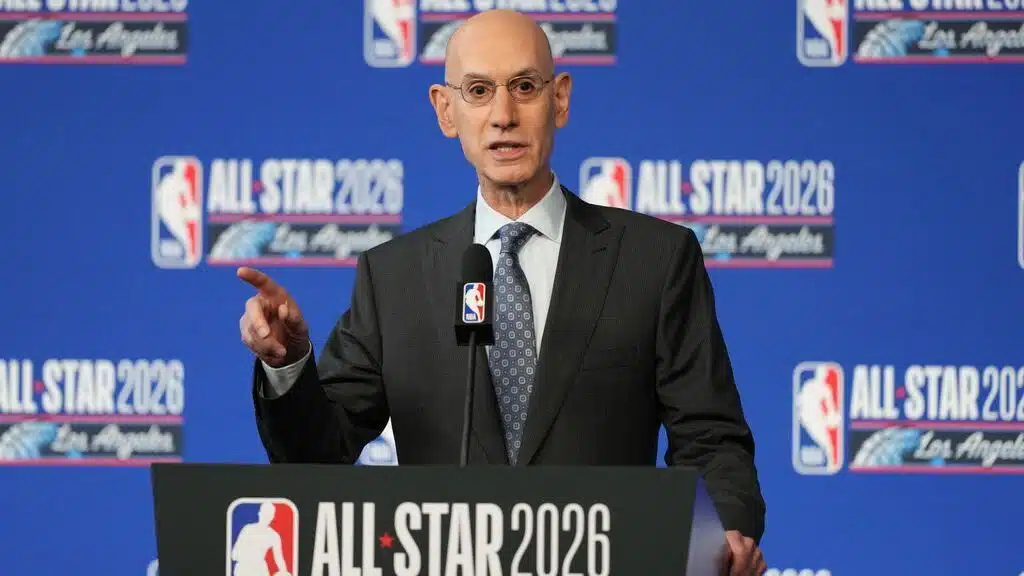
Adam Silver has spent the better part of a decade trying to clean up the NBA’s tanking problem. Now he has a new reason to push harder. It is not just competitive balance. It is betting integrity.
A fresh wave of reporting suggests several major gambling operators have voiced frustration over late season games that flip in the fourth quarter when non-contending teams pull starters. The pattern is familiar. A young roster competes for three quarters, keeps the spread tight, then the rotation shrinks into developmental minutes and the game gets away. For fans it is ugly. For sportsbooks, it is a liability.
Adam Silver Tanking Comments
Silver has publicly acknowledged that the league keeps a close eye on tanking, especially after flattening lottery odds in recent years to discourage intentional losing. The NBA Draft Lottery now gives the three worst teams equal odds at the top pick, a direct response to franchises gaming the system.
Behind the scenes, league sources say the concern has shifted from season long tanking to in-game management. Pulling healthy starters in competitive fourth quarters is harder to regulate than resting players on back to backs. It lives in a gray area. Coaches call it development. Bettors call it manipulation.
“Are we seeing behavior that is worse this year than we’ve seen in recent memory? Yes, is my view. Which was what led to those fines,” Silver said during All-Star Weekend media availability.
NBA Tanking Investigation
The league has already fined teams in recent seasons for violating player participation policies. Those penalties were framed around star rest and transparency. This new scrutiny feels different. It centers on whether teams are distorting competitive outcomes within a single game.
Sportsbooks build live betting markets around minute by minute data. When a team that has played its normal rotation suddenly empties the bench in crunch time without injury or foul trouble, the line swings violently. Operators argue that repeated patterns from certain clubs make those swings predictable for insiders but chaotic for the broader market.
NBA Betting Integrity Concerns
The NBA’s partnership with major betting companies has become a core revenue stream. Official data deals, sponsorships, and in arena integrations have tied the league closely to wagering growth. With that comes pressure.
Operators are not asking the league to outlaw losing. They understand rebuilding cycles. The complaint is about competitive effort within a game. When spreads are shaped by three quarters of honest play and then blown up by a developmental lineup in the final six minutes, books take hits and bettors cry foul.
Integrity is the buzzword. The same language used in match fixing discussions now pops up in tanking debates. No one is accusing players of fixing games. The concern is structural. If a team’s incentives shift from winning the game in front of them to protecting lottery odds, the betting market absorbs the shock.
NBA Draft Lottery Odds Debate
The flattened lottery odds were meant to reduce extreme tanking. They have worked to a degree. The worst team no longer has a dominant edge at the top pick. Yet the incentive to land in the bottom tier remains strong, especially in draft classes headlined by franchise level prospects.
Front offices know the math. Sliding from the seventh worst record to the fourth worst record can materially change the odds of landing a top three pick. That reality bleeds onto the floor in March and April.
Silver now faces a choice. He can tighten participation rules even further, potentially requiring teams to keep healthy starters in during competitive games. Or he can accept that development and draft positioning are part of the ecosystem and trust that the lottery system is enough of a deterrent.
“There is talk about every possible remedy now to stop this behavior. Yes. Everything is on the table to stop this behavior,” Silver said when asked if the league would consider revoking draft picks.
NBA Live Betting Lines Controversy
Live betting has amplified everything. Ten years ago, a fourth quarter collapse was just a bad beat. Today it can flip dozens of micro markets, from alternate spreads to player props. Books monitor rotation patterns in real time. Sharp bettors do the same.
If certain teams develop reputations for predictable fourth quarter drop offs, the market adjusts. Lines shade earlier. Totals move. That hurts casual bettors who rely on standard projections rather than tracking coaching tendencies.
Silver understands that perception matters. The NBA has leaned heavily into its image as a progressive league that embraces wagering but protects integrity. A narrative that tanking is distorting betting markets undercuts that message.
The irony is clear. Tanking was once about ping pong balls. Now it is about point spreads. As the league tightens its grip on player participation and late season rotations, the pressure is coming from an unexpected corner. The house wants certainty. The teams want draft capital. Silver stands in the middle.
The crackdown may not eliminate tanking. It may simply push it further into the shadows. But one thing is obvious. In the modern NBA, losing strategically is no longer just a basketball issue. It is a business one.
Players trust our reporting due to our commitment to unbiased and professional evaluations of the iGaming sector. We track hundreds of platforms and industry updates daily to ensure our news feed and leaderboards reflect the most recent market shifts. With nearly two decades of experience within iGaming, our team provides a wealth of expert knowledge. This long-standing expertise enables us to deliver thorough, reliable news and guidance to our readers.
Latest News