Tennessee Judge Questions CFTC Authority Over Kalshi Sports Contracts
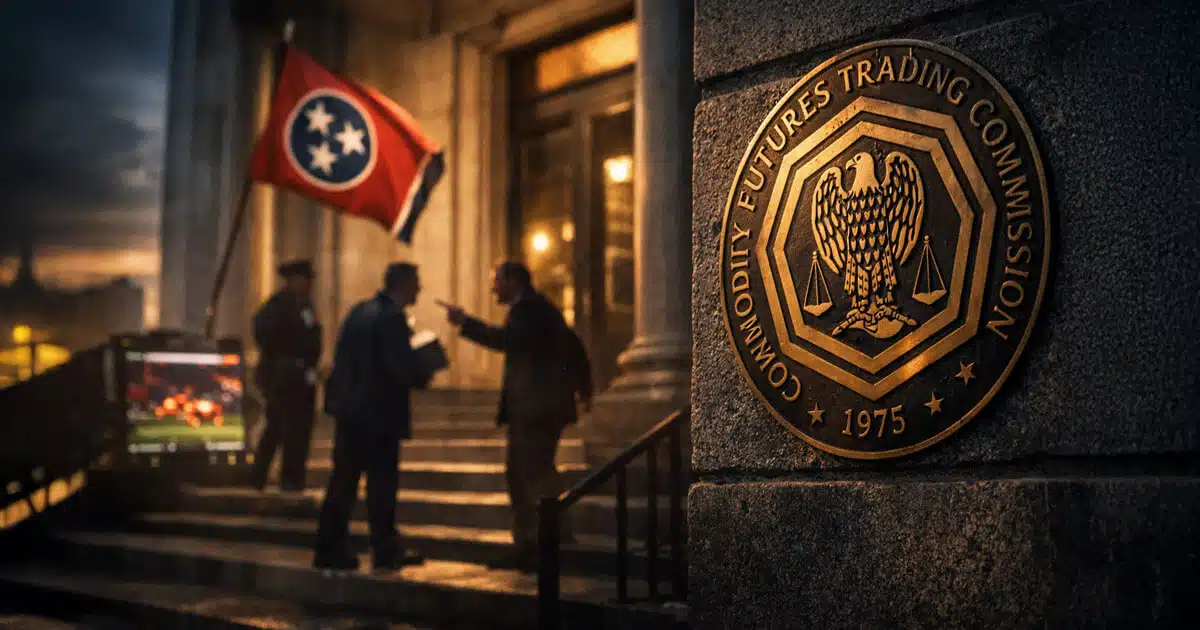
A Tennessee judge raised doubts about the CFTC’s authority to approve Kalshi sports contracts amid a broader state-federal regulatory clash.
A Tennessee judge has raised pointed questions about whether the Commodity Futures Trading Commission has the authority to permit sports event contracts offered by Kalshi, marking another flashpoint in the escalating legal battle between state regulators and federally regulated prediction markets.
During recent proceedings, the judge signaled skepticism about the scope of the CFTC’s oversight powers when it comes to contracts tied to sporting events, a product that several states argue resembles unlicensed sports betting rather than a traditional financial derivative.
The comments do not constitute a final ruling but underscore growing judicial scrutiny of the federal regulator’s interpretation of its authority.
The Core Legal Question
At issue is whether sports event contracts fall squarely within the CFTC’s jurisdiction under federal commodities law, or whether states retain the power to regulate or prohibit such offerings under their gambling statutes.
Kalshi operates as a CFTC-regulated exchange, allowing users to trade contracts on real-world events. While it historically focused on political and economic markets, the company expanded into sports-related contracts, triggering pushback from several state gaming regulators.
Tennessee officials argue that:
- Sports outcome contracts function like wagers
- The state has exclusive authority over sports betting
- Federal approval does not override state gambling law
Kalshi maintains that:
- Its contracts are financial instruments
- They are regulated under federal commodities statutes
- State-level bans interfere with federally supervised markets
Why Tennessee Matters
Tennessee is a significant jurisdiction in the broader debate because it has an established, regulated online sports betting market.
The state’s regulators contend that permitting prediction market platforms to offer sports contracts without a state gaming license:
- Creates an uneven playing field
- Circumvents state tax frameworks
- Weakens consumer protection oversight
The judge’s questioning reflects this tension between state gaming authority and federal derivatives oversight.
Broader Regulatory Clash
The Tennessee case is part of a widening national dispute over sports-related prediction markets.
Across multiple states:
- Gaming regulators have challenged sports contracts
- Courts have issued temporary restrictions
- Federal and state authority boundaries have been tested
The legal uncertainty has created volatility in how and where platforms like Kalshi can operate sports-related markets.
What the Judge’s Comments Signal
While the judge did not immediately rule on the merits of the case, the questioning signals that courts are carefully examining:
- The statutory limits of CFTC authority
- Whether sports contracts qualify as permissible event derivatives
- The balance between federal preemption and state police powers
Legal analysts note that the outcome could set a meaningful precedent for how prediction markets operate nationwide.
Potential Implications
If courts ultimately determine that:
- The CFTC lacks authority over sports contracts → states could broadly block them.
- Federal law preempts state gambling regulation → prediction markets could expand significantly.
Either outcome would reshape the competitive landscape between:
- Traditional sportsbooks
- Federally regulated prediction platforms
- State gaming commissions
The stakes extend well beyond Tennessee.
Kalshi’s Position
Kalshi has consistently defended its model, emphasizing that it:
- Operates under federal supervision
- Complies with CFTC rules
- Is distinct from sportsbook operators
The company argues that fragmentation across states would undermine the national derivatives market structure Congress intended to create.
Why This Matters Now
The debate comes as prediction markets are:
- Gaining visibility during major sporting events
- Facing increasing political and regulatory scrutiny
- Competing more directly with licensed sportsbooks
Judicial signals questioning federal authority could slow expansion and embolden state regulators seeking tighter control.
What Happens Next
The Tennessee case will proceed through additional hearings and potential motions.
Key developments to watch include:
- Whether the court issues a preliminary injunction
- Further clarification on CFTC authority
- Potential appeals
Regardless of outcome, the case adds momentum to a broader legal reckoning over where sports-based event contracts fit within U.S. law.
Bottom Line
A Tennessee judge’s skepticism about the CFTC’s authority to oversee Kalshi’s sports contracts highlights the growing state-federal conflict over prediction markets.
As courts weigh whether sports event contracts are gambling or derivatives, the future of federally regulated sports trading platforms hangs in the balance.
Players trust our reporting due to our commitment to unbiased and professional evaluations of the iGaming sector. We track hundreds of platforms and industry updates daily to ensure our news feed and leaderboards reflect the most recent market shifts. With nearly two decades of experience within iGaming, our team provides a wealth of expert knowledge. This long-standing expertise enables us to deliver thorough, reliable news and guidance to our readers.
Latest News