Hawaii Prediction Markets Ban: House Committee Advances HB 2198
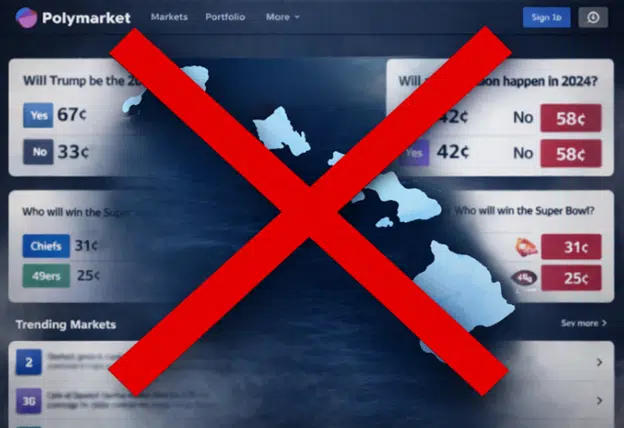
Prediction markets just ran into a wall in Hawaii. A House committee moved House Bill 2198 forward after a hearing where critics framed these platforms as gambling dressed up as financial trading. If HB 2198 keeps moving, Hawaii could become the first state to push a straight-up prediction markets ban through the legislature.
The basic idea is simple: Hawaii already bans gambling, and lawmakers want the law to say, clearly, that buying and selling event contracts tied to real-world outcomes counts as gambling too. The bill targets contracts linked to sports, politics, disasters, and even death-related outcomes.
Hawaii Prediction Markets Bill
Hawaii’s House Committee on Consumer Protection and Commerce advanced an amended version of HB 2198 by voice vote. The bill would classify prediction markets as illegal gambling under state law, rather than creating a licensing path or a regulatory framework.
Some states have tried to thread the needle by regulating new betting-style products. Hawaii is taking the opposite approach: fold prediction markets into the gambling definition and make enforcement cleaner.
What Is A Prediction Market
A prediction market lets users buy and sell contracts tied to an outcome. Think of it like a “yes/no” market that moves in price as people bet for or against an event happening. When the event resolves, the winning side gets paid out.
Platforms argue this looks like financial risk pricing. Critics argue it looks like some sports betting apps, political betting, or novelty wagering with a new coat of paint.
House Bill 2198 Hawaii
HB 2198 expands the definition of gambling to include buying, selling, or financially speculating on securities, commodities, or similar products when the “value” depends on specific event outcomes. The categories in the bill go well beyond sports.
- Sports and contests (including games of skill or chance)
- Politics and elections
- Catastrophes and public health emergencies
- People-based outcomes
- Death-related outcomes
Supporters say platforms keep changing labels and product wrappers to dodge state gambling rules. This bill tries to make that harder by focusing on what the contracts do, not what the company calls them.
Are Prediction Markets Legal In Hawaii?
Hawaii has one of the strictest gambling environments in the U.S. That is why this fight is happening here now. If the state already treats gambling as illegal, lawmakers do not need to debate tax rates or licensing fees. They just need to decide whether prediction markets fit the same bucket.
HB 2198 is built for that argument. It essentially says: if you are putting money down to profit from real-world outcomes, you are gambling, even if your app calls it “trading.”
Kalshi Prediction Markets
Kalshi keeps showing up in these state-level battles because it operates as a federally regulated derivatives exchange, overseen by the Commodity Futures Trading Commission (CFTC). That federal status sits at the center of the legal dispute: Kalshi’s position is that federal regulation should preempt at least some state gambling enforcement.
Hawaii lawmakers and witnesses pushing HB 2198 are not buying that framing. In the committee hearing coverage, critics emphasized that sports-related contracts drive a large share of activity on “pure” prediction market platforms, and they argued the real consumer experience mirrors betting.
Kalshi Massachusetts Injunction
The timing is not an accident. The Hawaii committee action comes while Kalshi is fighting court battles in other states. In Massachusetts, a judge ordered Kalshi to stop offering sports-event contracts in the state within 30 days unless it gets a state gaming license. The judge rejected Kalshi’s attempt to pause that order while appealing.
That ruling lands like a warning shot for other states watching the same issue: courts may treat sports-event contracts as gambling activity, even if they are packaged as federally regulated contracts.
CFTC Prediction Markets
The big picture is a tug-of-war between federal oversight and state gambling laws. Operators point to the CFTC and argue their contracts are legitimate derivatives. State regulators argue the effect on consumers is the same as sports wagering, and states have the power to regulate gambling inside their borders.
You can see why lawmakers want clearer statutes. If a platform can claim federal cover while offering what looks and feels like wagering, states want language that closes loopholes and makes enforcement less dependent on technical product definitions.
New York Prediction Markets Bill
Hawaii is not alone. Other states have started floating bills that either restrict prediction markets or force them into a state licensing setup. New York has multiple proposals aimed at prediction platforms, including bills that would limit the types of markets allowed and bills that would require licensure.
Even if those bills do not move quickly, they show the direction of travel: more lawmakers want to decide whether prediction markets belong in financial regulation, gambling regulation, or a brand-new category.
Hawaii Sports Betting Legal Info
This is happening in a state that has also flirted with legal sports betting bills in recent sessions. That creates an interesting split screen: lawmakers can debate regulated sports betting as a policy choice while still deciding they do not want prediction markets operating in the background as an unregulated alternative.
In other words, the message can be: if Hawaii ever expands gambling, it wants that expansion to happen through a controlled system, not through apps that claim they are not gambling while offering gambling-style outcomes.
Prediction Markets Ban
HB 2198 now has momentum, but it is still a long road. Hawaii’s legislative calendar matters here, and the bill also needs broader support to become law. There is also the practical issue: prediction markets are online products, and enforcement often turns into a geofencing and compliance fight.
Still, the committee vote is the headline. Hawaii is treating prediction markets as a direct legal problem, not a quirky tech product that lawmakers should ignore until it grows bigger. If other states want a model for a clean, simple prohibition, this bill is built for that job.
Players trust our reporting due to our commitment to unbiased and professional evaluations of the iGaming sector. We track hundreds of platforms and industry updates daily to ensure our news feed and leaderboards reflect the most recent market shifts. With nearly two decades of experience within iGaming, our team provides a wealth of expert knowledge. This long-standing expertise enables us to deliver thorough, reliable news and guidance to our readers.
Latest News