Kalshi’s New 15-Minute Commodity Markets Already Rank Among Its Most Popular

Commodities, just faster
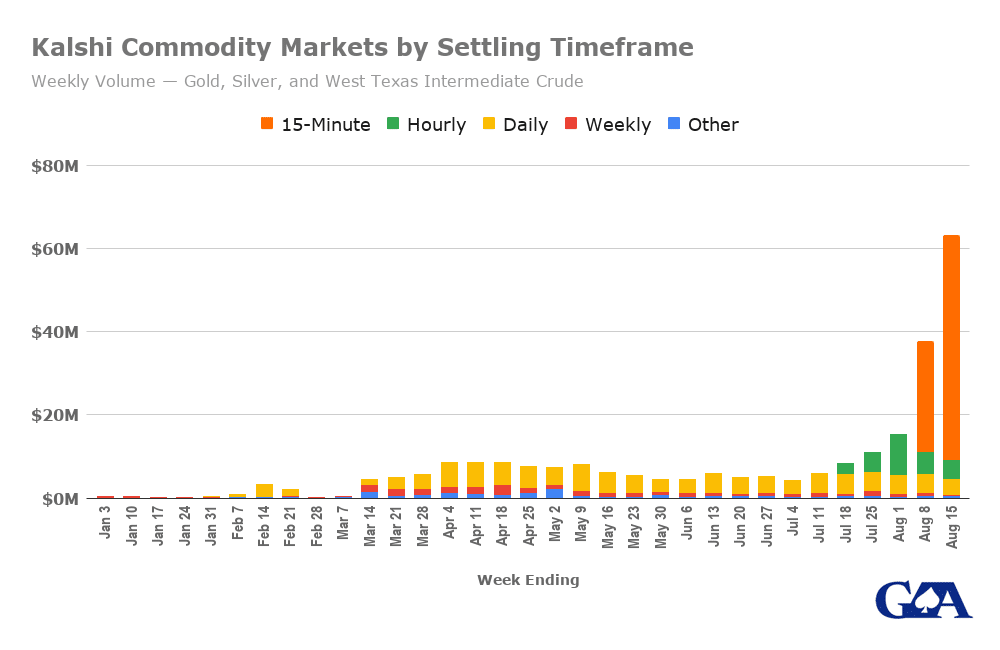
Two weeks ago, Kalshi debuted event contracts on whether the price of three commodities — gold, silver, and oil — will go up or down in the next 15 minutes. Already, they’re consistently among the most popular markets outside of sports betting and crypto.
This new class of contracts mimics the extremely popular 15-minute cryptocurrency “up-down” contracts. These appeared on Polymarket’s international site last October, followed by Kalshi in December.
Even these faster-paced commodities markets remain a niche compared to 15-minute crypto. For instance, the daily volume on 15-minute Bitcoin is rarely less than $100 million, while the daily high volume on any commodity so far is just under $8 million on 15-minute gold, set last Friday.
However, all three of the available commodities have traded at above $1 million volume every weekday since August 5. That’s rare, on Kalshi, for anything not related to sports or crypto. Most days, only one or two markets in other categories exceed that threshold, often coinciding with voting days for primaries, presidential speeches, or the release of highly anticipated movies or albums.
The rise of the 15-minute markets shows just how much of a premium prediction traders put on a quick turnaround. The heaviest single day of trading on weekly commodities markets, for instance, was a measly $623,695 across gold, silver, and oil combined. That was on March 20, with most of the trading being on oil, against the backdrop of the Iran conflict and an impending Federal Reserve rate decision.
Fast Turnaround Equals High-Frequency, Low-Stakes Trading
Part of the reason that 15-minute markets produce so much volume is that they settle more quickly, and many participants are likely to bet again on the next interval. In that regard, they’re similar to the in-game “microbets” popular with sportsbooks.
One might expect that users making more trades would reduce the size of each individual trade. However, that appears to be only partially true. Since they launched on July 31, 15-minute commodity markets have posted an average trade size of just over $30. Over the same period, hourly markets have actually seen smaller trades on average, at just over $25.
By contrast, the longer-term markets have averages closer to $50. So, the average trade on the slower-moving markets is nearly twice as big. In the case of the hourly markets, that’s offset by the fact that the number of trades is about twice as large. But for the 15-minute markets, the difference is much greater.
Daily and weekly markets combined produced around 220,000 separate trades over the two weeks from July 31 to August 14. Hourly markets produced about twice as many. The 15-minute markets, on the other hand, produced over ten times as many trades as the slower markets. On August 14 alone, there were over 550,000.
Total Gold, Silver & WTI Activity on Kalshi Since July 31
| Weekly | Daily | Hourly | 15-Minute | Other | |
|---|---|---|---|---|---|
| Volume | $399,799 | $1,065,988 | $2,024,390 | $14,110,739 | $118,902 |
| Trades | 6,950 | 21,198 | 57,101 | 552,090 | 1,706 |
| Avg. Trade Size | $54.92 | $47.93 | $25.50 | $30.43 | $56.27 |
| Largest Trade | $29,992 | $9,000 | $3,341 | $46,759 | $49,972 |
Fifteen-Minute Markets Are a Battleground for Bots
Gaming America was unable to find any traders willing to talk at length about the new markets, but obtained comments from a few participants in online communities dedicated to algorithmic trading.
Indications are that such automated, bot-based activity accounts for much of the volume on the short-term markets. In one community, a single user mentioned trading manually in the 15-minute markets and was met with surprise from the others. That person’s strategy: “I wait until I see a market settle in the same direction three times in a row, then bet on it going the other way.”
Some botting strategies involve a more sophisticated version of this logic, attempting to infer the patterns of other traders. Others target market inefficiencies, looking to snap up winning shares just before a market settles or respond to a change in the spot price before the competition.
Most of the users in these communities seem to understand that they’re gambling. One told Gaming America — presumably jokingly — that they just use a random number generator to pick up or down and have been right 61% of the time. Another Discord user announced an upcoming video on 15-minute markets to their followers, before mentioning that the next two videos would be on Stake (a crypto casino) and esports betting.
If the audience for 15-minute commodities is the same as for 15-minute crypto, the question is what the relative advantage is. What would entice a crypto trader to try their hand at gold?
One user told Gaming America: “I trade 1H gold sometimes and the fills are surprisingly decent for short-term stuff, less slippage than I expected.”
In other words, the lower volatility of the underlying asset may make it easier to get trades in at the expected price. The amount of available liquidity on either side of the bid-ask spread also appears to be higher relative to the volume of trading than it is in the crypto markets.
Players trust our reporting due to our commitment to unbiased and professional evaluations of the iGaming sector. We track hundreds of platforms and industry updates daily to ensure our news feed and leaderboards reflect the most recent market shifts. With nearly two decades of experience within iGaming, our team provides a wealth of expert knowledge. This long-standing expertise enables us to deliver thorough, reliable news and guidance to our readers.
Latest News