

Gallup Poll Challenges the Perception of a U.S. Gambling Epidemic

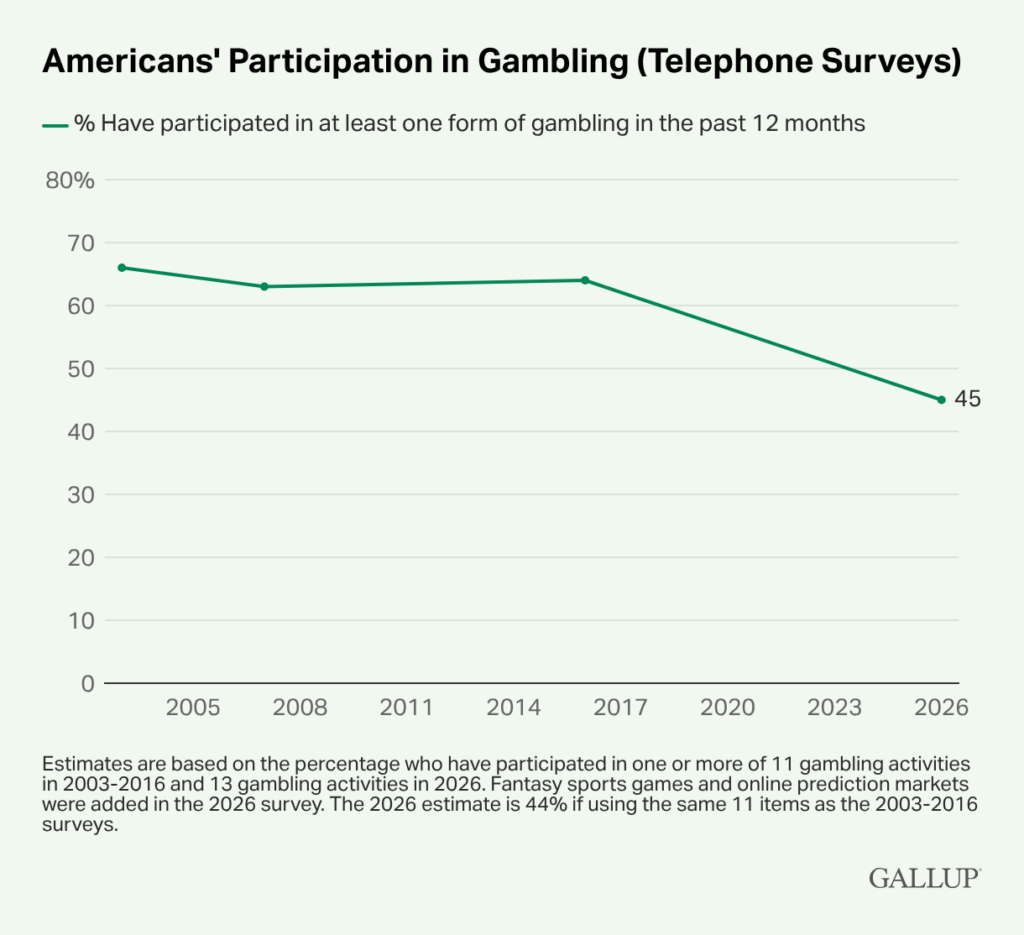
Forty-five percent of U.S. adults say they participated in at least one of thirteen forms of gambling in the past year.
That sounds like a lot. It is actually the lowest figure Gallup has recorded since it began tracking the question, down from 64% a decade ago and from roughly similar levels in 2003 and 2007.
The gambling industry and its critics have both spent the last eight years trying to convince you that everyone is gambling now. The industry wants you to believe the market is vast and growing. The critics want you to believe the harm is everywhere and urgent. Both narratives rely on the impression that legal sports betting has turned America into a nation of gamblers.
The Gallup data does not support that impression; in fact, it complicates it considerably.
The Lottery Was Always Leading the Charge
State lotteries have always been the most common way Americans gamble. Between 1989 and 1999, consistent majorities said they had played a state lottery. That figure has fallen to 31% in the current survey, down from 49% in 2016.
That 18-point drop in lottery participation is driving most of the decline in overall gambling rates. The lottery has been the dominant gambling product in the United States for decades, and it is declining. Not because people have given up gambling and turned virtuous, but because the product is aging, state lotteries have not modernized at the pace of commercial gaming, and a generation of consumers raised on mobile apps finds scratch tickets less compelling than their parents did.
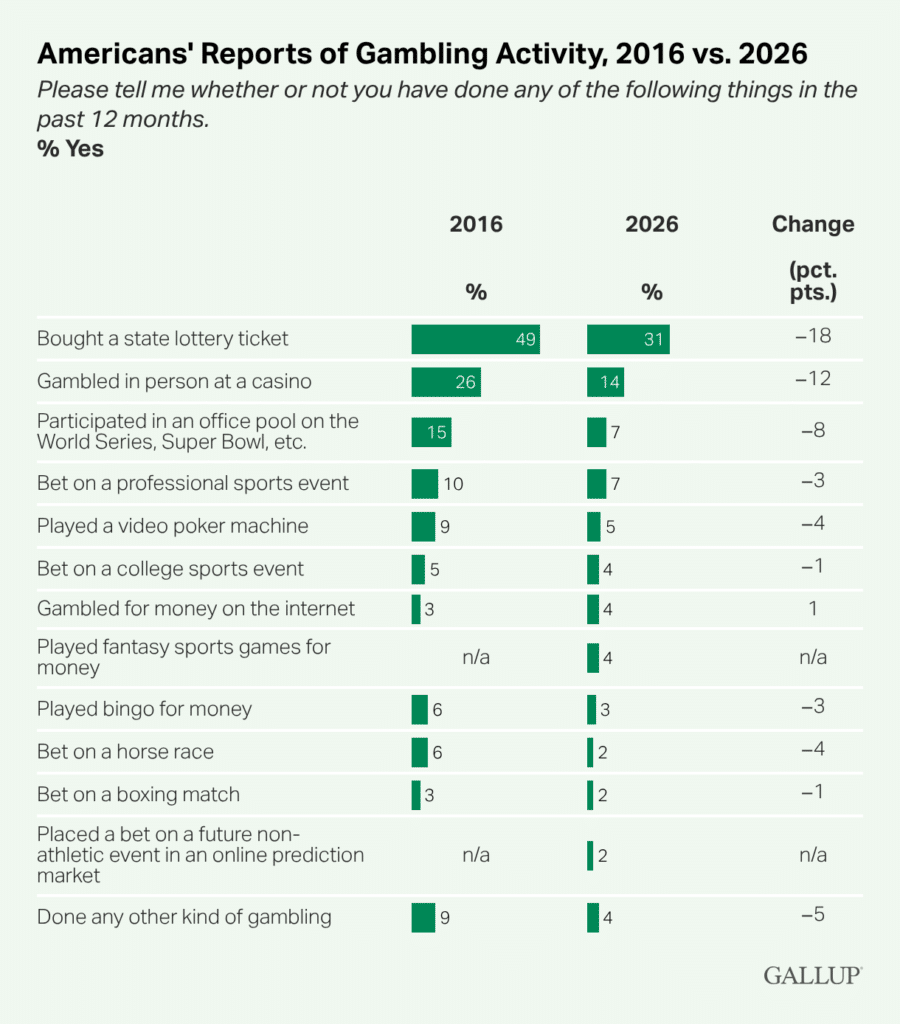
In-person casino gambling peaked at 30% in 2003 and has now fallen to 14%. That is a real and significant decline, though the Gallup report notes it could partly reflect a shift to internet gambling rather than an overall reduction in casino gaming.
Betting on professional sports, the category that has received the most attention since PASPA fell in 2018, has barely moved. Seven percent of adults say they bet on professional sports, compared to 10% in 2016 and 7% in 2007. Legalizing sports betting has produced record revenue for operators. It has not, at least by this measure, dramatically increased the share of Americans who bet on sports.
The Perception Problem Is Real and Deliberate
The gap between the polling data and the public narrative about gambling’s expansion reflects something neither side of the debate wants to acknowledge. The ubiquity of sportsbook advertising since 2018- the DraftKings and FanDuel logos on every broadcast, the bet-now promotions during every commercial break- creates a perception of saturation that the participation numbers do not support. Advertising presence is not the same as market penetration.
Both the industry and its opponents benefit from the saturation narrative, just in opposite directions. Operators use it to attract investors and signal market size. Critics use it to build support for regulation and harm reduction programs. The reality that gambling participation has actually declined while gambling revenue has grown is inconvenient for both stories.
The Methodological Wrinkle Everyone Should Read
Gallup conducted a parallel web survey alongside its telephone poll and found higher participation rates meaningfully. The telephone survey found 45% of adults gambled in any form. The web survey found 53%. The difference is particularly pronounced for bingo (3% phone, 9% web), office pools (7% phone, 12% web), and sports betting on professional games (7% phone, 9% web).
Gallup’s explanation is social desirability bias. People are less willing to tell a human interviewer they gamble than they are to enter that information into a computer form. The recent decline in Americans saying gambling is morally acceptable, from 67% in 2016 to 57% this year, may be making respondents more reluctant to disclose gambling activity to an interviewer.

That caveat matters a lot when interpreting the 45% headline figure. The true participation rate is probably somewhere between the phone and web numbers. The trend direction, fewer people gambling than a decade ago, likely holds regardless of the mode effect. But the decline is probably not as dramatic as the telephone survey implies.
The Number the Survey Does Not Capture
The most important limitation in the Gallup data is one that the report itself acknowledges: individual participation rates do not reflect total spending or total harm.
Gambling revenue may result from a smaller pool of Americans gambling more frequently or paying higher prices to gamble than in the past. That is exactly what the sports betting era has produced. The AGA estimates legal sports betting handle exceeded $150 billion in 2025. A significant portion of that volume comes from a relatively small population of high-frequency bettors, not from the broad casual participation that lottery tickets once represented.
A state in which 20% of adults buy lottery tickets once or twice a year and another 5% bet on sports every week has fewer gamblers than a state where 40% buy lottery tickets. It may have significantly more gambling harm. Problem gambling correlates with frequency and product intensity, not with raw participation rates. The shift from lottery to sports betting and from casual to engaged betting is a shift toward products with higher addiction potential, even if the headcount of gamblers is declining.
Nine percent of adults say gambling has been a source of problems in their family, up from 4% to 5% in the late 1980s and early 1990s. Fewer people are gambling, but more families are reporting problems. Those two trends can coexist when the remaining gamblers spend more, more often, on more intense products.
That is the story the Gallup data hints at but cannot fully tell. Counting gamblers is not the same as measuring harm. The headline number challenges the epidemic narrative. The footnotes suggest the epidemic narrative is not entirely wrong either, just poorly measured.
Players trust our reporting due to our commitment to unbiased and professional evaluations of the iGaming sector. We track hundreds of platforms and industry updates daily to ensure our news feed and leaderboards reflect the most recent market shifts. With nearly two decades of experience within iGaming, our team provides a wealth of expert knowledge. This long-standing expertise enables us to deliver thorough, reliable news and guidance to our readers.
Latest News