Kentucky’s Governor Vetoed a Sweeping Gambling Bill, and the Reason Had Very Little to Do With Gambling
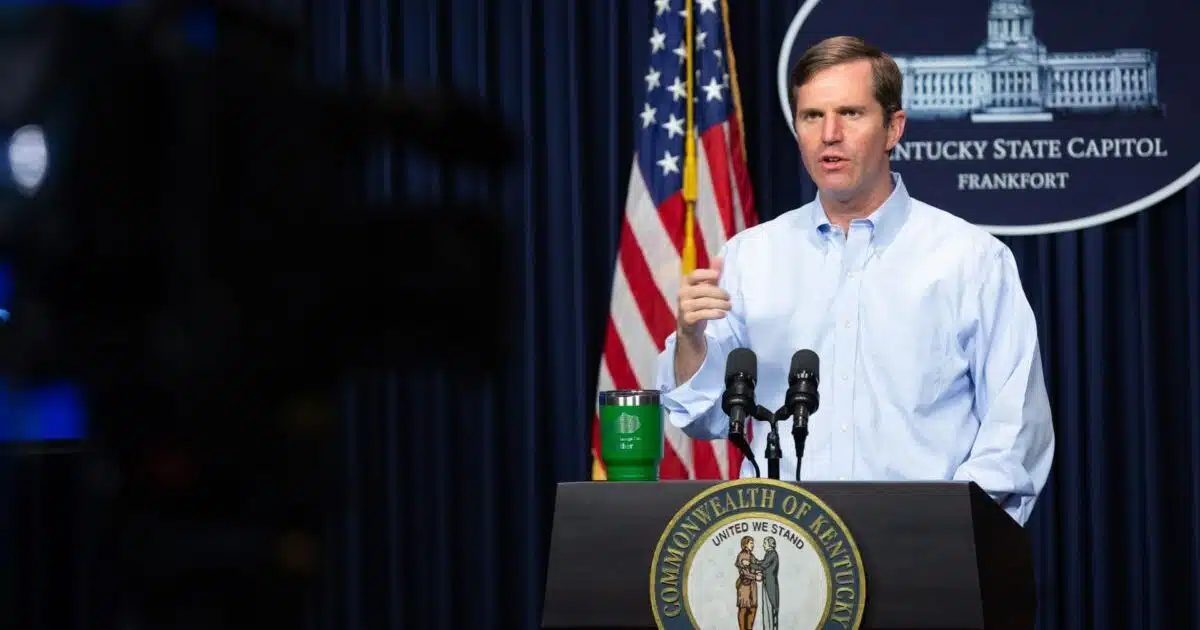
Kentucky Governor Andy Beshear vetoed House Bill 904 on Monday, sending back to the legislature one of the most ambitious gambling reform packages any state has attempted this year. The bill touched nearly every form of legal wagering in the state, from sports betting age limits to horse racing modernization to a significant new framework for prediction markets. None of that is why Beshear said no.
In his veto message, the governor focused entirely on a provision that would have allowed the Kentucky Lottery Corporation and the Kentucky Horse Racing and Gaming Corporation to file emergency and standard administrative regulations without his review or approval. “Authorizing an agency to file an emergency regulation in this manner would prevent the Governor from carrying out his constitutional duties and allow boards and agencies to impose rules on Kentuckians without executive oversight,” Beshear wrote.
That particular fight, a Democratic governor against a Republican supermajority legislature over the boundaries of executive authority, has defined Beshear’s time in office and predates anything in HB 904 by several years. The gambling provisions were, in a sense, collateral damage.
What Was Actually in the Bill
HB 904 was a 150-page omnibus that managed to be genuinely consequential across multiple areas of Kentucky’s gambling landscape simultaneously.
On sports betting, the bill would have raised the minimum legal wagering age from 18 to 21 and prohibited licensed operators from offering prediction markets within the state. It also required sportsbooks to forward self-exclusion requests to the Kentucky Horse Racing and Gaming Corporation, and banned under proposition bets on college athletes from Kentucky schools.
The prediction market provisions went through a meaningful evolution before reaching their final form. The bill originally would have prohibited all Kentucky-licensed racetracks, sportsbooks, and fantasy sports operators from either operating or affiliating with a federally regulated exchange that offers event contracts anywhere in the United States. In effect, that would have invalidated the Kentucky licenses of FanDuel, DraftKings, and Fanatics, all of which offer event contracts in states outside Kentucky.
A committee substitute pulled that back significantly, limiting the prohibition to prediction market activity within Kentucky only, thereby allowing operators to retain their licenses so long as they did not offer event contracts to Kentucky bettors.
The bill would also have taxed gross revenue from prediction markets at 14.25%, the same rate applied to online sports betting platforms, and explicitly banned election betting.
For horse racing, the bill mandated upgrades to pari-mutuel wagering systems, established fixed-odds wagering at in-state tracks, and prohibited tracks from partnering with prediction market operators. Charitable gaming also received attention, with new age limits for e-pulltab machines and a raised prize cap.
The Override Question
The veto is almost certainly temporary. Republicans hold 80% supermajorities in both chambers of the Kentucky General Assembly, and only simple majorities are needed to override. The bill passed its final vote 64-19 in the House and 24-13 in the Senate. Lawmakers returned Tuesday for the final two days of the session with veto overrides expected to dominate proceedings.
There is one wrinkle worth noting. Some Democrats voted against the bill specifically over concerns about the prediction-market language and its potential impact on the broadcast of the Kentucky Derby.
The Derby is one of the most watched sporting events in the country, and several broadcast partners have active relationships with prediction market platforms that the bill’s language could have complicated. That concern did not produce enough opposition to block passage, but it is a reminder that the politics around prediction markets do not divide neatly along partisan lines.
Kentucky as a Microcosm
What makes the Kentucky situation interesting beyond its immediate outcome is what it reveals about how states are approaching prediction markets when they actually sit down to legislate rather than litigate.
The original version of HB 904 was essentially an exclusion order: keep prediction market operators out entirely by making their presence incompatible with holding a Kentucky license. The amended version accepted coexistence but drew a hard line at the state border.
That retreat reflects the underlying legal reality. States that have tried to ban prediction market operators outright have faced federal preemption arguments and costly litigation. A framework that taxes their revenue and restricts their activity within the state, while leaving the federal jurisdictional question to the courts, is more defensible and probably more durable.
The 14.25% tax rate on prediction market revenue is also notable. It signals that Kentucky’s legislature, whatever its concerns about the product, recognizes that prediction markets are generating real economic activity that a state government has an interest in capturing. That is a different posture from the outright prohibition that states such as Washington have pursued, and it may end up being closer to the equilibrium that the rest of the country settles on once the legal dust clears.
For now, the bill is headed back to the legislature, and the override vote this week will almost certainly restore it. When it becomes law, Kentucky will have the most comprehensive state-level framework for prediction markets of any state that has not simply tried to ban them outright.
It arrived through accident as much as design, and its survival depended on a governor whose objection had nothing to do with any of the gambling provisions it contained. That is a fairly accurate description of how gambling law gets made in America.
Players trust our reporting due to our commitment to unbiased and professional evaluations of the iGaming sector. We track hundreds of platforms and industry updates daily to ensure our news feed and leaderboards reflect the most recent market shifts. With nearly two decades of experience within iGaming, our team provides a wealth of expert knowledge. This long-standing expertise enables us to deliver thorough, reliable news and guidance to our readers.
Latest News