

Don’t Bet Against Utah: Utah Senator John Curtis Fires Back At CFTC on Prediction Markets
Key Highlights
- CFTC backs Crypto.com in the Ninth Circuit case, asserting exclusive federal authority over sports event contracts.
- Utah Gov. Spencer Cox and Sen. John Curtis rejected federal oversight, calling prediction markets illegal gambling.
- April oral arguments could set up a Supreme Court showdown over state versus federal power.
The fight over who governs America’s fast-growing prediction markets burst into the open on February 17, 2026 — when CFTC Chairman Michael Selig publicly dared the states to challenge his authority in federal court.
In a video posted to X, Selig announced that the Commodity Futures Trading Commission had filed a friend-of-the-court brief in a federal appellate case and warned states attempting to regulate sports prediction markets that the agency would not back down.
“American prediction markets have been hit with an onslaught of state-led litigation,” Selig said, explaining that the CFTC intervened “to defend its exclusive jurisdiction over these derivatives markets.” He closed with a pointed warning: “To those who seek to challenge our authority in this space, let me be clear — we will see you in court.”
Utah didn’t flinch.
The Friend of the Court Brief
The CFTC filed its amicus brief in support of Crypto.com in its escalating legal battle with regulators in Nevada.
Nevada regulators issued cease-and-desist letters in May 2025, arguing that prediction markets like Crypto.com were offering unlicensed sports betting. Crypto.com sued and sought a preliminary injunction, but U.S. District Judge Andrew Gordon denied the request in October. The company suspended Nevada operations while appealing to the Ninth Circuit.
The CFTC’s brief argues that state gambling regulators cannot “re-characterize swaps trading on designated contract markets as illegal gambling” in order to “invade” the agency’s exclusive jurisdiction.
Selig’s position rests on the Commodity Exchange Act. Sports event contracts, the agency contends, qualify as “swaps” under federal law — placing them squarely under CFTC oversight following the expansion of derivatives regulation after the 2008 financial crisis.
The filing marks a dramatic shift in posture. Just a year ago, the CFTC was litigating against Kalshi over election markets before dropping its appeal after President Trump took office. Since his Senate confirmation in December 2025, Selig has repositioned the agency as an unapologetic defender of prediction markets.
Don’t Bet Against Utah
Governor Spencer Cox responded directly and forcefully.
In a reply on X, Cox mocked the federal government’s claim to oversee contracts tied to individual player statistics:
“Mike, I appreciate you attempting this with a straight face, but I don’t remember the CFTC having authority over the ‘derivative market’ of LeBron James rebounds.”
Cox called sports prediction markets “gambling — pure and simple” and accused them of “destroying the lives of families and countless Americans, especially young men.” He pledged to use every resource available to challenge the federal government’s position in court.
Senator John Curtis echoed that stance.
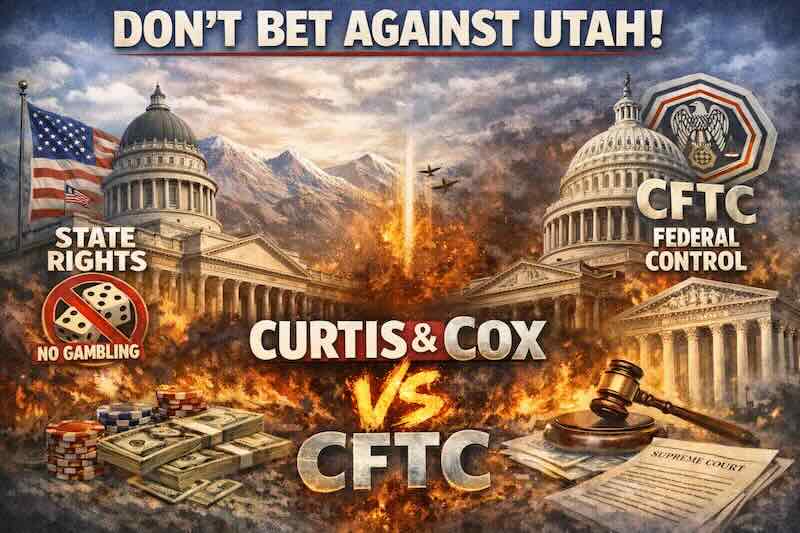
“Let’s call a spade a spade — sports prediction markets are gambling, and gambling is regulated by states, not the CFTC,” Curtis said. “If I were the Commission, I wouldn’t bet against Utah.”
Utah’s position is particularly consequential. The state constitution bans gambling outright, leaving no gray area for regulators. As prediction market platforms expand nationally, Utah officials argue that federal recognition of sports event contracts would effectively override the state’s constitutional prohibition.
Why Utah Matters
Utah has not led the wave of enforcement actions against prediction markets — but it may become one of the most important battlegrounds.
The state legislature is advancing a bill clarifying that certain sports proposition contracts fall under Utah’s constitutional gambling ban. If enacted, it would set up a direct legal collision between federal derivatives authority and state gambling law.
The pushback is not partisan. Nevada, Massachusetts, Maryland, Arizona, Michigan, New York, and Illinois have taken action against prediction markets. Senator Elizabeth Warren has accused the CFTC of stripping states of their authority to protect residents.
What makes Utah different is clarity. In a state where gambling is constitutionally prohibited, the legal conflict is stark: either sports event contracts are federally regulated derivatives — or they are illegal gambling under state law.
What Comes Next
Crypto.com, Kalshi, and Robinhood are scheduled to present oral arguments before the Ninth Circuit in April.
Legal observers increasingly believe the dispute is headed toward the Supreme Court — a process that could take years. In the meantime, Selig has pledged new rulemaking on event contracts, though the CFTC currently lacks a full slate of confirmed commissioners to finalize any major regulatory changes.
The stakes extend far beyond Utah.
If the CFTC prevails, prediction markets could operate nationwide under federal oversight, largely insulated from state gambling regulators. If the states win, platforms may face a patchwork of enforcement actions — or be forced out of key markets entirely.
The courts will now decide whether sports event contracts are financial innovation — or gambling in disguise.
Tags/Keywords
Players trust our reporting due to our commitment to unbiased and professional evaluations of the iGaming sector. We track hundreds of platforms and industry updates daily to ensure our news feed and leaderboards reflect the most recent market shifts. With nearly two decades of experience within iGaming, our team provides a wealth of expert knowledge. This long-standing expertise enables us to deliver thorough, reliable news and guidance to our readers.
Latest News