FanDuel Just Admitted What the Data Has Shown for Years: Retail Sportsbook Handles Don’t Hold Up
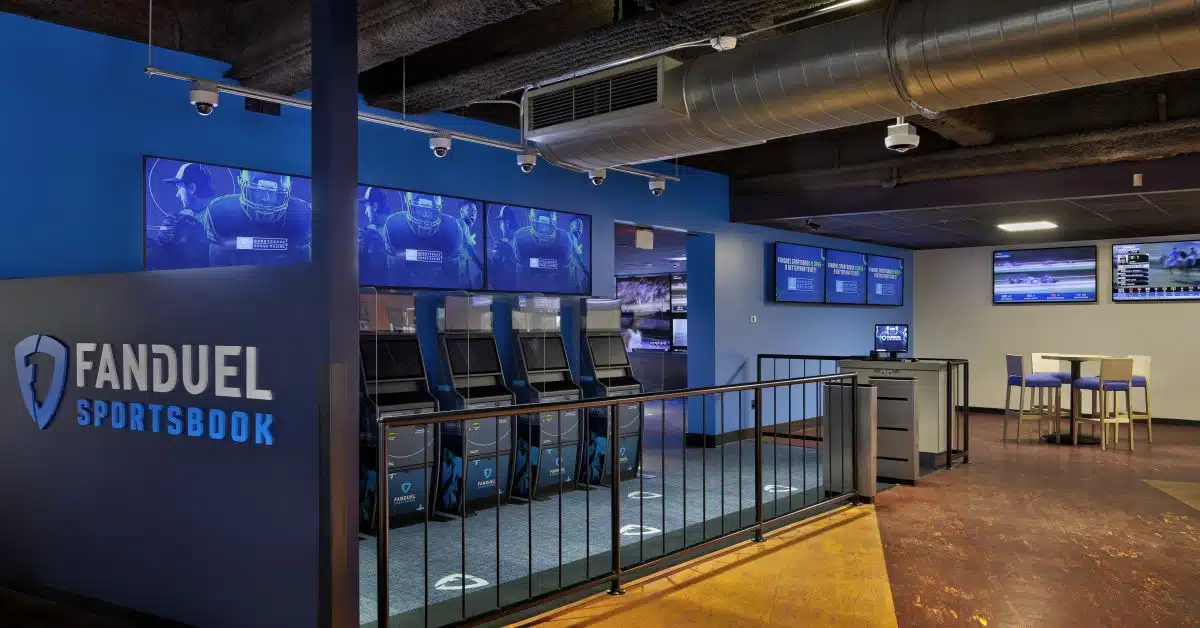
FanDuel’s closure of Fairmount Park Sportsbook appears to be a cost-cutting measure. The data shows it was inevitable from the start.
FanDuel closed its physical sportsbook at Fairmount Park racetrack in Collinsville, Illinois, on Monday, ending a retail betting operation that had been running at the track since FanDuel’s early push into the state. The closure was described by Fairmount Park’s general manager as part of FanDuel’s broader restructuring nationwide. DraftKings made a similar move in May, closing its sportsbook at Wrigley Field in Chicago.
Neither closure is surprising. What is surprising, in hindsight, is how long both companies kept those locations open, given what the numbers have been saying for years.
From January through March of this year, bettors placed 21,000 in-person wagers totaling more than $1.3 million at Fairmount Park. Over the same period, more than 26 million bets were placed online through the same location’s license, totaling more than $928 million. That is roughly 1,240 times as many handles online as in person. The physical sportsbook was not a sustainable business. It was a footnote to a business that is losing its purpose daily.
The Dwindling National Numbers For Retail Sportsbooks Don’t Lie
The Fairmount Park data is a bit of an extreme example, but the national trend lines are consistent. In June 2018, when the post-PASPA sports betting market was just opening up, retail accounted for roughly 54% of total U.S. sports betting handle. That made sense at the time. Online licensing was still being sorted out state by state, and retail was where the infrastructure was in place.
The shift since then has been relentless. By late 2019, retail’s share had already fallen to around 32%. By the end of 2021, it was below 11%. By late 2025, it had settled in around 3.5%. In November 2025, U.S. sportsbooks processed approximately $17 billion in online handle and $677 million in retail. That is a ratio of roughly 25:1 in favor of online.
Retail handle in absolute dollar terms has not collapsed entirely. Monthly figures have generally stayed in a range of $300 to $800 million over the past several years. But online has grown from hundreds of millions per month in 2018 to $15-$17 billion. Retail did not shrink so much as it got left behind by a market that scaled around it. A channel that represented more than half of all bets placed in 2018 now represents a shrinking sliver.
Brick-and-Mortar Sportsbooks Were A Gateway to Entry In Illinois
This is where the Illinois history matters, and where the Fairmount Park closure becomes more analytically interesting than a typical cost-cutting move.
Illinois introduced what was informally known as a penalty box rule when it legalized sports betting in 2019. The rule was designed to give a head start to operators with existing retail presences in the state, specifically casinos and racetracks. Online-only operators like FanDuel and DraftKings were required to partner with a licensed Illinois venue and operate retail first before being permitted to launch online. The intent was to protect brick-and-mortar operators from being steamrolled immediately by national digital players.
The practical effect was that FanDuel needed Fairmount Park to get into Illinois online betting in a timely fashion. The physical sportsbook at the track was not a revenue strategy. It was a regulatory entry ticket. Once FanDuel had established its online presence in the state and built up its user base, the retail operation had served its purpose. It became a cost center with no strategic rationale beyond the one that had already been fulfilled.
This dynamic is not unique to Illinois. Retail sportsbooks have functioned as loss leaders and customer acquisition tools in several states where licensing structures favored or required physical presence. For casino-based operators, the retail book serves a different purpose: it gets gamblers through the door, captures their data, and cross-sells them to table games, slots, and hotel stays. For digital-native operators like FanDuel and DraftKings, that logic simply never applied. Their product is the app on the phone that users hold in their hands. The retail location was always a means to an end. And it appears the end is nearing.
Betting Practices Have Become Increasingly Mobile and Operators are Adjusting
FanDuel is currently navigating its third round of layoffs in under a year, the sunsetting of its TV network, a CEO transition, and mounting pressure from prediction markets that launched sports event contracts nearly a year before FanDuel entered that space. In that environment, the calculus on retail becomes simple. A physical sportsbook generating $1.3 million in quarterly handle, while the online operation processes $928 million through the same license, is not a difficult line item to cut.
What the Fairmount Park closure illustrates, more than any single layoff announcement, is where the sports betting industry actually lives. It lives on phones, in apps, processed through data centers at a scale that physical betting windows cannot approach. Retail was the scaffolding the industry needed while it was being built. The scaffolding is coming down now, location by location, because the structure it supported no longer needs it.
FanDuel and DraftKings are not abandoning retail because conditions have changed. They are abandoning it because the conditions that made it necessary in the first place no longer exist, and they probably should have moved faster.
Players trust our reporting due to our commitment to unbiased and professional evaluations of the iGaming sector. We track hundreds of platforms and industry updates daily to ensure our news feed and leaderboards reflect the most recent market shifts. With nearly two decades of experience within iGaming, our team provides a wealth of expert knowledge. This long-standing expertise enables us to deliver thorough, reliable news and guidance to our readers.
Latest News