Illinois Is Taxing What It Can’t Ban, and That May Be the Point

Illinois has failed at banning prediction markets. It’s new per-transaction tax is the next best thing, maybe.
Illinois has spent the better part of a year trying to push prediction markets out of the state. The Illinois Gaming Board issued cease-and-desist orders to Kalshi, Crypto.com, and Robinhood in April 2025. In April 2026, the CFTC and Department of Justice responded by suing Illinois, Arizona, and Connecticut, arguing that states had attempted to “outlaw, regulate, or otherwise restrain” the activities of designated contract markets operating under federal law. The regulatory fight moved to federal court, on federal terms, which is where Illinois did not want it.
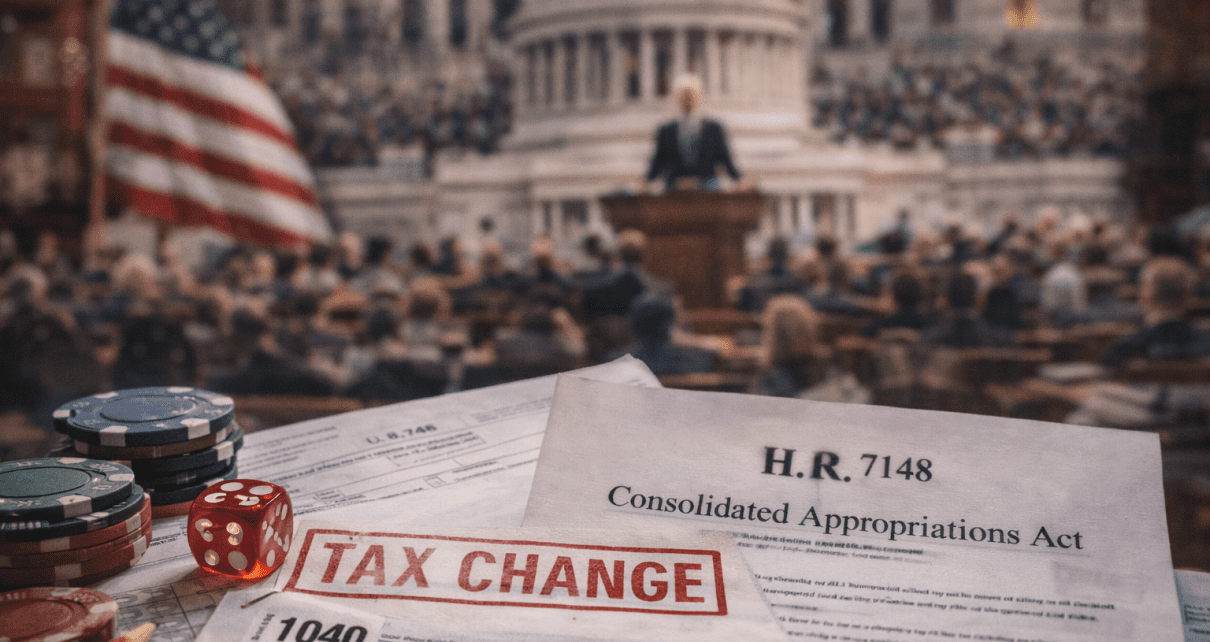
So the state tried something different. Buried inside the $56 billion FY2027 budget that passed June 1, SB3019 imposes a new “exchange wager” tax on sports prediction market contracts: 1.75% per transaction on the first five million wagers in a fiscal year, and 3.5% on every transaction thereafter. Illinois couldn’t cleanly ban prediction markets. It may be betting that it can tax them instead. But this raises many new legal questions. The biggest one is: can a state tax what the courts have already told it that it cannot regulate?
Illinois Already Taxes Sportsbooks Harder Than Almost Any State
While observing Illinois’s move against prediction markets, it helps to know what Illinois sportsbooks are already carrying and why those two should seemingly be equal in the state’s eyes. In 2024, the state moved from a flat 15% rate to a graduated scale ranging from 20% to 40% based on adjusted gross revenue. Then in 2025, Illinois added a per-wager fee: $0.25 for the first 20 million wagers per operator, rising to $0.50 beyond that threshold. Both structures are unique in the U.S. sports betting market. Illinois currently ranks fifth nationally and first in the Midwest in sports wagering taxes collected.
The per-wager tax alone generated meaningful revenue quickly. In July 2025, its first month of effect, Illinois sportsbooks paid more than $5.2 million through the new per-wager charge. But prediction market platforms, processing some of the same economic activity at enormous scale, paid nothing comparable. Kalshi processed more than 27.6 million trading transactions in December 2025 alone, with sports contracts driving the bulk of that volume. At $0.25 per transaction, that single month would have generated roughly $7 million in Illinois-equivalent fees, if the same rules applied. Fortunately for the prediction markets and unfortunately for Illinois, the same rules did not apply. The new exchange-wager tax is Illinois’s attempt to close that gap and level the playing field between Illinois’ sportsbooks and prediction market platforms.
The PM/ Sportsbook Tax Comparison Isn’t Perfect, but the Grievance Is Real
The tax structures don’t map cleanly, which muddies the water a bit. Illinois sportsbooks pay a percentage of adjusted gross revenue plus a flat per-wager fee. The new PM tax is purely transactional, at 1.75% per exchange wager. An “exchange wager” under SB3019 covers contracts “tied to a sporting contest or sporting event.” Whether the taxable base is the notional contract value, the premium paid, or something else will significantly affect the effective burden, and that ambiguity may invite litigation.
But the underlying competitive equity argument is hard to dismiss. Illinois has imposed what may be the most aggressive sportsbook tax structure in the country, a burden sportsbooks and industry groups argue has already driven customers toward offshore and unregulated alternatives. At the same time, platforms offering functionally similar products under federal licensing have operated in the state without any comparable tax obligation. From a sportsbook’s perspective, that’s not a regulatory distinction. It’s a subsidy and a massive advantage.
Whether the new PM tax actually levels that field depends on transaction volumes, the applicable tax base, and whether the law survives what will almost certainly be a legal challenge. The CFTC is expected to challenge the new tax on the same preemption grounds it used against Illinois’s C&D orders. If the commission argued that state gambling laws can’t be enforced against federally regulated prediction markets, it will likely argue the same about a state tax framed explicitly as a gaming levy.
The Big Question: Can a State Tax What It Can’t Regulate?
This is probably the most interesting question the Illinois budget raises, and it’s one where legal doctrine offers only partial guidance.
States routinely tax federally regulated entities: national banks, interstate railroads, and federally licensed broadcasters. The general principle is that a state may impose a non-discriminatory tax on an entity doing business within its borders, even if that entity is subject to federal oversight. The Supremacy Clause doesn’t create a blanket federal tax exemption.
The larger complication arises when the tax is structured specifically to burden an activity the state has already been told it cannot prohibit. Courts have held, with some consistency, that states cannot use their taxing power to accomplish federally preempted regulatory ends. A tax calibrated to make prediction market operations economically unviable in Illinois would probably face the same preemption analysis as an outright ban. The line between a revenue measure and a functional prohibition isn’t always obvious, but courts have found it before.
Illinois’s position is that this is a revenue measure, framed as an extension of its existing sports wagering tax regime. The CFTC’s position will likely be that the label doesn’t change the analysis. Which view prevails may depend on how courts ultimately read the scope of CEA preemption, a question that, remarkably, still doesn’t have a clean answer after two years of litigation across multiple circuits.
What Illinois seems to have concluded is that even a partial, uncertain, litigated tax is better than no tax at all. Given how aggressively the state has taxed sportsbooks, that logic is understandable, even if the legal footing is unsteady.
Players trust our reporting due to our commitment to unbiased and professional evaluations of the iGaming sector. We track hundreds of platforms and industry updates daily to ensure our news feed and leaderboards reflect the most recent market shifts. With nearly two decades of experience within iGaming, our team provides a wealth of expert knowledge. This long-standing expertise enables us to deliver thorough, reliable news and guidance to our readers.
Latest News