Scotts Valley Casino In Vallejo Blocked Again After Federal Judge Ruling
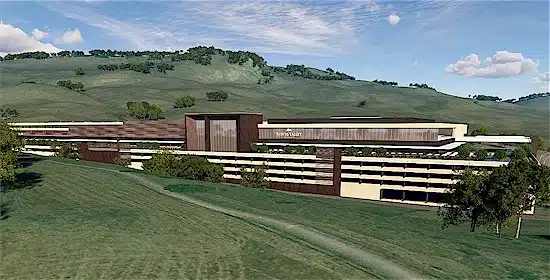
Artist's rendering of the proposed Scotts Valley Casino
A federal judge denied the Scotts Valley Band of Pomo Indians a preliminary injunction in the tribe’s lawsuit against the Department of the Interior (DOI) on Wednesday. The ruling is another blow for Scotts Valley’s hopes of building a casino resort in Vallejo, California.
The tribe filed a lawsuit against the DOI after it ruled in July that the site is not eligible for Class III gaming under IGRA’s restored-lands exception. This reverses a 2025 ruling that granted Scotts Valley’s application to conduct Class III gaming on the land.
The motion for a preliminary injunction aimed to allow the tribe to continue developing the casino plans while the full lawsuit remained ongoing. Judge Trevor McFadden, however, ruled the tribe is unlikely to succeed in its claims and, as such, refused to issue the injunction.
Rival Tribes Lay Claim To Land
The dispute centers on which tribe has historical claims to the 128-acre parcel of land near Highway 37 and Mare Island in Vallejo.
The Yocha Dehe Wintun Nation and Kletsel Dehe Wintun Nation claim Vallejo as part of their core ancestral homelands. The two Patwin tribes filed a lawsuit against Scotts Valley earlier this year.
The Yocha Dehe operates a casino near the proposed location of the Scotts Valley project, as do the United Auburn Indian Community and the Lytton Rancheria, both of which have also opposed the plans. Scotts Valley Chairman Shawn Davis argues they are acting out of greed.
“Two of the opposing casinos are located more than an hour from our land and have no reason to interfere with a fair and binary process except to protect their own financial interests,” Davis stated. “We will not bend under the knee of greed. It’s wrong. We will continue to fight valiantly to defend the Tribe’s rights, history, and economic future – both for the Scotts Valley and Vallejo.”
Judge McFadden did not rule that the land does not belong to Scotts Valley, and it remains in their trust. However, there is insufficient evidence to show the area qualifies as “restored lands” under the Indian Gaming Regulatory Act (IGRA). This means the tribe cannot legally operate a casino resort offering games such as slots, blackjack, and roulette.
No Evidence of Scotts Valley Ties To Land
The Vallejo parcel sits on what was historically Rancho Suscol. The government initially believed Scotts Valley’s ancestors worked as farm laborers on that ranch.
Furthermore, the tribe claimed a Pomo ancestor named “Augustine” was baptized near Vallejo in the 1830s.
However, records submitted by rival tribes show that Augustine had different parents and came from a different village. He belonged to the Southern Pomo, whereas Scotts Valley’s ancestors belonged to the Eastern Pomo.
A 19th-century federal map used to verify claims that Scotts Valley inhabited the lands was also shown to be inaccurate. Historians proved that federal negotiators never properly identified or mapped who actually occupied those lands.
History Of Dispute
Scotts Valley has eyed Vallejo as the site to develop a casino resort for around 20 years. There have been several back-and-forths during this time, as detailed by 500 Nations:
- Pre-2010s: Scotts Valley seeks land for economic development
- 2016-2020: Vallejo trust acquisition pursued with multiple DOI rejections
- 2021-2024: IGRA restored-lands review begins
- Jan 2025: Interior initially approves Class III eligibility
- Mar 2025: Interior rescinds approval
- Oct 2025: Federal judge vacates rescission, orders reconsideration
- July 24, 2026: Class II preview casino opens on the Vallejo parcel
- July 30, 2026: Interior issues final denial of Class III gaming
- July 31, 2026: Preview casino shut down
- Sept 30, 2026: Judge denies injunction
A similarly drawn-out dispute is ongoing over land in Madera County, where the North Fork Rancheria of Mono Indians plan to open a casino this month despite adverse legal rulings.
Yocha Dehe Applauds Court’s Ruling
A spokesperson for the Yocha Dehe contacted Gaming America after our original story was published to clarify some details, which have been amended. This includes the tribes that run nearby casinos, the tribes that have taken legal action, and the timeline of events above.
Anthony Roberts, Chairman of the Yocha Dehe Wintun Nation, said the tribe was grateful to the court for its decision not to grant Scotts Valley an injunction.
“We appreciate the court’s careful consideration of this matter, and we could not be more pleased by today’s decision,” said Roberts.
“The Department of the Interior considered all the evidence and properly concluded Scotts Valley lacks a significant historical connection to Vallejo and Solano County. This decision is another important step in exposing Scotts Valley’s false claims about our Patwin ancestors. Vallejo is Patwin ancestral territory, and we will never relinquish our responsibility to care for and protect these lands.”
Players trust our reporting due to our commitment to unbiased and professional evaluations of the iGaming sector. We track hundreds of platforms and industry updates daily to ensure our news feed and leaderboards reflect the most recent market shifts. With nearly two decades of experience within iGaming, our team provides a wealth of expert knowledge. This long-standing expertise enables us to deliver thorough, reliable news and guidance to our readers.
Latest News