Aqueduct Closes After 132 Years, a Farewell That Says More About Racing’s Future Than Its Past
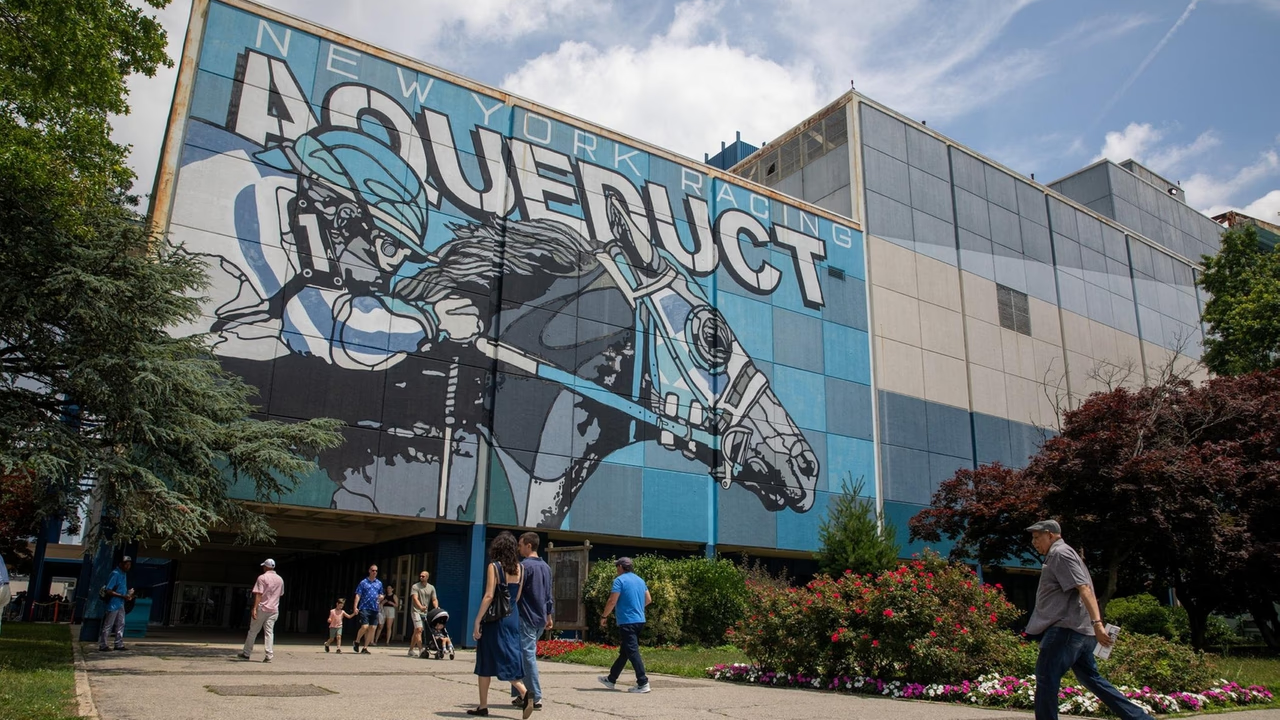
Aqueduct Closes After 132 Years, a Farewell That Says More About Racing's Future Than Its Past
The final race at Aqueduct Racetrack ran last Sunday afternoon at 5:44 p.m., appropriately titled “It Was a Good Run.”
Aqueduct Racetrack held its final race card Sunday at its South Ozone Park facility, bringing down the curtain on thoroughbred racing at a Queens oval that first opened in 1894. For most of its life, the track served a different function than its more glamorous neighbors: not the pageantry of Belmont or the carnival atmosphere of Saratoga, but a workingman’s track for serious bettors, daily railbirds, and the kind of devoted pick-six players who built their lives around the racing form. The facility will remain open for simulcast wagering through September 7, at which point New York State resumes control of the property.
That property is the part of this story that points forward rather than backward. The 110 acres in South Ozone Park, a stone’s throw from JFK Airport and sitting on a subway line, are too valuable to remain a racetrack. Resorts World New York City has operated a casino in a corner of the existing grandstand for years and holds one of the three full commercial gaming licenses the state issued for the New York City area. Its plans for the Aqueduct footprint include a substantially larger gaming facility, an entertainment venue, affordable housing, and a park built partially over the former racing surface. The horses are leaving. The slot machines, which have been there for some time, are staying and expanding.
The transition raises a question that the American thoroughbred industry has been unable to resolve for decades: what does horse racing look like as the gambling landscape it once dominated becomes the competition it cannot beat?
As Gambling Expands, Horse Racing Moves to Limited Marquee Tracks
There are roughly 75 thoroughbred tracks nationwide, compared to more than 300 facilities offering some form of horse racing during the sport’s peak in the late 1800s. Tom Rooney, president of the National Thoroughbred Racing Association, framed the contraction plainly: for over a century, thoroughbred racing was one of the very few sports outlets where you could legally bet, and with the expansion of sports gambling, the sport will naturally condense around a more pragmatic number of marquee tracks and locations.
Among the major tracks that have closed in recent years are Arlington Park in Illinois, purchased by the NFL’s Chicago Bears for a potential new stadium, and Golden Gate Fields in the San Francisco Bay Area. The pattern is consistent: aging facilities in expensive urban or suburban markets, struggling with declining attendance and competition from expanded legal gambling options, find more value in their real estate than in their racing licenses. The hard truth of it for the sport of horse racing is that the land is simply worth more than what the sport brings.
Aqueduct is the latest and perhaps most symbolically significant example. It sits on 110 state-owned acres in one of the most land-scarce markets in the country, is served by the subway, is adjacent to a major international airport, and already hosts one of the more successful regional casino operations in the Northeast. The economics of continuing to run thoroughbred racing there, alongside the Resorts World operation and in the shadow of a rebuilt Belmont Park reopening in September, did not withstand the financial reality of what else the site could do. And unfortunately, that spells the end of a national institution.
Limited Tracks to Focus on Flagship Racing Events
Aqueduct’s closure is not a random casualty of market forces. It is the planned outcome of a deliberate consolidation strategy that New York State and the New York Racing Association have been executing for several years. The 2024 state budget included a $455 million loan to NYRA to reconstruct Belmont Park on the condition that NYRA relinquish its lease at Aqueduct and consolidate all downstate racing at the rebuilt facility. The deal was explicit: the state funds a premier destination track at Belmont in exchange for recovering 110 acres of Aqueduct land for redevelopment. And this will be the new trend in horse racing. Despite history, notoriety, and a position in sporting lore, certain tracks like Aqueduct are going to be sacrificed for alternate gambling options while premium racetracks get massive upgrades.
The new Belmont Park facility is slated to open on September 18, 2026. The new grandstand, designed by architecture firm Populous, replaces a structure that last saw major renovation in 1968. On a typical day, the new facility will hold 9,000 to 10,000 fans, sized appropriately for racing in the current era, while maintaining capacity for up to 50,000 through temporary infield and adjacent space on marquee days like the Belmont Stakes or Breeders’ Cup. The 2027 Breeders’ Cup is already scheduled for Belmont, marking the first time the event has returned to New York since 2005 and serving as the public validation of the consolidation strategy.
The NYRA model trades volume for quality: fewer race days, fewer tracks, but concentrated investment in flagship facilities that can justify their existence as entertainment destinations rather than daily gambling venues. Saratoga remains the summer anchor, Belmont anchors the fall, and the Aqueduct product, which served a different function as what Andy Serling, the track’s longtime television analyst, described as “the city track” and “a players’ track,” does not fit cleanly into that premium destination framework.
New York’s Strategy is Becomeing the Nationwide Blueprint
What New York has done deliberately, other states are discovering by necessity. The closure pattern across American thoroughbred racing follows a similar logic in each case: a track closes, its racing dates are consolidated at a surviving facility or redistributed, and the land either redevelops or sits idle while its license value diminishes. The industry predicted decades ago that this consolidation was coming, and it has come more slowly than many expected, largely because the political and regulatory processes governing track closures are complex, and the stakeholders, from horsemen’s associations to state racing commissions to labor unions, have historically been effective at delaying unwinding. But the writing is on the wall.
What has accelerated the process is the same force that accelerated it at Aqueduct: the legalization of competitive gambling products. Every state lottery expansion, every new casino license, every online sports betting market that launches reduces the percentage of gambling dollars that flow through the pari-mutuel window. The 75 tracks that remain are competing for a share of a betting market that has exploded in total size while becoming indifferent, or even hostile, to horse racing as a vehicle for wagering. Younger bettors who came of age on DraftKings and FanDuel are not the same demographic that built Aqueduct’s culture of pick-six players and daily railbirds.
Roy Brown, a 68-year-old retiree from Jamaica, Queens, who hauled in $60,000 on a pick-six at Aqueduct in the late 1980s, captured the dynamic as well as anyone at the track’s final races. “It’s best to bet on them, not own them,” he said of the horses. “If you’re really passionate about it, it’s your best two minutes.” The two minutes that horse racing offers are still genuinely distinctive. The question the industry has been unable to answer for thirty years is how many facilities can support a product that most bettors now encounter, if at all, on their phones, simulcast from tracks they will never visit.
Aqueduct’s answer was 132 years; for now, the rest of the field is still running.
Players trust our reporting due to our commitment to unbiased and professional evaluations of the iGaming sector. We track hundreds of platforms and industry updates daily to ensure our news feed and leaderboards reflect the most recent market shifts. With nearly two decades of experience within iGaming, our team provides a wealth of expert knowledge. This long-standing expertise enables us to deliver thorough, reliable news and guidance to our readers.
Latest News