Caesars’ Business Is Increasingly Tilting Away From Las Vegas
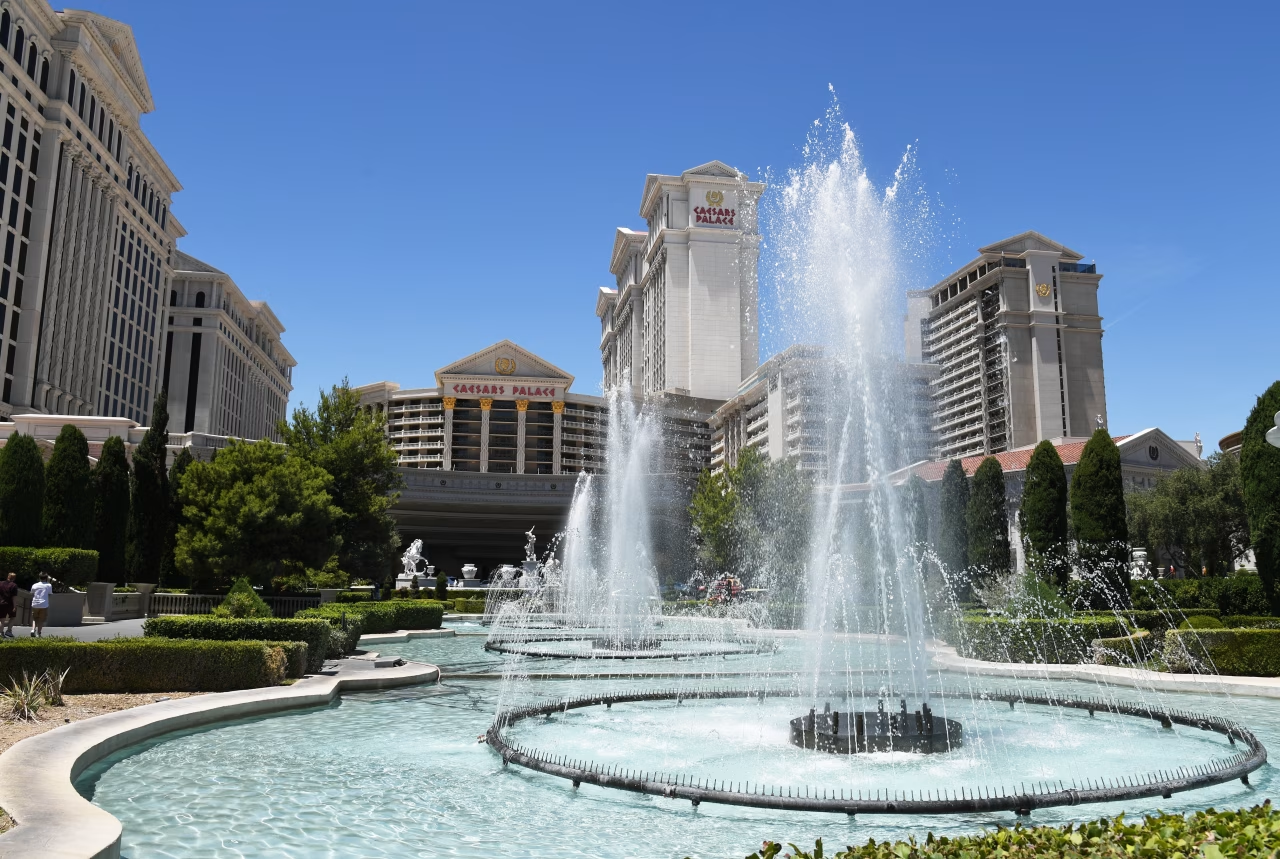
Caesars Entertainment reported Q2 2026 results Tuesday without hosting an analyst call, citing its pending acquisition by Fertitta Entertainment as the reason for the abbreviated disclosure.
The company generated $2.99 billion in quarterly net revenue, up 3% year over year, driven entirely by its regional casino portfolio, which posted a 9.4% increase to $1.57 billion. Las Vegas revenue fell 3.5% to $1.02 billion, with adjusted EBITDA declining 12.6% to $410 million.
The quarter extends a growing trend from a longer-term perspective than a single earnings report provides. In 2022, Caesars’ regional and Las Vegas segments operated at roughly a 4:3 revenue ratio. The Q2 numbers put that ratio closer to 3:2. The Strip is not collapsing, but it consistently underperforms while regional properties outperform, and the gap is widening.
Truist Securities analyst Barry Jonas described the outcome as fitting his preview that regionals were a bright spot while the Strip was soft, noting the results boded well for other regional-heavy operators including Penn Entertainment and Churchill Downs, while suggesting Caesars may have lost Las Vegas market share given lower hold and occupancy.
A Company That Has Always Been More Than Caesars Palace
The revenue split matters analytically, but it also carries a historical irony. The company that files these earnings under the Caesars Entertainment name owns hundreds of properties across the country, most of them regional casinos bearing the Harrah’s, Horseshoe, and Eldorado brands. Caesars Palace, the property that gave the parent company its name and identity, is now roughly one of many smaller elements in a much larger portfolio whose center of gravity has been drifting away from Las Vegas for years.
That drift is every bit as intentional as it appears in the numbers. It is the cumulative result of two acquisitions in which regional casino companies bought Caesars and kept the name.
The original Caesars Palace opened on the Las Vegas Strip in 1966 and became one of the most recognized resort brands in the world. Harrah’s Entertainment, a regional casino operator built on riverboat gambling and drive-to destination properties across the Midwest and South, acquired Caesars Entertainment in 2005 for $9.4 billion. The combined company took the Caesars name, apparently deciding the Las Vegas cachet was worth more than the Harrah’s brand equity. The company then went through a leveraged buyout, a bankruptcy, and emerged as the Caesars Entertainment that trades today.
Then, in 2020, Eldorado Resorts acquired Caesars Entertainment for $17.3 billion, again keeping the Caesars name while folding in a portfolio built primarily around regional casino management in smaller markets. The CEO who engineered the deal, Tom Reeg, came from Eldorado. The operational center of gravity came from Eldorado. The name on the building came from a 60-year-old hotel on the Las Vegas Strip that the acquiring company had not previously owned.
The result is that what files quarterly earnings as Caesars Entertainment is, in its operational reality, Eldorado Resorts doing business under a brand that carries Las Vegas prestige it acquired through a financial transaction rather than through decades of Strip operation. The Q2 results, with regional casinos outperforming Las Vegas by nearly 13 percentage points, describe a company whose identity and whose business have been moving in opposite directions for years.
The Fertitta Acquistion Adds Another Angle
The pending Fertitta acquisition does not obviously resolve that tension. Fertitta Entertainment’s portfolio is built around the Golden Nugget brand, which operates properties in Las Vegas but is primarily known as a regional chain with locations in Mississippi, Louisiana, Indiana, and New Jersey. Golden Nugget competes with Caesars in six markets, five of which are regional.
Fertitta also owns the Houston Rockets, a collection of restaurants including Landry’s and Del Frisco’s, and Post Oak Hotel Houston, a luxury property in Texas. His instinct as an operator is hospitality and food and beverage integrated into gaming, not Vegas Strip mega-resort management. The Caesars Palace he is acquiring is an asset in a portfolio, not an identity he is ready to adopt.
That means the company that emerges from the Fertitta acquisition, if regulators approve it and it closes as expected next spring, will be the third time a regional casino operator has acquired Caesars and kept the name. Each time, the brand has survived while the business it describes has shifted further from the Las Vegas origins the name implies. Whether Fertitta eventually rationalizes the brand structure or continues running what is fundamentally a diversified regional casino company under the most recognizable name in Las Vegas gaming history is one of the more interesting strategic questions the deal raises.
The Q2 numbers suggest the business will continue answering that question in favor of the regions regardless of what happens to the name.
Players trust our reporting due to our commitment to unbiased and professional evaluations of the iGaming sector. We track hundreds of platforms and industry updates daily to ensure our news feed and leaderboards reflect the most recent market shifts. With nearly two decades of experience within iGaming, our team provides a wealth of expert knowledge. This long-standing expertise enables us to deliver thorough, reliable news and guidance to our readers.
Latest News