

Dana White Publicly Asks President Trump to Reverse Unpopular Change to Gambling Taxes
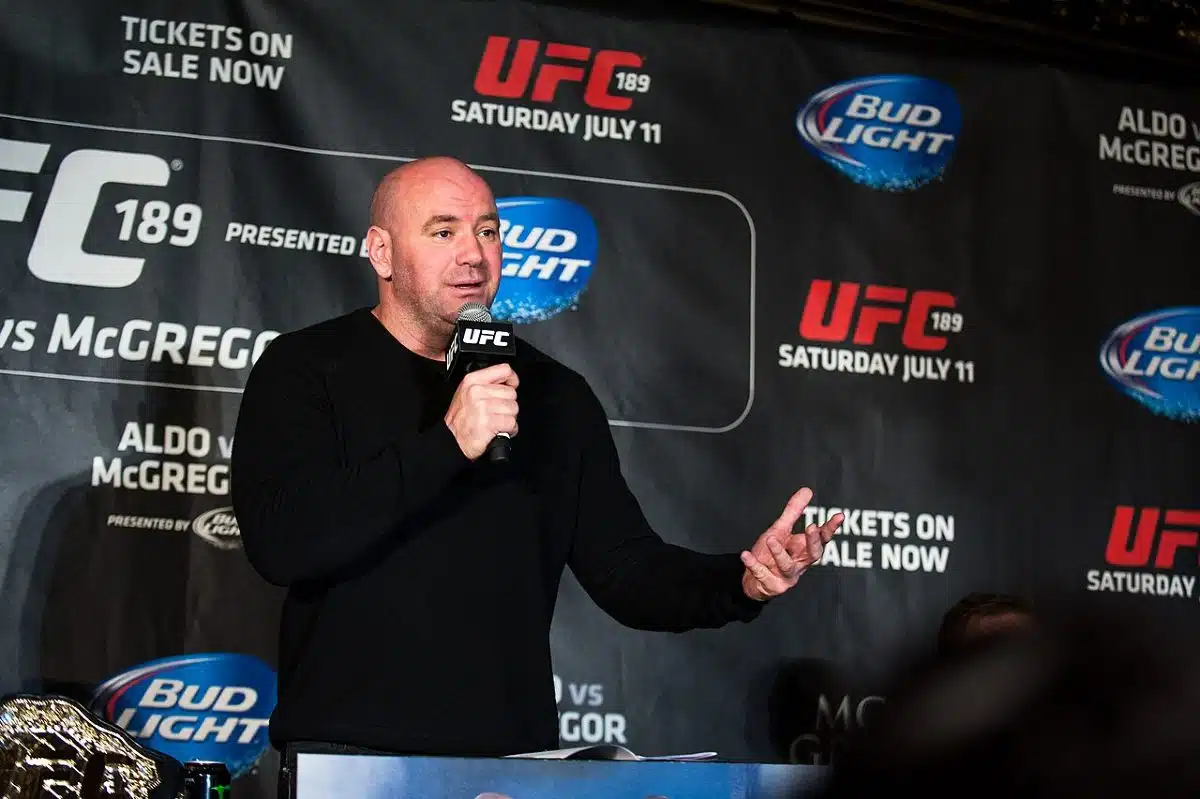
Credit: Andrius Petrucenia/Wikimedia Commons
Ultimate Fighting Championship (UFC) President Dana White is publicly appealing to the president to repeal an unpopular gambling tax change that caps deductions at 90% of losses.
Under the terms of the tax change, gamblers could be taxed on income they never actually made. A break-even gambler who cashed for $50,000, for example, would owe taxes on $5,000 in gambling “winnings.”
The change negatively affects White in multiple ways, both personally and professionally. He has a well-documented history as a high-dollar gambler in Las Vegas, so it could cost him a pile in tax liability. The UFC has also been one of the most gambling-forward sports leagues for years.
While White thanked Trump for his budget policy in general, he noted in his letter that the policy makes it “irrational” to bet in the U.S. right now. The UFC counts many Trump supporters among its fans, while White and Trump are known to be close, with a UFC event scheduled to take place at the White House next month.
“When legal betting is discouraged, it hurts the ecosystem we’ve spent years building in partnership with state regulators and licensed operators,” White wrote. “Fixing this deduction issue would send a strong signal that the United States supports common-sense regulation.”
Timeline of Gambling Tax Change
“One Big Beautiful Bill” And The Tax Deduction Cap
July 4, 2025
One Big Beautiful Bill Act (OBBBA) signed into law by Donald Trump
Congress passed the controversial budget after much consternation. It had engendered fierce debate. The bill included a provision limiting tax deductions on gambling losses to 90%. Gamblers raised alarm bells late in the process, but efforts to stop it ultimately failed.
July 7, 2025
U.S. Rep Dina Titus introduces FAIR BET Act
Titus, who represents Nevada’s 3rd Congressional District (which includes a chunk of Las Vegas), had lobbied hard against the tax change due to its potential impact on the casino industry. After it passed, she introduced legislation aimed at a repeal. She called it the Fair Accounting for Income Realized from Betting Earnings Taxation (FAIR BET) Act.
Sept. 9, 2025
FAIR BET Act rejected from defense-spending bill
Rep. Titus attempted to attach the FAIR BET Act to a must-pass bill, a common legislative tactic for getting minor changes that wouldn’t normally call for a stand-alone law pushed through. However, a Republican-controlled committee blocked it. A similar process occurred in January 2026.
Jan. 8, 2026
Bipartisan FULL HOUSE Act introduced
U.S. Reps Steven Horsford of Nevada (Democrat) and Max Miller (Republican) of Ohio reintroduced the FULL HOUSE Act (Facilitating Useful Loss Limitations to Help Our Unique Service Economy). The bipartisan bill had originally been introduced around the same time as Titus’s attempt, also with bipartisan support from Ted Cruz and Catherine Cortez Masto.
Jan. 9, 2026
Titus’ bill gains bipartisan support
U.S. Rep. Tom Cole gives bipartisan support to the FAIR BET Act. The support of Cole, a Republican who chairs the House Appropriations Committee, was viewed as a key step for Titus’ campaign to repeal the tax deduction change.
May 13, 2026
Dana White makes his public plea to President Trump
White’s letter called for “common-sense” regulation and asked Trump to repeal the tax change. It also noted that the tax deduction cap was “an issue we have discussed in the past.”
June 14, 2026
UFC Freedom 250
White’s entreaty comes ahead of high-profile PPV event to be held on the South Lawn of the White House, emblematic of his close relationship with the President.
Dec. 31, 2026
Deadline to repeal tax change before first effects
While the tax change passed in 2025, the 2026 tax year is the first one in which it applies. Therefore, any gambling losses in 2026 are subject to the 90% deduction. Gamblers must keep this in mind when logging their results for the year, unless a repeal is successful.
April 15, 2027
First tax filings reflecting the deduction cap are due
Gamblers filing by this date for their 2026 taxes must provide numbers that reflect the 90% deduction cap.
Dana White May Have Selfish Motivations on Gambling Tax Deduction
White himself stands to potentially lose quite a bit of money due to the deduction cap.
White has never been shy about his propensity for high-dollar blackjack and other casino games. Last year, reports emerged that White had gambling debts in the tens of millions of dollars. A deep dive by The Hollywood Reporter suggested he owed as much as $50 million to one casino company. It noted that since Red Rock, the casino company in question, is owned by White’s business partners, Lorenzo and Frank Fertitta, he may not be under serious pressure to pay.
White called the story “clickbait bullshit.”
While he’s well-compensated and has an estimated net worth in the hundreds of millions, nobody likes paying exorbitant taxes, and high-dollar gamblers are the most vulnerable to the change. If White is wagering millions of dollars per year, that opens him up to the possibility of paying some staggering tax sums on “phantom income.”
A gambler of White’s means could easily place millions or tens of millions of casino bets in a single year, usually winning back most of that. However, the tax changes mean that break-even or slight-winning years can turn into losses.
If a wealthy gambler grosses $21 million across his winning sessions during a year, but also books $20 million in his losing sessions, he’d net $1 million. However, he’d pay taxes on $3 million in winnings. In a high-earning tax bracket, that could easily erase all profits and then some.
As White suggested in his letter, he has the president’s ear. The two have frequently appeared in public together over the years. White has been a donor and backer of Trump’s dating to his first term. He has appeared at multiple Trump rallies and was present for his 2025 inauguration. Trump frequently attends UFC events as well.
Early market indicators suggest White’s influence is very real here. A Kalshi prediction market speculating on a repeal of the deduction cap by year’s end was sitting at about 19% before White’s letter became public. After the letter hit the newswire, the odds for a repeal rocketed to 38% before settling back at 32%.
UFC Could Also Benefit from Gambling Tax Deductions
Apart from potentially saving White six figures or more in tax liability, White’s business interests also stand to benefit from a potential repeal.
For one thing, the UFC holds many events in Las Vegas. That gives the company an obvious motivation to have gambling taxes be as player-friendly as possible. The happier customers are to travel to Las Vegas, attend events, and gamble, the better the live-gate revenue is going to be for the UFC.
Conversely, the more Las Vegas struggles, the more live-gate revenue is likely to suffer. As White says, if it doesn’t make sense for people to bet, it follows that it doesn’t make sense for them to travel to Vegas to patronize UFC events and gamble on them.
The UFC has also been aggressive in seeking to monetize gambling on its product. It was the first to embrace gambling odds and give them a prominent place on its broadcasts. Today’s UFC events show the closing odds for each fighter just before the fight begins.
And while other leagues have been slow to embrace prediction markets, the UFC enthusiastically jumped aboard. The league inked a deal with Polymarket last November, promising to integrate prediction odds into broadcasts.
The UFC has not been shy about wanting fans to bet on its product, and White undoubtedly understands that legislation discouraging such activity is bad for business.
Image credit: Andrius Petrucenia/Wikimedia Commons (license)
Players trust our reporting due to our commitment to unbiased and professional evaluations of the iGaming sector. We track hundreds of platforms and industry updates daily to ensure our news feed and leaderboards reflect the most recent market shifts. With nearly two decades of experience within iGaming, our team provides a wealth of expert knowledge. This long-standing expertise enables us to deliver thorough, reliable news and guidance to our readers.
Latest News