Opinion: Peter Jackson Exits Flutter Having Won the Market and Lost the Valuation Game
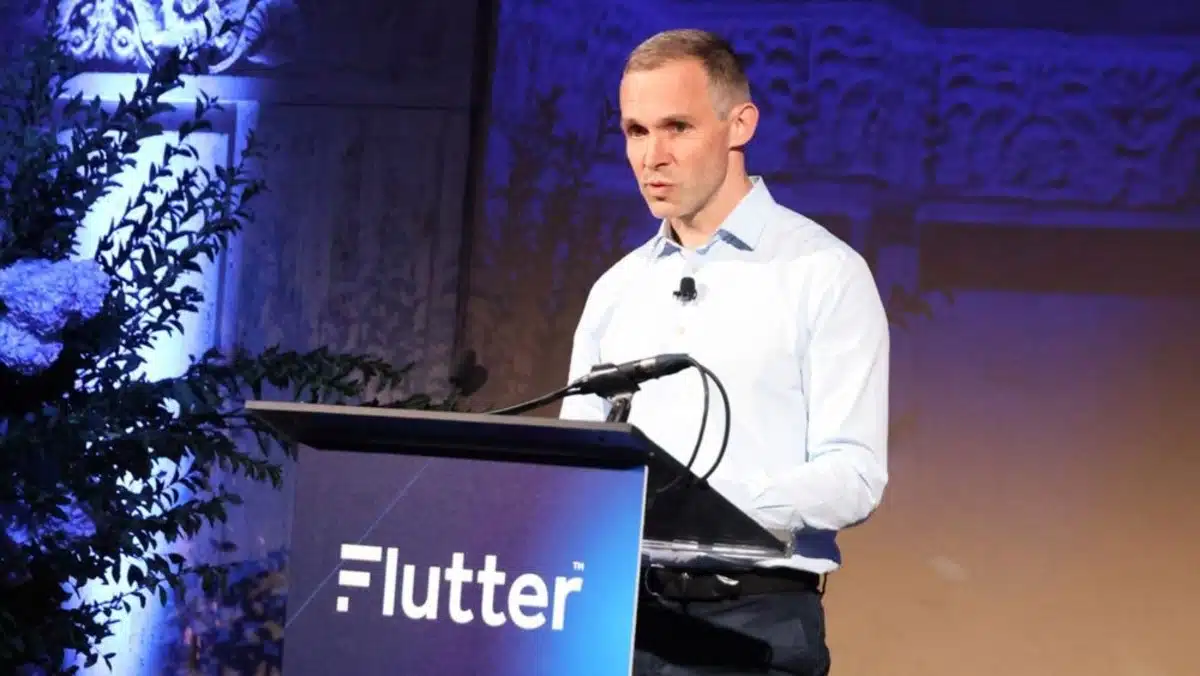
Peter Jackson is stepping down as CEO of Flutter Entertainment after nine years. He built FanDuel into a dominant US sportsbook.
Flutter’s market capitalization grew from roughly $2 billion when he joined to more than $30 billion at its peak. He is leaving a company that is the clear market leader in US sports betting, that has a functioning prediction market product, and that just posted revenue of $4.33 billion in a single quarter.
He is also leaving a company whose stock fell more than 11% on the day his departure was announced, whose full-year guidance has been cut, and whose US adjusted EBITDA fell 70% year over year in Q2. The implied message from the market was that nine years of building the best sportsbook in America was not sufficient, and somebody had to go.
The story of who actually failed here has been told backward.
Flutter Investors Big Ask
The period from 2018 to 2022 was extraordinary for US sports betting. PASPA fell, states legalized, and operators rushed in, ready to spend on customer acquisition and capture market share. It was the Wild West. Revenue grew at rates that looked, to people accustomed to mature industries, like exponential trajectories. Investors bid stocks to valuations that assumed exponential trajectories would continue indefinitely.
DraftKings peaked above $70 per share in 2021. Flutter’s market cap crossed $30 billion. Smaller operators raised at absurd multiples. The affiliate industry, which earns revenue by sending customers to sportsbooks, grew faster. Companies like Catena Media, which built its entire North American strategy around the US rollout, hired aggressively, expanded into every new state, and built cost structures premised on continued double-digit growth.
The same investors who bid these stocks up were also the ones communicating, through their valuations and their analyst calls, that the addressable market was essentially unlimited. That every new state legalization would add linear revenue. They sent the message that hold rates would stabilize, and customer acquisition costs would fall as brands matured. They also hypothesized that prediction markets would add incremental TAM rather than cannibalize existing revenue.
None of those assumptions were wrong in isolation. All of them were wrong in combination, at the speed the market demanded.
FanDuel Won Big In The US, And That Was Not Enough
FanDuel is the current US sports betting market leader, and it has been for years. Its market share is substantial, and it has built a brand that casual bettors in legal states recognize. Amy Howe built the product and the culture through the critical years of growth, then was pushed out in May. Peter Jackson built the parent company that funded it, then stepped down this week.
What did they fail to do? They failed to maintain the growth rate that investors priced in when they bid Flutter to $30 billion. That is a different failure from losing the market. It is the failure of a market that overpriced the future and then held the executives accountable when the future arrived at a normal pace.
FanDuel’s Q2 this year would have looked like an excellent quarter by any pre-PASPA standard. $4.33 billion in quarterly revenue, market leadership maintained, prediction markets growing, and international operations performing. The problem is that $4.33 billion in revenue is being measured against a stock price that assumed something faster and more profitable was coming, to absolutely no fault of Peter Jackson.
The Affiliate Industry Saw It More Clearly
The regulated gaming affiliate industry is a useful canary for what actually happened to US sports betting economics. Catena Media, the Swedish affiliate company that doubled down on North America at exactly the wrong moment, has now gone through at least five rounds of layoffs since 2024. Its peak employee count was above 450. Recent reports put it below 150. CEO Manuel Stan assured investors in November 2024 that no further short-term redundancies were expected. The August 6, 2026 round was confirmed earlier this week.
Catena sold its UK and Australian assets in 2023 to focus entirely on North America, which was its strongest market at the time. It then wrote down €40 million in sports betting assets as non-core, reported EBITDA margins collapsing from 20% to below 10%, and has been cutting continuously since. XLMedia, another North American-focused affiliate, sold its remaining assets to Sportradar, acknowledging that the market was not generating enough revenue for shareholders.
The affiliate industry made the same bet the operators made: that US sports betting would grow without a ceiling. It can be argued that it was an understandable bet in 2021. That does not change the fact that it was the wrong bet, and smaller companies with less capital to absorb the correction paid for it faster and more visibly than Flutter or DraftKings.
The Prediction Market Playbook
The irony of this earnings cycle is that the very thing presented as the new growth story, prediction markets, is partly responsible for making the current numbers look worse. DraftKings spent $200 to $300 million building Predictions. Flutter’s US adjusted EBITDA fell 70% partly because of prediction market investment. Both companies are now carrying the cost of building a second business while the first business is under margin pressure.
That investment may prove correct. Prediction markets may deliver the incremental TAM both companies are projecting. The NFL season will provide the first serious evidence. But the dynamic is familiar: investors see a new exponential growth opportunity, push operators to invest aggressively, and then measure the investment cost against quarterly earnings without fully crediting the future value being built.
Peter Jackson framed the prediction market investment as analogous to the early bets FanDuel made on US sports betting, and he may be right. Those early bets did pay off. But they paid off at a pace that took ten years to fully deliver. The investors who pushed Flutter stock to $30 billion were not pricing in a ten-year payoff. They were pricing in something much faster.
Dan Taylor, who takes over on October 1, inherits a company that is the clear market leader in US sports betting, a prediction market product that is behind schedule, a cost structure being tightened, and a stock that has been marked down for failing to be something it was never quite going to be. That is the brief, and it was built by the same capital markets that will now hold him accountable for solving it.
Players trust our reporting due to our commitment to unbiased and professional evaluations of the iGaming sector. We track hundreds of platforms and industry updates daily to ensure our news feed and leaderboards reflect the most recent market shifts. With nearly two decades of experience within iGaming, our team provides a wealth of expert knowledge. This long-standing expertise enables us to deliver thorough, reliable news and guidance to our readers.
Latest News