

What Has Tilman Fertitta Actually Been Doing as Ambassador to Italy?
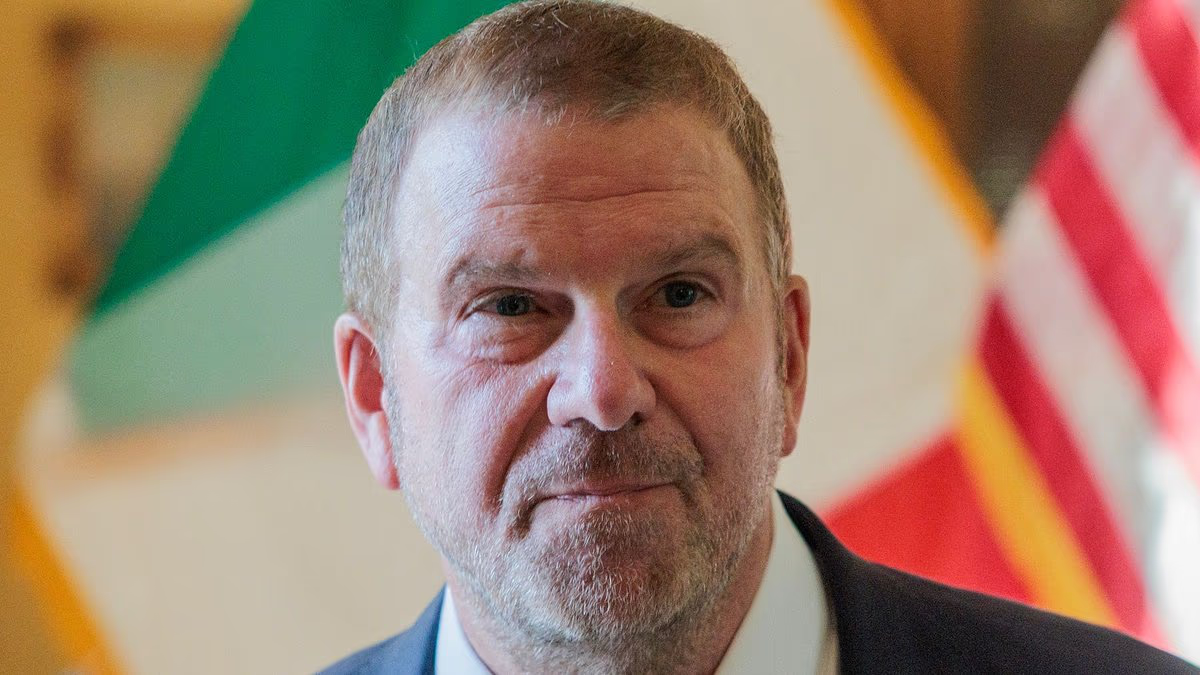
Many might not know this, but Tilman Fertitta is currently serving as the US Ambassador to Italy. What has he actually been doing in that role?
If you follow American gaming industry news, you know Tilman Fertitta primarily as the man trying to buy Caesars Entertainment for $18 billion, the owner of the Houston Rockets and the newly minted Houston Comets, and the founder of the Golden Nugget casino empire. What you might not know is that since May 2025, he has also been the United States Ambassador to Italy and San Marino, living in Rome and handling one of the more consequential diplomatic postings in the current administration.
That work has been considerably more complicated than a ceremonial title might suggest.
How He Got To This Ambassador Role
Trump nominated Fertitta in December 2024, calling him “an accomplished businessman and a proud American who knows how to lead.” The Senate confirmed him 83 to 14 in April 2025, a wide bipartisan margin that reflected both Fertitta’s genuine business reputation and the relatively low-controversy nature of the posting in Italy compared to some of Trump’s more contentious diplomatic picks.
Fertitta presented his credentials to Italian President Sergio Mattarella at the Quirinale Palace on May 6, 2025, met with Prime Minister Giorgia Meloni and Foreign Minister Antonio Tajani in his first week, and formally moved into Villa Taverna, the ambassador’s official residence, in July after renovations were completed. He even hosted an exhibit of American art there as part of Fourth of July festivities, which is either charming cultural diplomacy or a very expensive way to entertain guests, depending on your perspective.
The posting suits him in ways that are not entirely coincidental. Fertitta’s ancestors immigrated from Sicily to Galveston, Texas, which gives him a personal connection to Italy that most ambassadors cannot claim. Italian officials welcomed him warmly upon his arrival, and Fertitta has leaned into it, framing his role as a homecoming of sorts for a family that has been American for generations but has never fully lost the thread.
What He Was Actually Sent to Do
The substantive diplomatic agenda Fertitta laid out at his Senate confirmation hearing was straightforward and consistent with the Trump administration’s priorities. He said he wanted to close the gap in the U.S. trade deficit with Italy, which stood at more than $43 billion in 2024. He pushed for Italy to work more closely with American energy companies and to reduce its reliance on countries like Libya. He pledged to monitor Italy’s ties with China closely, particularly after Italy formally exited Beijing’s Belt and Road Initiative.
These were not abstract priorities. Italy under Meloni has been the Trump administration’s most reliable European partner, and the relationship between the two governments created an unusual opportunity for American economic interests. Meloni was the first European leader to visit Washington after Trump imposed and then paused tariffs on the EU in April 2025, and her closeness with the administration gave the embassy access and influence that American ambassadors in Paris, Berlin, or Brussels could not have matched. Fertitta, as a businessman with no ideological baggage and genuine deal-making experience, was well-positioned to exploit that opening.
The tariff situation also meant that Fertitta’s role was never purely ceremonial. Analysts noted that the Trump administration’s approach to European diplomacy was explicitly focused on promoting the American economic agenda, and that Fertitta’s background made him particularly suited to that framing. “The focus seems to be on promoting Trump’s agenda, especially around trade,” noted Italian economist Riccardo Puglisi. An ambassador who has spent his career negotiating real estate deals and expanding a hospitality empire across 36 states is not a conventional diplomat, but he speaks the language of economic leverage fluently.
The Pope Problem
Then things got complicated in ways that no amount of Sicilian heritage could smooth over.
The relationship between the Trump administration and the Vatican has deteriorated throughout 2026 into what Vatican officials themselves have described as an unprecedented low. Pope Leo XIV, the first American-born pope elected in May 2025, has repeatedly condemned the U.S.-led war against Iran that began in February 2026, criticized American immigration enforcement actions, and positioned himself as a moral counterweight to the administration’s foreign policy.
Trump has responded by publicly accusing Leo of “endangering a lot of Catholics and a lot of people,” claiming falsely that the Pope thinks it is acceptable for Iran to have a nuclear weapon.
Italian Foreign Minister Antonio Tajani, one of Fertitta’s primary interlocutors, responded to Trump’s latest comments by calling them “neither acceptable nor helpful to the cause of peace,” adding his personal support for Pope Leo. Meloni herself, long Trump’s closest European ally, has taken exception to the attacks on the pontiff, and Trump responded by criticizing her in turn, framing her refusal to support the Iran war as a betrayal by a NATO ally.
This is the environment Fertitta is operating in. His boss is publicly feuding with the head of the Catholic Church, the Italian government he has spent a year cultivating is caught in the middle, and Secretary of State Marco Rubio is flying to Rome this week to attempt a diplomatic repair job with the Vatican that Trump undercut by attacking Leo again on the same day Rubio’s trip was announced.
Rubio’s visit, announced by the State Department as focused on “the situation in the Middle East and mutual interests in the Western Hemisphere,” is widely understood in Rome as a damage-control mission. Fertitta would almost certainly have been involved in the groundwork for that visit, given that the embassy’s relationships with both the Italian government and Vatican adjacents would be essential to making it happen.
The Business Side Has Not Stopped for Fertitta
It is worth noting what Fertitta has not been able to do while serving as ambassador. Under U.S. government ethics rules, he is prohibited from taking an active operational role in his business interests while in office. He resigned from his executive positions at Landry’s and Fertitta Entertainment, retaining only passive stakes. He holds a deferred compensation arrangement rather than a severance package.
That ethical framework is why the Caesars’ negotiations, now in their third month of exclusive talks, have proceeded without his direct participation. The deal is being managed by advisors and Fertitta family interests rather than by the ambassador himself. Whether that passive role will survive the requirements of closing a transaction of that complexity is a question the regulatory process will eventually answer.
For now, Fertitta is in Rome doing a job that has turned out to be significantly more demanding than his confirmation hearing suggested. Trade negotiations with a friendly government were the easy part. Managing the diplomatic fallout from a running feud between the President of the United States and the first American-born Pope in history is something no Senate hearing adequately prepares anyone for.
Players trust our reporting due to our commitment to unbiased and professional evaluations of the iGaming sector. We track hundreds of platforms and industry updates daily to ensure our news feed and leaderboards reflect the most recent market shifts. With nearly two decades of experience within iGaming, our team provides a wealth of expert knowledge. This long-standing expertise enables us to deliver thorough, reliable news and guidance to our readers.
Latest News