Ohio’s Battle Against Kalshi Has Rallied 39 Other States to the Cause

All but a handful of state governments have rallied behind Ohio in its battle against prediction markets.
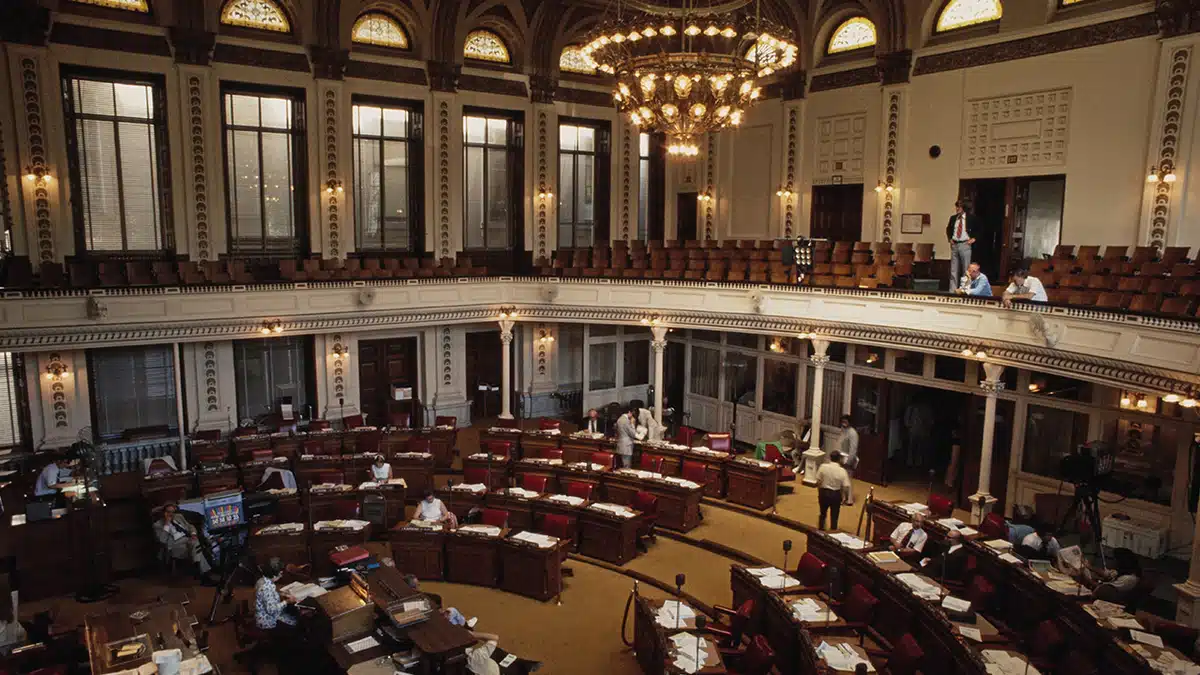
A coalition representing the majority of the country’s state governments has thrown its weight behind Ohio in its escalating legal battle with prediction market operator Kalshi.
The group signed an amicus curiae (“friend-of-the-court”) brief to provide background and support for Ohio’s arguments. It claims that the dispute directly threatens the historic power of states to police gambling within their borders. On the opposite side, Kalshi has the support of the federal Commodity Future Trading Commission, which believes it has the exclusive right to regulate event contracts, even those that are functionally the same as sports bets.
A total of 39 states and the District of Columbia filed the amicus brief on June 11 in the U.S. Court of Appeals for the Sixth Circuit, urging the court to uphold a lower court ruling against Kalshi. Nevada Attorney General Aaron Ford and Utah Attorney General Derek Brown led the filing in KalshiEX LLC v. Schuler, the appeal Kalshi brought after a federal judge in Columbus refused to protect the company from Ohio enforcement actions.
The breadth of the coalition matters. The brief brings together attorneys general from states that have embraced legal sports betting with states that ban it outright. That shows a shared anxiety across the usual partisan and policy lines. If Kalshi prevails, every state could lose its grip on an activity they have presided over for decades.
Kalshi, CFTC Agree Event Contracts Are Federal Jurisdiction
The prediction market company’s legal theory treats sports contracts as “swaps” under the Commodity Exchange Act, which would put the CFTC exclusively in charge of their oversight. Kalshi argues that this lets it offer sports markets in all 50 states regardless of local gambling laws.
The states reject that theory, and the coalition relies especially on three doctrines in its brief. The first is the federalism canon, which says courts should not read a general statute to displace traditional state authority unless Congress speaks with a clear statement. Gambling, the states argue, has long sat “at the heart of the state’s police power.”
Then there’s the major questions doctrine, which holds that agencies can’t claim sweeping new power over matters of vast economic and political significance through “modest words” or “subtle devices.” Sports betting involves billions of dollars and millions of people, so the states place it in that category.
The third doctrine invokes the 2024 decision Loper Bright Enterprises v. Raimondo, which ended Chevron deference. The states argue that the CFTC’s interpretation of its own jurisdiction doesn’t deserve special weight, especially because, they say, the agency reversed its long-standing position only recently and only for litigation.
The brief also focuses heavily on the practical stakes. The states point to harms like gambling addiction, financial ruin, threats to athletes, and match fixing. They warn that Kalshi’s model would effectively lower the gambling age in many states because the platform admits users at 18 years old, while many states restrict sports betting to people 21 and older. They also point to the lack of consumer protections and exclusion lists for problem gamblers that state gaming regimes provide.
Ohio Could Be the Supreme Court Vehicle for Predictions Dispute
The jurisdictional battle between the CFTC and state regulators is bound for the Supreme Court one way or another. The level of activity around this appeal has pushed legal observers to speculate that the Ohio case could be the one that takes it there.
The growing circuit split contributes heavily to that idea. The Third Circuit sided with Kalshi in part in a New Jersey case, holding in a 2-1 decision that sports contracts are “swaps” and that federal law preempts state regulation.
Courts elsewhere have leaned the other way, issuing adverse rulings for Kalshi in Nevada, Maryland, and Massachusetts. When appeals courts diverge on the same federal question, Supreme Court review becomes far more likely.
The Sixth Circuit also stands in an unusual position because it sits above two district courts that reached opposite conclusions. A Tennessee federal judge granted Kalshi a preliminary injunction in February, while the Ohio court denied one in March.
The appeals court has consolidated the cases and scheduled oral arguments for July 30, so a single panel will deal with the issue head-on.
Ohio also has plenty of support beyond the states’ brief, including 30 Native American tribes and 11 tribal associations, the American Gaming Association, and the Indian Gaming Association. On the other side, the CFTC filed its own brief backing Kalshi in May.
Ohio Regulators, Lawmakers Forge Ahead as Case Proceeds
The issue remains up in the air. A Sixth Circuit panel declined in late April to protect Kalshi from Ohio enforcement while the appeal proceeds. That allowed state regulators to propose a multimillion-dollar fine against the company.
Ohio lawmakers have also filed legislation that would explicitly bring prediction markets into the state’s existing sports betting framework as a contingency. The Sixth Circuit’s July hearing will provide the first real signal of how one appeals court views the clash.
Players trust our reporting due to our commitment to unbiased and professional evaluations of the iGaming sector. We track hundreds of platforms and industry updates daily to ensure our news feed and leaderboards reflect the most recent market shifts. With nearly two decades of experience within iGaming, our team provides a wealth of expert knowledge. This long-standing expertise enables us to deliver thorough, reliable news and guidance to our readers.
Latest News