WSOP-Branded Apparel Store Opens at the Horseshoe
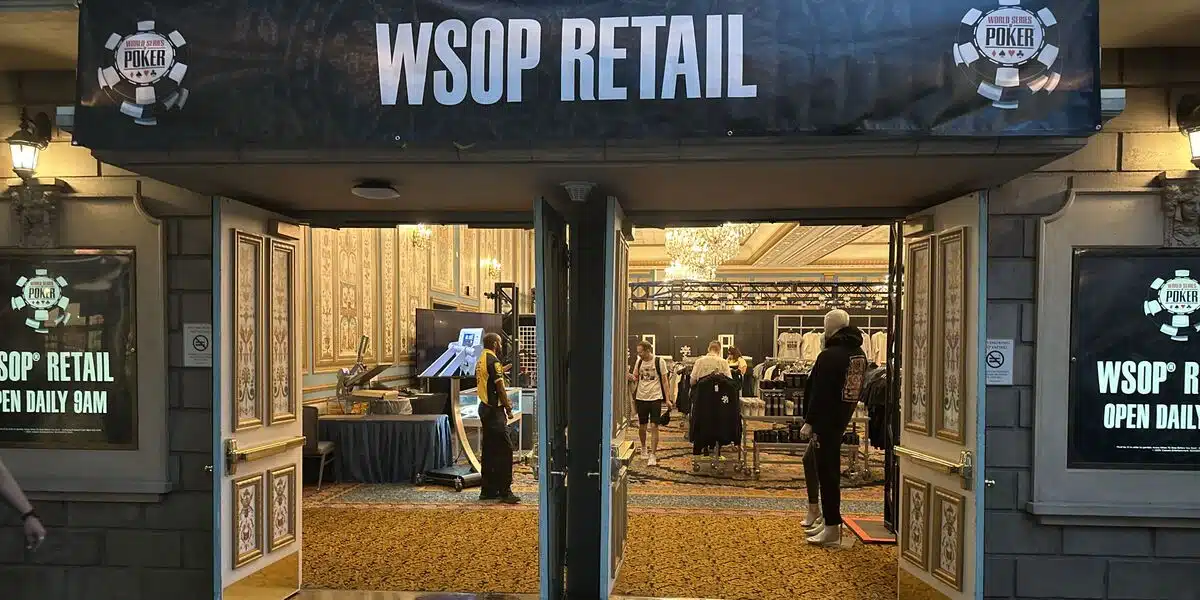
The World Series of Poker opened its first permanent retail store on the Las Vegas Strip on Friday, June 12, with a ribbon-cutting ceremony at the Horseshoe Las Vegas featuring Jack Binion, 89-year-old son of WSOP founder Benny Binion.
The store, which opened to the public on Monday, occupies 2,320 square feet in the shopping corridor connecting Horseshoe and Paris Las Vegas, where the 57th annual series runs through July 15. It is the largest dedicated WSOP retail space in the series’ history, featuring more than 100 merchandise designs across apparel, accessories, and collectibles.
The design splits the space into two experiential halves: one side reflecting early WSOP history through rustic wood finishes and saloon-style elements, the other highlighting the modern game. A chandelier constructed from cascading poker chips and a cash-wrap counter modeled after Benny Binion’s Million Dollar Display anchor the space. Executives described the store as giving the WSOP brand a “forever home” on the Strip beyond the annual summer tournament window.
What the announcement did not address is the interesting context surrounding it involving Caesars, which is more complicated than a typical retail opening.
Caesars Recently Sold the Brand, Which it Now Says is Worth Celebrating
Caesars Entertainment sold the WSOP intellectual property to NSUS Group in a $500 million transaction in 2024, retaining the rights to host the series in the United States and to operate retail and related licensing businesses. The sale was a straightforward asset monetization: Caesars concluded that the WSOP brand had standalone value that could be unlocked outside the tournament-hosting relationship.
That’s a defensible logic that not many would take issue with. What is harder to square is the posture the new flagship store reflects. A 2,320-square-foot permanent retail space built around WSOP history, anchored by the Benny Binion legacy and designed to keep the brand present on the Strip year-round, is a brand-building exercise. It is an investment in the identity and cultural resonance of the WSOP name. It is exactly the kind of thing a company does with a brand it considers central to its identity, not one that it decided to move on from.
Caesars decided in 2024 that the WSOP brand was worth $500 million as a separable asset. It is now investing in retail infrastructure to celebrate that brand’s history on property it controls. Those two positions are not impossible to reconcile, but the tension between them is real. Either the brand was important enough to keep, or it was right to monetize it. Opening a flagship store two years after the sale does not, by itself, resolve that question in Caesars’ favor.
Multiple Factors Have Led to Declining WSOP Event Fields
The store opened during a series that, by most measurable indicators, is smaller than recent editions. Most 2026 WSOP events with direct comparables from prior years have seen smaller fields, and international representation in late-stage tournament finishes is down significantly. The Monster Stack, $500 Freezeout, and $600 Deepstack all saw reductions of nearly 40% or more in the number of top-100 international finishers compared to 2023.
The $2,000 no-limit hold ’em event saw its field decline by more than half year over year. The $5,000 8-handed event dropped 15% from 2025, with the prize pool falling from $3.7 million to $2.6 million.
Two distinct headwinds appear to be driving the declines. International attendance is down partly due to reduced travel to the United States under the current political environment, with Canadian and UK players notably underrepresented compared to prior years. On the domestic side, the One Big Beautiful Bill changed the deductibility of gambling losses from 100% to 90%, creating what tax professionals describe as phantom income for high-stakes players who could owe taxes on a losing year. Some professionals appear to be playing reduced schedules as a result.
Neither of those headwinds is within Caesars’ or WSOP’s control. But they are the backdrop against which a year-round nostalgia store opens on the Strip, targeting the international poker tourist audience that is currently the least likely to show up.
A Multi-Retail Location Plan With a Longer Runway Makes Sense
The flagship store is probably best understood not as a response to the series’ current trajectory but as a long-term bet on the WSOP brand’s durability beyond any single year’s attendance numbers. The WSOP has survived downturns before, and the Main Event remains one of the most recognizable annual sporting events in the world, even in a soft year. A permanent retail presence is the kind of infrastructure investment that makes more sense over a ten-year horizon than a one-year one, especially so close to Caesar’s sale to NSUS.
The store’s description as a flagship also suggests additional locations are likely on the way, probably at regional casinos that regularly host WSOP Circuit events, including Harrah’s Cherokee in North Carolina, Horseshoe Hammond in the Chicago area, and Harrah’s Atlantic City. If that rollout happens, the Strip store is the anchor of a retail network rather than a standalone investment, which changes the calculus somewhat and sheds a bit more light on Caesars’ overall strategy.
Still, the timing is what it is and is difficult to ignore. A brand Caesars sold two years ago is getting its most prominent permanent home on the Strip during a series where the international audience most likely to seek out WSOP merchandise is materially smaller than it was two years ago.
Whether the store proves to be well-timed infrastructure or a monument to a more prosperous moment in the series’ history probably depends on whether the attendance trends reverse, and on whether the poker tourist who might wander into a Strip store in July eventually shows up in numbers that justify a year-round footprint.
Players trust our reporting due to our commitment to unbiased and professional evaluations of the iGaming sector. We track hundreds of platforms and industry updates daily to ensure our news feed and leaderboards reflect the most recent market shifts. With nearly two decades of experience within iGaming, our team provides a wealth of expert knowledge. This long-standing expertise enables us to deliver thorough, reliable news and guidance to our readers.
Latest News