Live! Casino Replaced “LV” With “Live!” on a Louis Vuitton Knockoff. Louis Vuitton Just Sued.
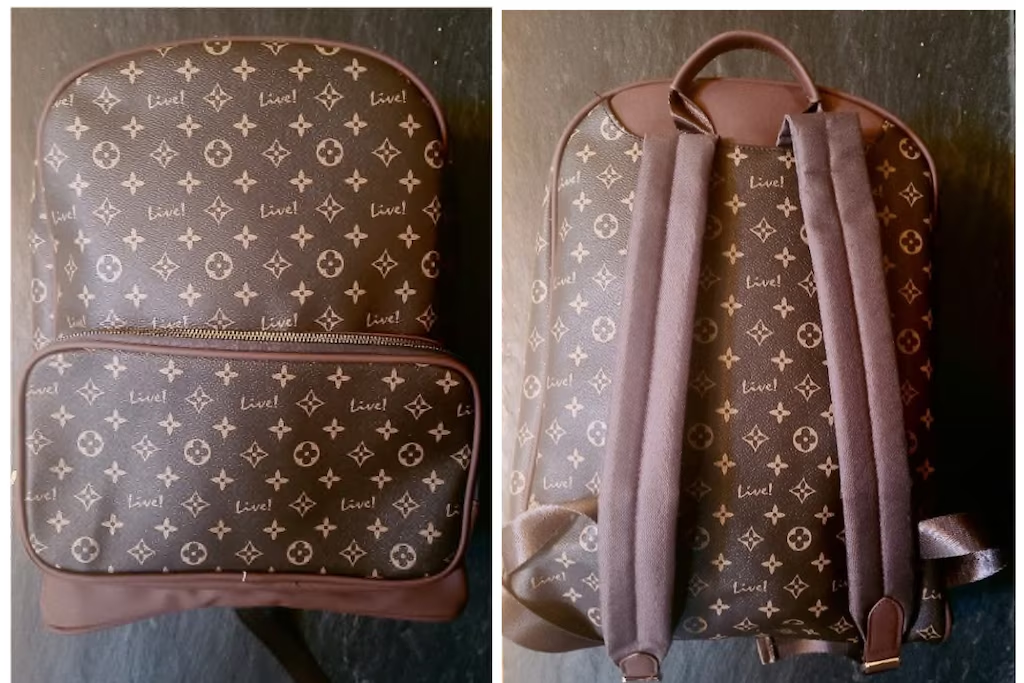
Louis Vuitton sued The Cordish Companies for distributing handbags featuring its monogram with the “LV” logo replaced by “Live!”
Louis Vuitton Malletier filed a federal trademark complaint against PPE Casino Resorts Maryland and The Cordish Companies on June 1 in the U.S. District Court for the District of Maryland. The 29-page complaint alleges willful trademark counterfeiting, infringement, false association, dilution, and unfair competition under Maryland common law. The conduct at issue is a regional casino’s decision in April 2026 to manufacture and distribute, as loyalty rewards, a “luxury bag collection” featuring the iconic Louis Vuitton monogram pattern, with the interlocking “LV” logo replaced by the word “Live!”
The complaint includes side-by-side photographs of the items in question. They look exactly like what they are, and it’s hard to believe Live! marketing thought this would be a non-issue. A handbag, toiletry case, backpack, and tote bag rendered in canvas patterned with the famous repeating Louis Vuitton flower-and-quatrefoil motif, in the same brown-and-tan color palette, in product shapes that closely mirror the Louis Vuitton Alma, Toiletry Pouch, Backpack, and Neverfull silhouettes. The only meaningful difference, by Louis Vuitton’s account and as visible in the exhibits, is that the company’s signature interlocking LV monogram has been replaced throughout the pattern with the word “Live!”, rendered in a similar typeface.
The campaign was titled “The Art of Luxury.” It is now the subject of statutory damages claims that, under the Lanham Act, can run up to $2 million per counterfeit mark per type of goods.
The Products Could Have Easily Been Mistaken as a Louis Vuitton Collab
The complaint lays out the campaign’s structure in detail, and its loyalty-marketing logic is the part most worth understanding for anyone in the casino industry. Live! Casino & Hotel Maryland is the East Coast flagship of The Cordish Companies, which owns and operates Live! properties in Maryland, Virginia, Louisiana, and both Philadelphia and Pittsburgh. The Maryland location runs a multi-tier loyalty program with Chairman, Black, Jade, Platinum, and Gold card levels. Players earn tier credits by gambling, dining, and shopping at the property.
The April promotion offered a four-piece “luxury bag collection” featuring the infringing products as part of the scheduled weekly giveaways. A toiletry case on April 7. A backpack on April 14. Then a handbag on April 21, and finally a tote bag and a pochette on April 28. Patrons could collect all four pieces by attending each Tuesday. Alternative redemption was available through the tier-credit system at 750 credits per item, which equates to roughly $750 in slot coin-in spending or $7,500 in retail spending per bag.
This is standard casino loyalty marketing machinery. Frequent-player comp programs use scheduled giveaways and redemption thresholds to drive repeat visitation. The same model produces the weekly free-play vouchers, the holiday turkey giveaways, and the gift-shop appliances that have been part of regional gaming for decades. Cordish’s apparent miscalculation was that the comp inventory this time was modeled with sufficient precision on a luxury brand that the brand wouldn’t notice, while still giving the appearance of a possible collaboration with the luxury handbag brand. What happened next was an even stranger move by the Casino loyalty program.
Louis Vuitton’s Cease-and-Desist Which Was Acknowledged and Somewhat Ignored
Louis Vuitton sent a cease-and-desist letter on April 15, eight days after the first distribution event. The complaint says Cordish responded on April 17, indicating it would stop distributing the products. The two later scheduled events on April 21 and April 28 do not appear to have proceeded as originally planned.
What happened next is the part of the story that makes the second half of the complaint distinct from the first. In May, Cordish ran a follow-up promotion called “Endless Elegance” that offered a chance to win “a luxury French Collection” as part of a $40,000 sweepstakes drawing held on May 29 and May 30 at Live! Maryland. The prizes, by Louis Vuitton’s description and the promotional materials in the complaint, were actual Louis Vuitton products. A handbag, a backpack, a duffle bag, jewelry, sunglasses, a hat, a belt, wallets, and fragrances. Promotional materials prominently featured what appears to be a genuine Louis Vuitton Keepall duffle bag.
The complaint argues that the pivot from counterfeit knockoffs to genuine products did not solve the underlying problem. By the time the May campaign ran, Cordish had already spent April conditioning its loyalty database to associate the Live! brand with Louis Vuitton. In that context, distributing real Louis Vuitton products without authorization or affiliation reinforces the implied partnership that the cease-and-desist letter had specifically demanded Cordish stop implying.
The Strategy Is Somewhat Funny, The Legal Exposure is Anything But
The damage exposure is substantial. The Lanham Act allows for statutory damages of up to $2 million per counterfeit mark per type of goods in cases of willful infringement. The complaint identifies at least five federally registered Louis Vuitton trademarks involved in the campaign, including the Monogram Design Trademark, the Décor Florale Design Trademark, and three Stylized Flower Design Trademarks. With four distinct product types in the April collection alone, the theoretical ceiling on statutory damages runs into the high eight figures even before treble damages for willfulness.
In practice, statutory damages are rarely awarded at the maximum. The actual settlement or judgment will depend on whether Cordish can establish a good-faith mistake, the extent of distribution, and the documented harm to Louis Vuitton’s brand. The complaint notes that Cordish “failed to provide” a complete accounting of the infringing products when Louis Vuitton requested one in April, a detail that tends to push courts toward willfulness findings rather than away from them.
The complaint also names ABC Corps. 1-10 as unidentified additional defendants, which is standard placeholder language for entities Louis Vuitton expects to identify through discovery. The most likely targets are the manufacturers, designers, and marketing contractors who produced the infringing products on Cordish’s behalf. In short, Live! has created an absolute mess through one month of its loyalty membership giveaways.
Casino Loyalty Marketing Will See This Blunder As a Cautionary Tale
For the casino industry specifically, the case raises a question worth thinking about beyond the immediate facts. Regional casino loyalty marketing depends heavily on comp inventory that can be procured at scale and distributed weekly. The economics work because the comp items are typically commodity goods or licensed merchandise procured through wholesale relationships with established manufacturers. When a property wants to upgrade the perceived value of its comp inventory, the temptation to model that inventory on recognizable luxury aesthetics is structural, not isolated.
Cordish is not the first operator to flirt with the line. It may be the first major operator to cross it this brazenly with a brand of Louis Vuitton’s scale and IP-enforcement record. Louis Vuitton’s litigation history is well known in the fashion and counterfeit-goods spaces. The company has filed thousands of infringement actions globally and pursues them aggressively. Anyone in casino marketing who looked at the proposed April collection should have recognized that this particular brand would notice and would not be quiet about it.
The case is now in federal court in Maryland, and Cordish has not yet filed a response. The first practical question is whether the company will settle quickly to limit reputational damage or fight the willfulness finding to keep the statutory damages calculation in check. Either path leads to a real bill. Whether it leads to a meaningful change in how casino loyalty programs source their comp inventory is the harder question, and one that the rest of the industry will likely be watching for.
Players trust our reporting due to our commitment to unbiased and professional evaluations of the iGaming sector. We track hundreds of platforms and industry updates daily to ensure our news feed and leaderboards reflect the most recent market shifts. With nearly two decades of experience within iGaming, our team provides a wealth of expert knowledge. This long-standing expertise enables us to deliver thorough, reliable news and guidance to our readers.
Latest News