Rahm Emanuel Proposes 10% Federal Online Gambling Tax to Fund Innovation And the Precedent Already Exists
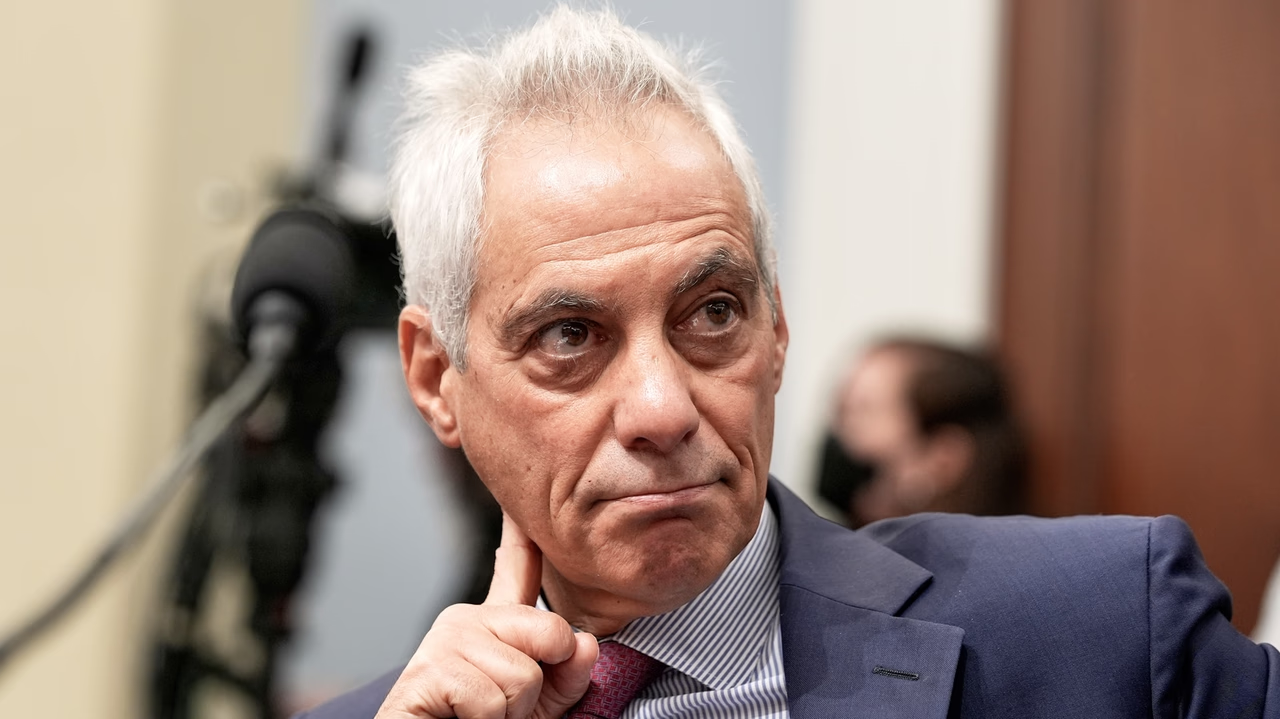
Former Chicago Mayor Rahm Emanuel has proposed a 10% federal transaction tax on online gambling and prediction markets to fund an American Innovation Fund, reviving a debate with deeper historical roots than most realize.
The former Chicago mayor, White House chief of staff, and US Ambassador to Japan floated a 10% federal transaction tax on online sports betting, digital casino platforms, and prediction market exchanges at a Wall Street Journal Live event in Washington on April 15. The proceeds would flow into an American Innovation Fund targeting artificial intelligence, quantum computing, fusion energy, life sciences, and national security technology. He estimates the levy would generate between $30 billion and $50 billion annually.
“I’m tired of people betting against America,” Emanuel said. “I want to bet on America. I want to not reward gambling, and I want to actually reward the entrepreneur.”
Emanuel has been mulling over a 2028 Democratic presidential run and has been steadily releasing policy proposals. This one landed squarely in the gaming industry’s lap.
What Emanuel Is Proposing
The tax would be a transaction-level levy on wagers placed through licensed platforms, applying to online sportsbooks, digital casinos, and prediction market apps and exchanges. Emanuel framed it explicitly as funding that would supplement rather than replace existing research spending. “It doesn’t replace what you spend today. It builds,” he said. “It’s new money, not replacing old money.”
He has also separately proposed banning all federal employees from trading on prediction market platforms, citing concerns about insider trading. Both proposals fit a broader political argument that Democrats need a proactive economic agenda rather than simply opposing President Trump.
The revenue math, however, is not straightforward. State-regulated online sportsbooks and casinos generated roughly $27 billion in gross gaming revenue in 2025. Emanuel’s $30 to $50 billion figure implies either a handle-based calculation rather than a revenue-based one, or inclusion of prediction market volume.
The tax structure, whether applied to gross or net revenue, has not been specified and would dramatically affect both revenue yield and industry impact.
This Is Not Actually New Territory
Emanuel’s proposal sounds novel. It is not. The federal government has taxed gambling since 1951, and the constitutional authority to lay a federal excise tax on top of state-regulated activity is well established. The more interesting question is whether a 10% rate is workable, and what history tells us about what happens when federal gambling taxes get too high.
The 1951 Revenue Act established a 10% federal excise tax on sports wagers, originally designed to combat organized crime and assert federal control over the gambling sector. Congress reduced the rate to 2% in 1974, then to 0.25% in 1982, where it has sat ever since. That 0.25% handle tax currently generates roughly $150 to $300 million annually, a figure that has grown alongside the expansion of legal sports betting since the Supreme Court struck down the federal ban in 2018.
The reason the rate was cut so dramatically in the 1970s and 1980s is instructive. At 10%, the tax made legal betting economically uncompetitive with the illegal market. Bookmakers operating outside the law paid nothing. Licensed operators paid the full freight. The result was to drive business toward the unregulated alternatives the tax was ostensibly designed to suppress.
That dynamic has not gone away. The American Gaming Association estimates that roughly 40% of US sports betting volume still flows through illegal channels, generating around $44 billion in unregulated revenue annually. Layering a 10% federal transaction tax on top of state taxes that already range from 6.75% to 51% of gross gaming revenue would sharply erode the price competitiveness of licensed platforms against offshore and illegal operators.
The Federal-State Overlay Is Already the Norm
Beyond gambling, the federal government has a long history of imposing taxes on industries regulated primarily at the state level. Alcohol is taxed federally by the Alcohol and Tobacco Tax and Trade Bureau and by every state. Tobacco carries federal excise taxes alongside state levies that vary enormously by jurisdiction. Motor fuel is taxed at both the federal level, where rates have been frozen at 18.4 cents per gallon since 1993, and at the state level, where states add their own charges. Cannabis, in states where it is legal, faces state and local taxes but not yet a federal layer, primarily because it remains federally illegal.
In each of these cases, the dual-taxation structure is accepted by industry and consumers as a cost of operating in a legal market. The constitutional authority is not seriously contested. The practical concern is always rate design: too high a combined burden, and the legal market loses share to the illegal one.
The gambling industry has been lobbying for years to have the existing 0.25% excise tax repealed entirely, arguing that it is a relic of the anti-gambling era and serves no purpose now that states have taken on the regulatory and tax burdens themselves. Bipartisan legislation, the WAGER Act, has been introduced to eliminate it. Emanuel is proposing to go in the opposite direction, raising a 0.25% tax to 10%, a forty-fold increase.
The Tax Foundation has analyzed what a 5% handle tax would do to the market and concluded it would force sportsbooks to restructure their product offerings and would drive meaningful volume toward illegal alternatives. A 10% rate would compound those effects considerably.
What are Emanuel’s Chances?
Emanuel’s proposal arrives as part of a broader audition for the 2028 Democratic presidential nomination, a field expected to be large and competitive. His policy rollouts, which have also included a mandatory retirement age of 75 for elected officials and a $25,000 tax credit for first-time homebuyers, are the work of a candidate building a platform rather than a policymaker advancing legislation.
Kalshi users currently price his odds of winning the Democratic nomination at approximately 3.1%. He briefly spiked to around 5% on April 11, likely in response to increased media coverage of his policy announcements, before settling back. California Governor Gavin Newsom remains the clear market favorite. Illinois Governor JB Pritzker, who has been making parallel moves to establish a policy identity, is also in the conversation.
The 2028 nomination will not be decided by a gambling tax proposal. But Emanuel’s willingness to engage the issue directly is notable in a political environment where most Democrats have either ignored the industry’s rapid expansion or gently praised the tax revenues it generates for states. Coming out with a federal tax framework tied to China’s competition and innovation funding is a way to reposition online gambling as a resource-extraction opportunity rather than a consumer product, which is a different political argument from the one the industry has been winning at the state level for the past eight years.
Whether the math works, whether Congress would ever pass it, and whether the unintended consequences would undermine the stated goals are all separate questions from whether it is good politics. On that last dimension, Emanuel clearly thinks it is.
Players trust our reporting due to our commitment to unbiased and professional evaluations of the iGaming sector. We track hundreds of platforms and industry updates daily to ensure our news feed and leaderboards reflect the most recent market shifts. With nearly two decades of experience within iGaming, our team provides a wealth of expert knowledge. This long-standing expertise enables us to deliver thorough, reliable news and guidance to our readers.
Latest News