

Polymarket Files Federal Lawsuit to Block Massachusetts Crackdown on Prediction Markets
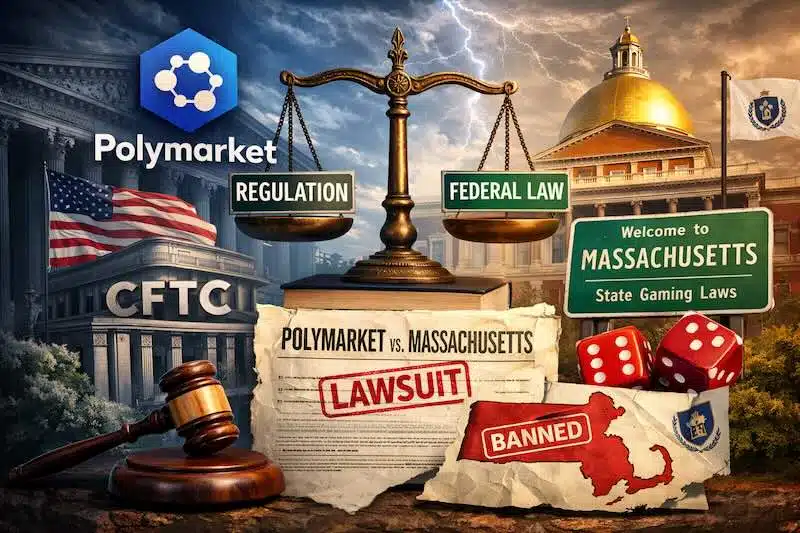
Key Highlights
- The Dispute: Polymarket sues Massachusetts in federal court, claiming the state lacks authority to regulate prediction markets.
- The Catalyst: Action follows a recent preliminary injunction against rival Kalshi, which labeled sports contracts as unlicensed gambling.
- The Stakes: A victory for Polymarket could establish the CFTC as the sole arbiter of event-based trading, stripping states of oversight power.
The fight over the legality of prediction markets has intensified after Polymarket filed a preemptive lawsuit in federal court seeking to stop Massachusetts officials from enforcing state gambling laws against its platform. The case sets up a pivotal confrontation over whether event-based trading falls under federal commodities regulation—or state gaming control.
The filing comes just days after Massachusetts won a preliminary injunction in Superior Court against Kalshi, Polymarket’s chief U.S. rival. In that decision, the state successfully argued that sports-themed event contracts operate as de facto sportsbooks and must be licensed under Massachusetts’ existing gaming framework.
The Case for Federal Preemption
Polymarket’s lawsuit hinges on a core claim: prediction markets are not gambling products, but commodity contracts governed exclusively by the Commodity Futures Trading Commission (CFTC).
According to the complaint, state interference would directly conflict with federal law and undermine Congress’s intent to centralize oversight of derivatives markets.
The company’s key arguments include:
- Irreparable harm: State enforcement poses an “imminent risk” of civil and criminal penalties that could force Polymarket to shut down operations in Massachusetts entirely.
- Federal supremacy: Allowing individual states to regulate event contracts would create a fragmented patchwork that destabilizes the national regulatory framework.
- Nevada precedent: The CFTC’s prior intervention to block Nevada from restricting similar markets is cited as proof that federal—not state—authorities hold jurisdiction.
“Polymarket US seeks declaratory and injunctive relief to prevent unlawful state overreach [and] preserve the integrity of the federal regulatory framework,” the lawsuit states.
A Battle of Definitions
At the center of the dispute is a fundamental question: Are prediction markets tools for information discovery or just another form of wagering?
| How Prediction Markets Work | |
| Pricing | Shares trade between $0.00 and $1.00 based on market demand. |
| Logic | Prices reflect the “crowdsourced” probability of an event (e.g., $0.60 = 60% chance). |
| Outcome | Contracts pay out $1.00 if the event occurs and $0.00 if it does not. |
Platforms frame this model as data-driven risk hedging similar to futures trading.
The Massachusetts Gaming Commission (MGC), however, views the mechanics as indistinguishable from sports betting.
Last year, the commission warned licensed operators that only wagers explicitly authorized by the state are legal, effectively drawing a hard line against event contracts.
High Stakes for the Gaming Industry
The implications extend far beyond one company. A Polymarket victory could sharply limit the authority of state gaming regulators nationwide, opening the door for prediction markets to operate outside traditional sportsbook licensing, even when contracts track sporting events.
For now, Massachusetts officials are standing firm. The MGC has declined to comment on the new filing, pointing instead to its recent win over Kalshi as evidence that state oversight remains intact.
The lawsuit names Attorney General Andrea Campbell and MGC Chair Jordan Maynard as defendants, setting the stage for a landmark test of who controls the future of event-based trading in America.
Players trust our reporting due to our commitment to unbiased and professional evaluations of the iGaming sector. We track hundreds of platforms and industry updates daily to ensure our news feed and leaderboards reflect the most recent market shifts. With nearly two decades of experience within iGaming, our team provides a wealth of expert knowledge. This long-standing expertise enables us to deliver thorough, reliable news and guidance to our readers.
Latest News