

Commodity Futures Trading Commission Sues Illinois, Arizona, and Connecticut on Behalf of Prediction Markets
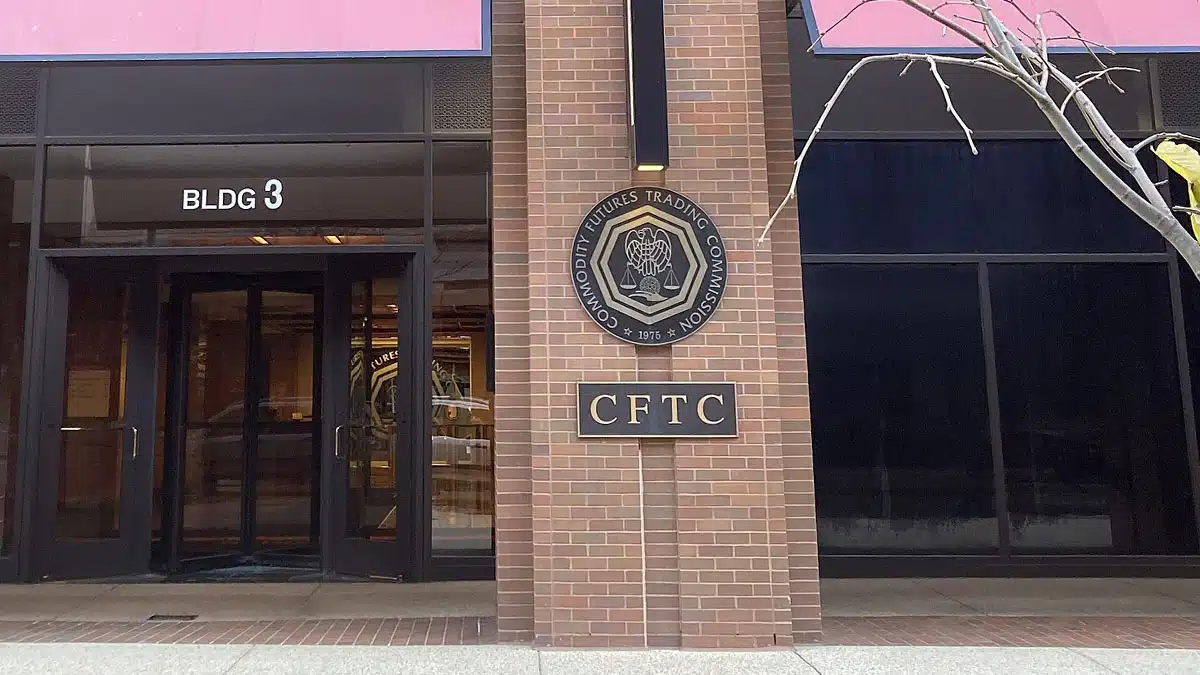
Credit: Dclemens1971 via Wikimedia Commons
A new front has opened in the battle between state regulators and prediction markets, as the federal government begins its first attempt at direct intervention.
The Commodity Futures Trading Commission took the unprecedented step today of filing lawsuits against Illinois, Connecticut, and Arizona officials. It accused them of overstepping state jurisdiction by issuing cease-and-desist notices to prediction market operators.
News of the Illinois lawsuit was first broken by Reuters. Two similar lawsuits, against Connecticut and Arizona, followed later in the day. However, this is a development that has long seemed inevitable to those watching state-level legal battles unfold between regulators and major operators like Kalshi, Polymarket, and Crypto.com.
The CFTC subsequently released a statement of its own, explaining its decision.
Each of the states’ regulators had pursued prediction operators, informing them that the states consider their products to be a form of illegal gambling. The CFTC’s stance is that state regulators have no authority over national swaps markets.
“The CFTC will continue to safeguard its exclusive regulatory authority over these markets and defend market participants against overzealous state regulators,” said CFTC Chairman Michael S. Selig. “This is not the first time states have tried to impose inconsistent and contrary obligations on market participants, but Congress specifically rejected such a fragmented patchwork of state regulations because it resulted in poorer consumer protection and increased risk of fraud and manipulation.”
CFTC’s Laissez-Faire Stance Evolves Into Direct Support
The CFTC’s new leadership under the Trump administration enabled last year’s surge in prediction market activity by withdrawing its earlier objections to event contracts on sports event outcomes. It has repeatedly signaled support for “innovation” since then. However, this is the first time a federal agency has actively involved itself on behalf of the prediction market industry.
Previous court cases have all been initiated either by prediction markets seeking permission to continue operating despite cease-and-desist notices or by state authorities attempting to shut them down.
What we’ve seen from those cases is that they have tended to favor the plaintiff. That’s largely because the plaintiff selects the venue. Operators like Kalshi have filed their cases in federal courts, which naturally see the issue as a federal matter. State authorities have had greater success going on the attack in state courts, which are more likely to believe that they are operating within their powers.
It has seemed inevitable that the underlying jurisdictional issue would eventually lead to a direct conflict between the federal and state governments.
The complaint states:
“Illinois’s attempt to shut down federally regulated DCMs intrudes on the exclusive federal scheme Congress designed to oversee national swaps markets.”
Who Regulates Sports Predictions Depends on What They Are
The battle over prediction markets stems from a fundamental disconnect between how prediction markets are structured from a technical standpoint and how users interact with the product in practice.
Event contracts are a financial product that, upon resolution, pays out one party or another in a binary way, based on a real-world event. If the terms of the contract are met before it expires, the “Yes” holder receives the money. Otherwise, it goes to the “No” holder.
That is effectively the same way that peer-to-peer betting works. Traditionally, however, event contracts concerned events that businesses and investors might want to hedge against. For instance, a contract might concern the national unemployment rate or whether the price of a certain commodity would exceed a certain threshold.
As soon as event contracts on sports outcomes became possible, users began interacting with prediction markets as they would with a sportsbook.
The stance of the Illinois Gaming Board and other state regulators is, in a nutshell, that if a product serves the same purpose for the user as a sports bet, then it is a sports bet. And gambling is a state-level issue.
Conversely, the CFTC believes that it’s the product’s structure that matters. Its position is that it has the exclusive authority to regulate anything structured as an event contract. It holds that to be the case regardless of what the event is or why users are trading predictions on it.
States’ Best Argument Creates Federal Conflict
In their attempts to impose limits on prediction markets, states have typically relied on one of two arguments. One of those has proven to be more compelling to the courts. Unfortunately, it’s the one that most directly creates a conflict between state and federal jurisdiction.
Early attempts by states like Nevada focused on whether sports events are valid subjects for swaps. For an event contract to be legal, there needs to be some realistic economic interest in the underlying event.
The problem with that argument is that it doesn’t necessarily need to be the people actually trading the contracts who have such an interest. It’s sufficient if someone could hypothetically have a legitimate hedging interest in the event.
It’s hard to argue that no one’s business is impacted by who wins a sporting event. For instance, sports bars are likely to make more money when the local team is in the playoffs.
So, states pivoted to a second argument. This is that, even if sports event contracts are swaps, they’re also sports bets and therefore subject to state regulation as well.
State courts, at least, have shown some willingness to agree with that logic. However, the CFTC is unwilling to share its authority in that way. That leads us to the current situation.
Questions of Congressional Intent
The “Supremacy Clause” of the United States Constitution establishes that federal legislation supercedes state law when the two conflict.
However, the Supreme Court relies heavily on the idea of congressional intent when ruling on whether any particular federal law supersedes a particular state law.
In its Illinois filing, the CFTC argues Congress created it specifically to supersede state objections to financial derivatives markets. It mentions that in the 19th century, states attempted to impede the uptake of novel financial products like commodity futures. Opponents argued in court that futures amounted to gambling, much as Illinois now argues against sports event contracts.
Congress later established federal jurisdiction over futures markets with the Commodity Exchange Act of 1936, before creating the CFTC to oversee exchanges in 1974. That law specified that the CEA applied to “all commodities” and gave the CFTC “exclusive jurisdiction” over futures and options markets.
However, the arguments we’ve already seen states make in court hinge on the idea that sports betting wasn’t on lawmakers’ radar in 1974. It was only legal in Nevada at that time, and online sports betting hadn’t even been conceived of.
Based on those other cases, Illinois, Arizona, and Connecticut regulators will surely argue that Congress in 1974 couldn’t possibly have intended for the CEA to supersede state sports betting laws for products like Kalshi’s. By that argument, “congressional intent” would require lawmakers to have anticipated both the modern Internet and the widespread adoption of state-regulated sports betting.
In recent years, we’ve already seen one state-vs.-federal gambling battle go almost to the Supreme Court: West Flagler Associates’ challenge to the “Florida model” of tribal online sports betting. Although SCOTUS ultimately declined to hear that case, it did so for narrow reasons.
This time, it’s hard to see any way these suits end any way other than in front of the Supreme Court.
Image Credit: Dclemens1971 via Wikimedia Commons (license)
Players trust our reporting due to our commitment to unbiased and professional evaluations of the iGaming sector. We track hundreds of platforms and industry updates daily to ensure our news feed and leaderboards reflect the most recent market shifts. With nearly two decades of experience within iGaming, our team provides a wealth of expert knowledge. This long-standing expertise enables us to deliver thorough, reliable news and guidance to our readers.
Latest News