
SBC Summit review: Predictions in the sunshine state
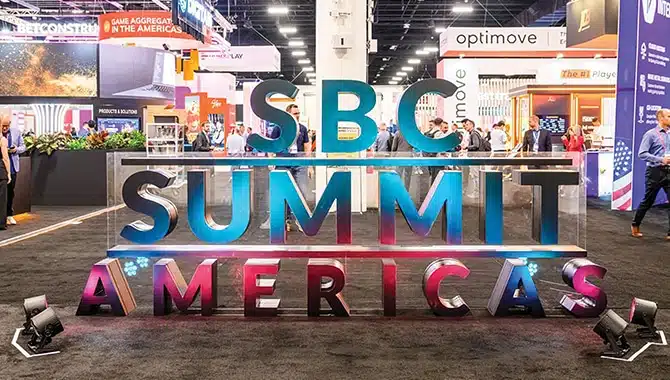
Having traveled to Fort Lauderdale, Florida for the SBC Summit Americas in May, Gaming America’s Kirk Geller recounts the most noteworthy topics discussed at the conference.
Transitioning away from New Jersey to the warmer climates of Fort Lauderdale for the first time, the SBC Summit Americas provided an increased look at the growth seen among LatAm markets and the polarizing state of prediction markets and sweepstakes. By way of various panels featuring executives from some of the most prominent companies in gaming, there was no shortage of expertise offered throughout the two-day conference.
A LatAm focus
Beginning on May 14, speakers such as Vixio Chief Analyst James Kilsby, Genius Sports VP of Brazil Guilherme Buso and Amusnet Brazil Manager Marco Pequeno touched on what companies looking to conduct business in the newly regulated Brazil market should expect for the remainder of 2025. Despite these past four months going by in what felt like “four minutes,” many applications have been passed since January 1 2025, when the country’s iGaming market officially went live under new regulations.
Operators with an interest in expanding their services to Brazil, especially those looking to partner with professional sports teams, had to “start from zero” due to legal challenges faced in the early going of 2025, building a “new marketing strategy” to find a presence within the country. The speakers made sure to properly warn foreign companies that Brazil is a “different animal,” and how extending olive branches such as contacting a local specialist could be the best way of entering the iGaming or sports betting market. “We do notice, since January, the game has changed. We’ve noticed how some practices needed to be altered, especially in sports betting. Prior to 2025, sports betting was something that was just expected, but the knowledge of bettors and players has changed in recent times,” Buso said.
“We are looking at the changes from operators in response to the high…competition occurring in the market, and that is important because the bettor needs to trust the industry and that no ‘yellow cards’ are being thrown around in regulation. The market needs to be proactive in building a relationship with the consumers that are being targeted in these practices.”

It was estimated during the panel that there are 293 applications still awaiting approval, and “many more” are expected throughout the remainder of 2025. Kilsby was unafraid to discuss the regulatory battles ahead for Brazil, and how illegal operators have already begun to make their presence known across the country.
“We studied almost all of the international markets that are regulated in gaming. The perfect solution for combatting regulation challenges does not exist,” Kilsby said. “This is very complicated and a very big challenge still. Illegal sites are finding advantages bypassing these regulations by offering bonuses and failing to pay tax, so a war has formed to keep these operators under control. It’s a common challenge found in Europe and the US as well, so we’re set up to see a real battle for regulation in these next few months.”
Issues with legality have also extended outside of the iGaming forms of gambling in Brazil, as concerns surrounding match-fixing and suspicious betting patterns have made themselves known in the past few months. In a new effort to strengthen the integrity of sports, however, the Brazilian Ministries of Sport and of Finance partnered with Sportradar on May 16 to launch specialized training focused on combating these threats to regulated forms of wagering.
Despite partnerships such as these, the Public Prosecutor’s Office of Rio Grande do Sul launched an investigation into Juventude footballer Ênio over suspicions of deliberate match-fixing on May 20, helping to exemplify how these issues have remained prevalent. Notably, the SBC Summit Americas in Florida made it clear that not only Brazil, but LatAm and its gaming industry as whole, would be a main focus in 2025 and beyond for the conference, as many of the panels featured Spanish or Portuguese speakers with live translation. With an entire section of the expo hall dedicated to LatAm gaming topics as well as the move to Florida, it would not come as a surprise if 2025 was just the beginning of LatAm markets being showcased on a grander scale.
iGaming in North America
Covering topics for iGaming in North America, executives from Resorts Digital, BetMGM Canada and High Roller spoke on the current state of the market on May 14, including the rapid expansion seen in Canada compared to growth carried out through the US.
High Roller SVP of Corporate Strategy & Investor Relations Seth Young discussed development seen in Ontario specifically, calling it the “most rapidly expanding market” over the past three years. The expansion has come as a surprise to Young, figuring regulations have been written by those “who may not understand the industry fully.”
Speaking on the future of verticals such as sweepstakes and prediction markets, Resorts Digital Gaming CEO Ed Andrewes believes states will “catch up” to the gaming types, and begin introducing legislation to properly regulate or ban operators conducting business. “If the assumption is that they will eventually regulate, you have to ask yourself how long will that take? I think sweepstakes will become regulated at some point, but I would never be able to give you an estimation as to when that would be,” Andrewes said. “In the past nine years, I have been continuously attempting to grab hold of an understanding for these new gaming types and how they would be regulated, but it’s difficult because of how each state has chosen to operate.”
Canadian Gaming Association President & CEO Paul Burns touched on how unregulated gaming has been around for 25 years, meaning sweepstakes “fails to stand out” despite the attention given to the vertical throughout 2025. Burns also said regulators need to adapt quicker with the constant threats of illegal operators looking to bypass regulation, having said, “You’ve chosen to do this, you’ve chosen to bring…
…this offering to players and residents and now you need to protect them.”
Calling the vertical a “very interesting” opportunity for the US, Young stressed that proper regulation would need to be set into place, but Adams had little issue suggesting prediction markets could be an offering BetMGM explores in the future, especially with how “exciting” Young made the opportunity appear during the panel.
Future of prediction markets
Prediction markets certainly took hold of everyone’s attention during the SBC Summit, with an entire panel having been assigned to the topic. It featured Sporttrade Founder & CEO Alex Kane, Jones Day Counsel David Aron and Wallach Legal Founder Daniel Wallach. The gaming type has not grown without controversy over the course of 2025, as regulators such as the Michigan Gaming Control Board (MGCB) began initiating investigations into unlicensed sports predictions markets operating throughout the state.
Michigan’s investigations align with similar actions already taken by other state regulatory bodies, such as Nevada, New Jersey, Connecticut and Ohio, while focusing on how this form of unlicensed offering may jeopardize the integrity of the state’s legal sports betting system.
“We take consumer protection very seriously and are committed to ensuring Michigan residents are engaging with safe and legal sports betting options,” MGCB Executive Director Henry Williams said. “Unlicensed entities not only pose a risk to consumers but also undercut the integrity and revenue-generating potential of the state’s regulated sports betting industry. We are actively investigating these practices and will pursue appropriate measures to protect Michigan bettors.”
The concern over proper regulation has not stopped operators such as Flutter or Kane’s Sporttrade from expressing interest in developing prediction market operations, as CEO Peter Jackson confirmed Flutter is monitoring the development of such activity during a Q1 2025 earnings call on May 9. Kane argued that Sporttrade has already been in the prediction market business for quite some time, saying the operator sent a letter to the Commodities Futures Trading Commission (CFTC) to apply for no action relief.
The panel seemed to have been affected by the Florida heat when Wallach became quite passionate in his argument as to why these markets should still be deemed illegal. Wallach went on to state there is “no congressional authorization” for sports event contracts, and that regulators and operators need to “take a step back” and realize why legislation such as PASPA specifically highlighted these offerings as illegal.
“At best what Kalshi is doing today is gaslighting. At worst they are committing a fraud on the courts by saying congress would allow this,” Wallach said. “Now, nine months later, they are denying all of these things. They’ve run up a two-court winning streak because I don’t believe attorney generals are properly fighting back against these offerings. If these things are bets or wagers, Kalshi will eventually lose the battle in the third circuit or somewhere down the road.”
Aron referred to the CFTC raising concerns about a potential deal with the…National Football League (NFL) where sports contracts could be exchanged, believing it would be “anti-competitive” to allow sportsbook operators to exchange sports contracts on the open market.

“There was no guidance Congress ever gave the CFTC to accurately describe the operation of these offerings, and therefore the CFTC never went along with approving these deals with the NFL,” Aron said.
“There was also no proper description of how these contracts could affect the public from a gambling or commercial standpoint.” Kane shared his belief that people follow what legal representatives such as Wallach and Aron say and see sports events contracts as a major threat, whereas what is currently being offered is “very, very, very different” than the concerns raised by regulators.
“We’re 100x off from what sports betting and sports event contracts are currently being offered. The only thing that is similar is you are risking money, and it involves sports,” Kane said. “It’s very different than if I go on DraftKings and say ‘I want this leg or that leg,’ but an exchange promotes one big juicy parlay that can be offered at various prices due to the competition in which operator is offering the best odds.”
Affiliate point of view
The conversation surrounding prediction markets would expand into the affiliate space as well at SBC Fort Lauderdale, as Catena Media CEO Manuel Stan, Vault Sports CEO Caleb Dykema and Media Troopers Business Development Officer Jonathan Sprung had the chance to speak on how their companies are adapting to the recently introduced gaming type. Sprung had no issue mentioning “prediction markets” at least 25 times throughout the 45-minute discussion, finding no shortage of opportunity to remind the audience how quickly the vertical is growing.
“Another thing that we have to mention is every time we go to a conference here, we’re talking about the next type of iGaming product. It was a sportsbook and then it was DFS and DFS 2.0, and then we’re talking sweeps. Now we’re talking about prediction markets, so it’s always shifting,” Sprung said.
“If you say, ‘hey, I’ve got this figured out,’ you are way behind and you’re missing out on what could potentially be the next big thing, which is prediction markets. Prediction markets… prediction markets.”
Dykema chose to shift the conversation towards how affiliates continue to market to consumers as the gaming industry expands so rapidly, highlighting a new focus on retaining loyal consumer bases as compared to building an engaging product from the get go.
“What we’re seeing is in terms of attacking that angle is diversifying through different channels, whether that’s a YouTube show where a player comes back day after day or week after week to see their favorite creator talk about sports, get their picks, get their analysis, that kind of thing. It’s channels like that where we’re finding they’re re-engaging and building a community of retention,” Dykema said.
While Sprung once again made his point known on how traditional advertising formats such as top lists and SEO “are not dead,” he did agree with Dykema on how engaging with influencers can be a way of opening new retention channels, as long as the criteria fits the personality.
“You can’t say, ‘oh, I’m just going to take six different operators and try it for each influencer.’ They have to connect with that brand. Every influencer can’t go, ‘I’m going to try everything and see what works,” Sprung commented.
“They have to go, ‘I’m already talking about DFS, let me work with the DFS brand that aligns with what my followers want’ and then potentially add in one or two from there. But you’re not going to go to a casino influencer and say ‘you should really talk about blackjack’ if all they do is talk about slots. You’re not gonna pigeonhole these people and influencers are crazy people.”
When breaching the topic of influencers, Stan compared the panel speakers to “dinosaurs” trying to attract customers the same way a yellow taxi cab would in New York or a hotel reaching out to potential guests. Referring to influencers as the “Ubers” or “Air BnBs” of the affiliate industry, Stan believes these content creators are similar to the companies each speaker represents, in that all are just attempting to find ways of “providing value and monetize” consumer activity.
Closing remarks
Throughout the SBC Summit Americas, and even dating back to the Indian Gaming Association (IGA) conference in San Diego which Gaming America was also able to attend, it’s been made clear there is a shift forthcoming within gaming. Whether from a regulatory space or in the iGaming scene across multiple countries, there is no shortage of opportunity and possible risk, presenting itself to operators, affiliates and suppliers alike.
Getting the chance to sit in on discussions with the executives directly involved with these new avenues of growth help to showcase how even top-level voices struggle to understand the complexity of verticals offered between iGaming and sports betting. In a space that has increasingly become “learn as you go,” there is no telling the pace at which companies will hedge potential risk to create enhanced revenue sources.
Players trust our reporting due to our commitment to unbiased and professional evaluations of the iGaming sector. We track hundreds of platforms and industry updates daily to ensure our news feed and leaderboards reflect the most recent market shifts. With nearly two decades of experience within iGaming, our team provides a wealth of expert knowledge. This long-standing expertise enables us to deliver thorough, reliable news and guidance to our readers.
Latest News