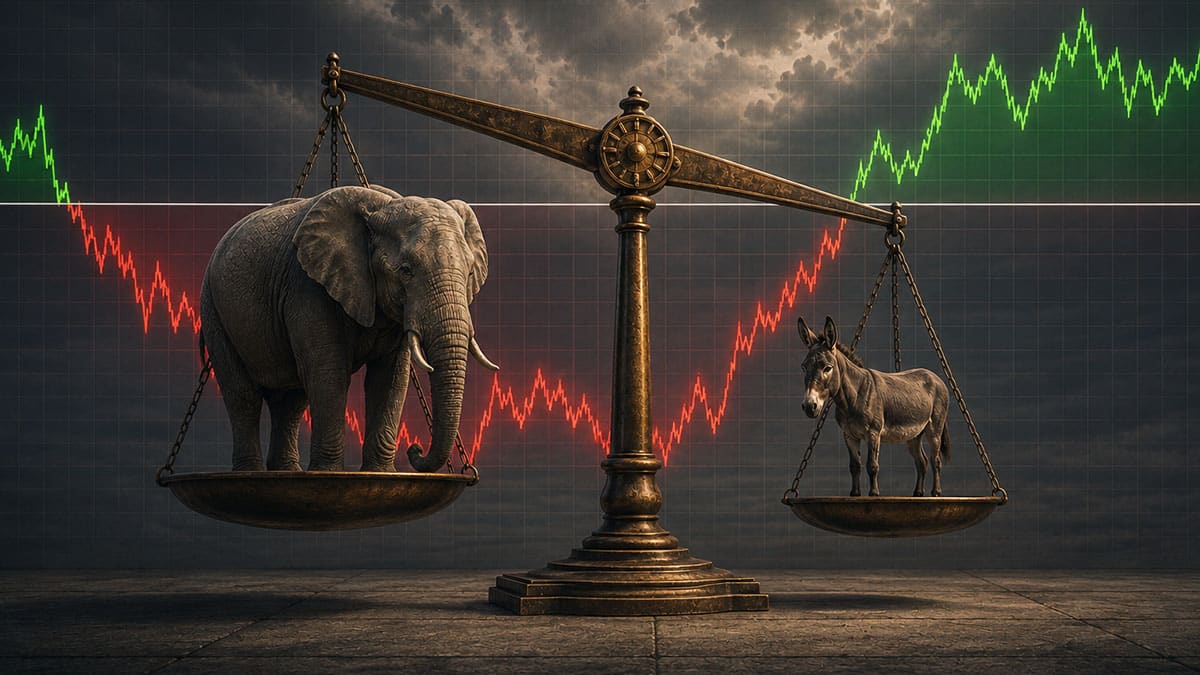
The ‘Citrini Scenario’ Has Become One of Kalshi’s Hottest Non-Sports Markets. But What Is It?

The Citrini Scenario, a viral research piece imagining an AI-driven economic collapse by 2028, has become one of Kalshi’s most actively traded non-sports markets.
Most of the attention around prediction markets has focused on sports contracts and their legal battles. But one of Kalshi’s most actively traded markets right now has nothing to do with a game. It is a bet on whether the American economy will collapse under the weight of artificial intelligence. It trades over $1 million in daily volume. And it has already attracted more than $15 million in total trades.
To understand why, you need to understand the Citrini Scenario.
What the Report Actually Said
On February 22, Citrini Research and co-author Alap Shah published a piece titled “The 2028 Global Intelligence Crisis.” It was written as a fictional macro memo from the perspective of June 2028, imagining the progression and fallout of an AI-driven economic crisis. The authors were explicit: “What follows is a scenario, not a prediction. This isn’t bear porn or AI doomer fan-fiction.”
The market read it as a prediction anyway.
The piece garnered approximately 16 million views on X, triggered real market selloffs in software and SaaS stocks, earned its own Wikipedia page, and drew a full-length institutional rebuttal from Citadel Securities. Jack Dorsey announced a 40% reduction in Block’s workforce the same week, writing that “intelligence tools have changed what it means to build and run a company.” It was the kind of real-world event that makes a speculative scenario feel suddenly less speculative.
The core of the Citrini scenario is a feedback loop. AI gets better and cheaper. Companies replace white-collar workers to protect margins. Displaced workers spend less. Companies that sell things to consumers sell fewer of them. They respond by investing more in AI. The loop repeats with no natural brake. At its center is the concept of “Ghost GDP”: economic output that benefits the owners of computing power but never circulates through the human consumer economy. The top 10% of earners account for more than 50% of all consumer spending in the United States. If that cohort is the one losing jobs, the consumer economy does not just slow down. It collapses.
How Kalshi Turned It Into a Market
For Kalshi’s market to resolve “yes,” three of five conditions must occur before July 2028: unemployment exceeding 10%, the S&P 500 declining more than 30% from its issuance level, the Zillow Home Value Index falling more than 10% year-over-year in at least one major city, labor’s share of gross domestic income falling below 50% in any quarter, or CPI falling below 0% in any monthly release.
These are not subtle thresholds. They describe a catastrophic economic dislocation. Three of five of those conditions firing simultaneously would represent a crisis with few historical precedents.
When the market opened last month, traders priced the chances at roughly one in ten. They now price it at over 30%, or nearly one in three. That repricing is itself the story. The macro environment has shifted in ways that are making more traders treat a scenario the authors labeled speculative fiction as a live risk.
Why the Volume Is So High
The easy explanation is momentum. The Citrini report went viral. The market opened. People piled in because everyone else was. One Kalshi user summed it up bluntly: “Just find the right time to cash out.” That kind of reflexive trading is real, and it almost certainly accounts for a portion of the volume.
But there is another explanation that is harder to dismiss, and it is the one that makes this market genuinely interesting from a policy perspective.
Prediction market critics have long argued that the “economic value” case for event contracts is largely fictional. The original justification for these markets, the reason the CFTC regulates them as financial instruments rather than gambling products, is that they allow participants to hedge against real-world risks. A farmer can hedge against crop prices. A business can hedge against interest rate movements. The market aggregates distributed information and produces a price signal that reflects genuine uncertainty.
Sports betting markets mostly do not work this way. Nobody hedges their business risk by betting on the Chiefs to cover the spread. The hedging argument in that context is economic window dressing.
The Citrini market is different. Consider who is actually trading it. Tech workers who are genuinely worried about AI displacing their jobs. Investors with significant equity portfolios who are watching the S&P and wondering how much of the AI bull case is already priced in. People who hold mortgages in San Francisco or New York and are aware that a 10% decline in urban home values is one of the trigger conditions. For these participants, a position on the Citrini scenario is not purely speculative. It is a hedge. If the scenario materializes, the payout partially offsets losses occurring in the rest of their financial life. That is exactly the economic function that justifies event contracts as financial instruments rather than bets.
There is also a structural observation worth noting. In extreme doom scenarios, the “yes” side has less liquidity precisely because if the S&P 500 actually drops 30% and unemployment hits 10%, most traders have bigger problems than checking their Kalshi balance. This creates an asymmetry. The payout in a world where the scenario resolves “yes” might be less valuable than it appears, because you are collecting it during an economic collapse. The “no” side, by contrast, pays out in a world where everything is broadly fine. That asymmetry shapes who is trading and why.
What the Odds Actually Tell Us
A market pricing the Citrini scenario at 30% is not a forecast. It is a measure of uncertainty. Kalshi markets on OpenAI, achieving Artificial General Intelligence before 2030, currently sit at 53%. Neither number should be read as a prediction that the event will happen. They should be read as the collective assessment of people putting real money behind their views.
Economist Claudia Sahm has argued that job losses of the magnitude described in the Citrini scenario would almost certainly force a strong policy response, and that the Federal Reserve’s standard toolkit would be deployed well before conditions reached that severity. That is the bear case against the bear case: the system has circuit breakers.
But the circuit breakers did not prevent the market from moving from 10% to 30% within weeks. Something in the broader economic environment, rising unemployment, a falling S&P, geopolitical stress, and a string of high-profile AI-driven layoffs, has convinced a significant pool of sophisticated traders that the scenario the Citrini authors called “relatively underexplored” deserves to be priced higher.
Whether they are right or wrong, the market exists, it is liquid, and it is growing. That is the prediction market functioning at something close to its stated purpose: aggregating dispersed information about a genuine economic risk and producing a price that anyone can observe and trade against. The fact that it started as a Substack post and ended up as a $15 million financial market is, depending on your perspective, either a remarkable demonstration of information efficiency or a cautionary tale about the distance between a scenario and a forecast.
The authors said it themselves: it is a scenario, not a prediction. The market did not listen.
Players trust our reporting due to our commitment to unbiased and professional evaluations of the iGaming sector. We track hundreds of platforms and industry updates daily to ensure our news feed and leaderboards reflect the most recent market shifts. With nearly two decades of experience within iGaming, our team provides a wealth of expert knowledge. This long-standing expertise enables us to deliver thorough, reliable news and guidance to our readers.
Latest News