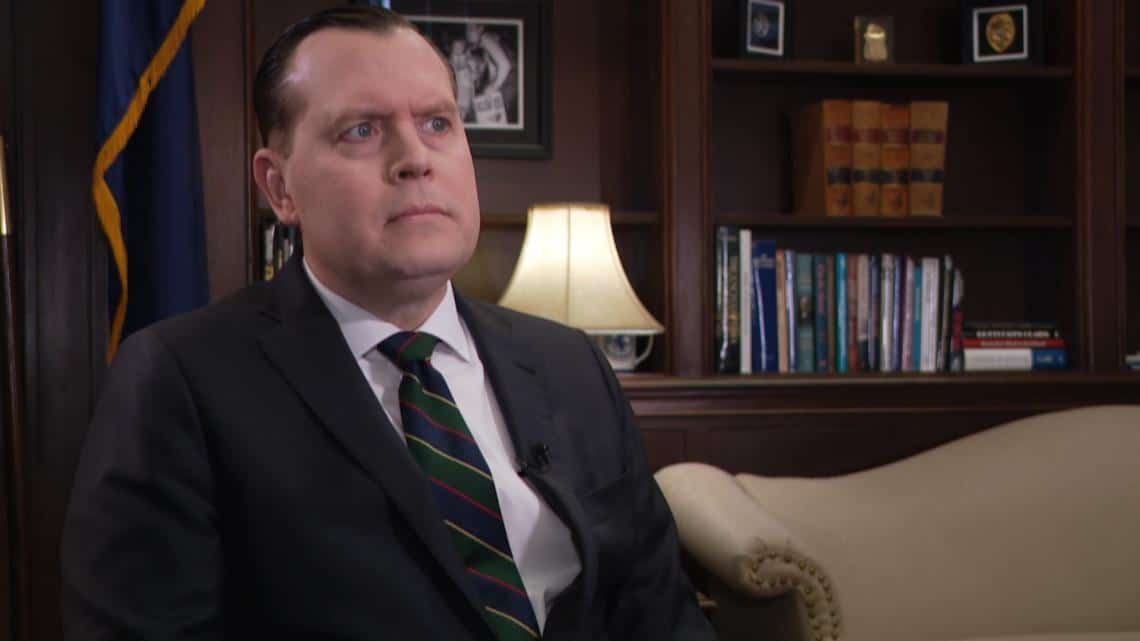
CEO Special: Mike Dreitzer – Regulated optimism

Gaming America’s Kirk Geller shares the story of NGCB Chairman Mike Dreitzer, whose gaming industry experience covers both sides of the constant tug of war between regulators and suppliers.
Across the average span of one’s career in gaming, it’s rare to find an executive, or any level of position really, who is on both sides of the regulatory compass throughout their journey. The constant interplay between regulators, operators and suppliers extends far beyond evolutionary moments such as the legalization of online gambling in 2013, or the overturning of the Professional and Amateur Sports Protection Act (PASPA) in 2018.
For Nevada Gaming Control Board (NGCB) Chairman Mike Dreitzer, these elements have been career ever-presents, starting at the very beginning of his path in the state’s Attorney General’s Office from 1996-1999, where he served as Deputy Attorney General under Frankie Sue Del Papa, the first-ever woman to be elected to the position in Nevada. Dreitzer’s experience would eventually take him through various roles with companies such as Global Gaming Group, BMM Test Labs, Ainsworth Game Technology and Gaming Arts, before finding his way back to the regulatory side, following the resignation of former NGCB Chairman Kirk Hendrick in January 2025.
Brooklyn born
Prior to his first position with the Nevada Attorney General’s Office, however, Dreitzer grew up in Brooklyn, New York, discovering the business-first mindset of the city that never sleeps.
“I grew up in a little neighborhood called Canarsie back in the 1980s and it was a great place to grow up. I’ve lived in Southern Nevada for 31 years now, but obviously I still have roots in New York and there’s still a part of me that loves New York. Interestingly, my older son lives in Brooklyn and it’s an entirely different place than what I left, but I had a great upbringing, good values and I’m proud to have grown up in New York,” Dreitzer shares with Gaming America.
“We were in Brooklyn, which was a little bit less hustle and bustle than Manhattan, but we would always take the L train from Canarsie into the city where I worked for various summers. Obviously the city has a rhythm and an energy which is unparalleled, so I always have a special place in my heart for that as well.”
When discussing the early lessons provided by his New York upbringing, Dreitzer highlights the authenticity and blooming curiosity handed down to him by his mother and father. He says, “Hard work was always important, something my parents taught me, as was the need to constantly be curious to learn and grow from that learning. They also taught me to be honest, humble and do my best at all times.”
Hog wild
Dreitzer would use the ideology to land a scholarship at Cornell University, further assisted by in-state tuition which helped the future gaming executive pursue a career in agricultural economics. From learning how to show pigs to interning at the Economic Research Service within the US Department of Agriculture, Dreitzer was gaining no shortage of firsthand experience in the field.
His work included clipping pigs’ nails and cleaning stalls at agricultural competitions, all the way to eventually receiving accreditation in a published research journal on the substitutability of inputs for crop yield. After these experiences, Dreitzer applied to Emory University School of Law in Atlanta, Georgia.
“I graduated from school in 1991 and after the winters in upstate New York, I thought Emory in Atlanta would be a good change. That was a big culture shift going from New York to Georgia at a time that was actually pre-Olympics, and I think Atlanta in some ways defines itself pre and post-Olympics. They were still creating a lot of the highway system and infrastructure in the early 1990s,” Dreitzer explains. “Atlanta has a very strong sense of US history and I definitely respected it and enjoyed learning about it.”
Throughout his years studying at Emory, Dreitzer would also receive the opportunity to study abroad in the Netherlands, where he learned about subjects such as aviation law, the differing legal systems in Europe as compared to the US and the experience of watching Super Bowl XXVII at the US Embassy in the Hague.
Following law school, a traditional legal career had little appeal for the former pig showman. Settled in a Washington DC market where “one-in-10” people were lawyers, Dreitzer instead found greater opportunity in Las Vegas, Nevada, where his future awaited.
The Wild West
“I moved to DC thinking I’ll be a government lawyer. I was a research assistant for a professor named Fred McChesney who had a lot of background with the FTC (Federal Trade Commission). I wanted to become a government lawyer, work for the FTC and do something in that space, but at the time one in 10 people in DC were lawyers. So I said, ‘hmmm, this might not be for me’ and the city just seemed overly structured,” Dreitzer says.
“So I had an opportunity to come out to southern Nevada, this was around Christmas of 1994, and I just loved it. I found that Nevadans were and still are very hard-working folks, and if you worked hard, were curious and got involved, you could both do well and do good at the same time.”
Dreitzer continues: “In 1996, the Attorney General at the time was Frankie Sue Del Papa. WhenI got there, I originally represented the Child and Family Services before moving over to the Nevada Gaming Control Board and the Nevada Gaming Commission. The NGCB Chairman was a man named Bill Bible, who had been just a real force within gaming regulation. It made a great impression on me to watch him and how it all happened, so I was hooked right away and have been involved in gaming ever since.”

Joining the Attorney General’s Office also provided Dreitzer with his first opportunity to be seen within the gaming industry, particularly after – respectfully – voicing his opinion during a meeting regarding a high-profile case. While not many young attorneys would risk disagreeing with more seasoned legal executives, the risk eventually paid off for Dreitzer, having gained recognition from the NGCB Chairman himself.
“I was assigned a case that was pretty high profile, and it was an investigation into something a licensee had done. They (the licensee) had a well-known attorney and I remember sitting down in a meeting talking about some of the details of the case and the attorney on the other side said what he had to say. I just said, ‘I respectfully disagree’ and, at the time, it was hard for somebody to potentially speak up like that and I did,” Dreitzer recalls.
“It turns out that I was right and the Chairman at the time said, ‘wow, good for you,’ kind of thing and I remember he called me afterward that evening and said, ‘you did good.’ At that moment I started to feel as if I had made my mark a little.”
The lessons shared with Dreitzer throughout his time spent with the Attorney General’s Office have stuck with the current NGCB Chairman, especially in his first few months since being appointed. Believing each member of the NGCB “stands on the shoulders of those who came before us,” Dreitzer recalls watching Nevada grow into the dominant market force it continues to represent in 2025. For years, Dreitzer had the chance to develop a more crucial understanding of the complex relationship between regulators and operators, as well as the “careful balance” of establishing a strong gambling industry.
Crossing over
For my first job after the Attorney General’s office, I had an opportunity to work for Progressive Gaming. I jumped in as Executive Director of Compliance and Associate General Counsel, so I was also able to do some of the legal work and by that I mean the transactional contracts, things of that nature,” Dreitzer said. “I’ve always enjoyed working in a regulatory environment. I’ve always had a good instinct for it. I feel as though I understood the importance of regulation and what regulators were looking for.”
Due to his work with the Attorney General’s Office in Nevada, Dreitzer had the experience necessary to obtain the trust of suppliers and operators, for what each respective company required out of new regulation. Gaining the “credibility and perspective” to show regulators he understood both sides of the gaming industry coin, Dreitzer would then move on to his first experience growing a company from the ground up, being part of the original team at Global Gaming Group.
“I had an opportunity to be a Founder of a company, which was interesting to me because, with Global Gaming Group, I was intrigued by not only regulation, but also business development. Being a Founder, you have to wear many hats, so I really enjoyed that aspect of being on the ground floor, wearing all these hats and needing to do many things for the business to succeed,” Dreitzer commented.
“Global Gaming Group was one of the first third-party game design studios; we were part of the early trend where we designed games for companies. Now third-party studios are quite common but, in the early days it was us and a few other ones, and I really enjoyed that type of space.”
Taking ownership of the mainstream
Claiming the Co-Founder and COO positions with Global Gaming Group also provided Dreitzer with the responsibilities of leadership and “getting the best” out of a team, even if the company resembled more of a “mom-and-pop shop” than the larger suppliers he would come to work with. The roles offered Dreitzer a “step towards learning how to be a leader” as well as the issues that can’t be replicated in a school environment. Not only that, but the executive also began to understand the importance of recognizing various strengths within one’s team, as Dreitzer utilized the creativity of others to help bridge the gap between design and regulation.
Dreitzer looks back: “We had to learn to work together and there was a recognition that we each had our own set of strengths, and would focus on the areas of the business that made sense. I wasn’t going to tell people how to draw a symbol and they weren’t going to tell me how to set up a deal or do something on the business side; so it worked in that way for several years.”
After spending six years helping to grow Global Gaming Group, Dreitzer decided to step back into what he described as the “mainstream” sector of the gaming industry, conversing with BMM Testlabs CEO Martin Storm about taking over the COO position. Storm had an interest in bringing Dreitzer on board as the company continued to develop its US presence, even opening a new office during the two-year run Dreitzer subsequently spent with BMM Testlabs. Dreitzer found himself responsible for both the company’s North and South American offices, slowly gaining knowledge of running a gambling testlab. Confronted with “something different” in his career yet again, Dreitzer found enjoyment in the innovation and perspective of entering a new space within gaming.
“It was sort of natural. I understood the environment. I didn’t get frustrated or overwhelmed by it, because I had been in a regulatory environment my whole career, so it was just another example of that.
“I was more on the product side, learning to manage, among other things, people who were doing test scripts and testing devices, but all within a regulatory context. As I said, one of the themes of my career has been understanding, respecting and being really effective at working in regulated environments – and that was no different.”
After his two years with BMM Testlabs, Dreitzer received a call from former Ainsworth Game Technology CEO Danny Gladstone, who was searching for the right fit to become President of the supplier’s North America operations in 2013. Despite having found new enjoyment in working within gaming testlabs, Dreitzer knew it was time for him to return to his “core passion” and delve further into the mainstream sector of gaming manufacturing.
Not only did Dreitzer find himself at the forefront of one of the industry’s fastest-rising companies, he also became acquainted with an “absolute legend” in Len Ainsworth, who he quickly realized was one of the most optimistic figures he would ever come across.
Glass half full
“I think, looking back, that’s a really important trait for our longevity and life outlook. He would always say, whatever the initiative was, ‘we’ll either go to success or oblivion, and we’ll just deal with that.’ He was always very optimistic about what was to come. You look at a guy like Len, he founded Aristocrat based upon dental equipment from his dad’s shop and then he left Aristocrat because he had a (cancer) diagnosis. I believe as the legend goes he outlived the doctor that gave him the diagnosis, and still founded Ainsworth,” Dreitzer recalled.
“Len Ainsworth has had his share of success and failure in Australia and the US, but he’s always been very optimistic and very forward-looking. In fact, many of the people I’ve been fortunate to know who lived into their 90s and even their 100s, the common trait is optimism and a teflon personality in a way. They don’t let anything overly affect them. They just deal with what they’ve got to deal with and keep going.”
Throughout his tenure with Ainsworth, Dreitzer played a part in numerous milestones for the supplier, including its shift into online gaming, the opening of its 291,000 sq ft North American headquarters in Las Vegas in 2016, and Novomatic AG’s acquisition of a majority stake in Ainsworth (with more shares being acquired by Novomatic this year).
“I remember when we were going to build the new office, the question was how big we were going to build it. I had suggested something more conservative, but Len and Danny pretty much said, ‘no, we’re building bigger,’” Dreitzer says. “He wanted a big building with a big red ‘A’ on the top as a real homage to stamping his flag in the US, so he ended up building a 300,000 sq ft office there which was, at the time, well in excess of what we needed. But that was what Len wanted so he made it happen.”
Building the base
In 2018, Dreitzer began having conversations with Gaming Arts Founder and Chairman David Colvin, who shared a similar optimistic trait that Dreitzer was quickly finding to be typical among the most creative minds across the industry. As President, and eventually CEO, of Gaming Arts, Dreitzer found himself with the familiar scene of building a company from the ground up. Commenting on the importance of “optimism and curiosity,” Dreitzer explained how those beliefs were quickly challenged by the emergence of Covid-19 in 2020, even though Gaming Arts used the shutdown period to develop a budding portfolio.
“In 2018 and then 2019, to say it was a mature industry is, and was, a huge understatement. You had your giants that had been developed and found great success, so we started off as a little platform with a couple of games, a little team of really dedicated and talented game designers and engineers. We had a Nevada license, built it up to 150 licenses across commercial jurisdictions and Tribes and put out our first game in 2019. We thought to ourselves, ‘okay this is good, we’re starting strong and things are going well,’ and then Covid-19 just slammed us,” Dreitzer recalls.
“Covid, of course, was super hard. My fear was that if we closed the doors, we would go away forever and wouldn’t get remembered because we’d just get washed away. To his great credit, David Colvin supported me and kept the doors open; we actually took the Covid period to catch up a little bit and build games, which was great. When Covid ended, we were able to come back stronger with more titles and more products, because one of the problems with the small companies is that you can only make so many games. These larger companies may create 400 games a year, but we were making four or six, so it became an opportunity to build out our portfolio.”
Despite creating more han most suppliers of comparable size were developing at the time, the goal was still to just “get a game or two on the floor that work,” due to a failure rate Dreitzer estimated was around 80-90% for suppliers. While not utilizing what Dreitzer described as a “great strategy” to build its presence in the market, Gaming Arts found successes with multiple products in the post-Covid recovery period, but the opportunity for non-organic growth could be felt by the leadership team.
Having begun conversations with potential partners that stalled prior to the Covid-19 shutdown, Dreitzer resumed talks with Germany-based company Merkur Group and its subsidiary, Merkur Gaming. The developer entered into a strategic cooperation agreement with Gaming Arts in October 2023, signaling its intention to become a direct supplier in North America. Fast forwarding to May 2025, the Nevada Gaming Commission approved a gaming license for Merkur Gaming, paving the way for its acquisition of Gaming Arts, which is expected to be completed in the third quarter of 2025.
“We won’t be IGT or Scientific Games, but we want to be a supplier in a robust niche market in the US. We don’t intend to operate B2C in the US. We want to stay in the B2B business. In the medium and long term, we see opportunities to provide games in the online space. Gaming Arts is trying online games, which are successful, in addition to the land-based,” Merkur Group Board Chairman and CFO Lars Felderhoff said during the hearing. “The content is great, but is different from what we have back home in Europe. We want to leverage all of the assets of Gaming Arts in other markets outside the US.”
Dreitzer shared his view of the transaction as well, having taken over the CEO role for Gaming Arts in April 2021. “A lot of times when you’re in a small company, you’re frankly in survival mode. We’re just trying to get the platform to be stable so it can perform well and consistently across all jurisdictions. And just getting some games that would go out and be accepted by our customers, so not necessarily a strategy of trying to figure out where we fit in or what sort of games we should make.
“The first few years of Gaming Arts was about making new and different products, and that was hard because the market didn’t really have an appetite for new games. We were unique and being unique is hard, and can cause a lot of failure, because players just aren’t used to this sort of game. While we were trying to figure all that out, ultimately the last couple of years it became about doing more and more integration with Merkur. Cash flow was a challenge because if you put a game out and don’t get paid right away, it will create problems you can’t even begin to understand. Merkur represented a perfect marriage and I’m proud of what we were able to accomplish. I can’t wait to see what they’ll do in the future.”
Years in the making
After just over seven years serving with Gaming Arts as President and CEO, Dreitzer had no plans to depart from the gaming supplier, wanting to build upon the agreement formed with Merkur in 2025 and beyond. In January 2025, however, former NGCB Chairman Kirk Hendrick announced his resignation from the Board following a 120-day legislative session, despite having been appointed to a four-year term by Nevada Governor Joe Lombardo in 2023.
Representing the “only position” Dreitzer would consider leaving Gaming Arts for, he quickly expressed interest in succeeding Hendrick as Chairman. Dreitzer viewed becoming NGCB Chairman as a “magical” moment, providing the executive with plenty of opportunity to “give back” to the state in which he had built his career.
“I had an opportunity to meet with the Governor and we talked about continuing to do the work Kirk had begun, streamlining regulation, bringing up the Board on more current regulation. Because the work never ends, you just have to always try and get better and better,” Dreitzer says.
“Having been there for over a month now, we are continuing to streamline regulation and modernize the Board. Our team is here to regulate gaming and protect the public while making things safe and collecting critical tax revenue on behalf of the state.”
With Dreitzer back on the regulators’ side of the business, he continues to form a “unique perspective” in his efforts to contribute to a mature Nevada gaming environment. Despite having gained over 25 years of experience working with regulators, operators and suppliers, Dreitzer still found himself undergoing a crash course in regulation after taking on the NGCB Chairman role.
“The term that commonly comes up these days is drinking through a fire hose, because there’s so much information and frankly it’s so different from what I’ve been doing. I’ve had to learn and learn… and learn and learn, I’m curious about everything. I literally am so blessed to be able to learn all of these fascinating things about our industry. I’m starting to get more comfortable in terms of decision making, what makes sense and what’s good policy, but I rely greatly on this tremendous staff. I couldn’t do it without them – and it’s all starting to slow down for me and make sense.”
Modernized approach
Dreitzer also shared that licensees in Nevada should expect regulations that are “consistently applied and predictable,” as the NGCB continues to modernize its approach to safeguarding one of the largest industries in Nevada.
“I just want to leave the Control Board a little better than I found it and it’s truly that simple,” Dreitzer explains. “There are so many lessons I take from the great people I’ve worked with along the way. I really think I’ve developed a specific leadership style that is accountable and authentic. I’m just trying to do my best to support this great group of professionals here at the Nevada gaming Control Board now that my career has led me to this point. I’m super grateful to be here, and I’m going to do what I can to work with this great team to make a lasting impact. And I think if you can do something with your time where you leave a mark for those who come after you, then there’s nothing better than that.”
With optimism, curiosity and authenticity, Dreitzer plans to enter this new stage of his career with an open mindset, and the desire to learn about the regulation that has helped Las Vegas and Nevada as a whole grow into the capital of gaming. Following in the footsteps of incredible leaders before him, the near 30-year gaming veteran will now be looked upon to help usher in the next evolution of this vast industry.
Players trust our reporting due to our commitment to unbiased and professional evaluations of the iGaming sector. We track hundreds of platforms and industry updates daily to ensure our news feed and leaderboards reflect the most recent market shifts. With nearly two decades of experience within iGaming, our team provides a wealth of expert knowledge. This long-standing expertise enables us to deliver thorough, reliable news and guidance to our readers.
Latest News