CEO Special: Stephanie Bryan – Agree to disagree, respectfully

As the only federally recognized Tribe in Alabama, Poarch Band of Creek Indians Tribal Chair and CEO Stephanie Bryan discusses her path to leading the organization with Gaming America.
In the early history of the Poarch Band of Creek Indians Tribe, various members would recall the struggles of having to persevere through poverty-stricken conditions while attempting to gain federal recognition from the United States Government. From land battles throughout the 1800s to discriminatory treatment, the Tribe relied on faith and an early focus toward education to continue nurturing the strength and resilience which had already persisted for well over 200 years.
Despite the hardships faced by Tribal Citizens prior to finally obtaining federal recognition from the US in 1984, Poarch Band of Creek Indians Chairwoman and CEO Stephanie Bryan recalls how “strong family and love” provided a sense of wealth “money could never buy” in her early childhood years.
The richest possession
“We really didn’t have much growing up, but I often tell people we had the most important thing money could never buy and that was love. We were a really close-knit community, sharing food, working in the garden with my uncle. Growing up in that community and not having much but love and a strong faith, those morals and values that were instilled makes me the person that I am today. Even though I was made fun of a lot of times in school as a little girl from Poarch, Alabama who didn’t have much, little did they know I had a lot,” Bryan tells Gaming America.
“My parents always said ‘agree to disagree, respectfully’ and I think that’s what the problem is in America today. It’s hard for people to agree to disagree respectfully. I have truly watched the community go from poverty to prosperity, but we’re still humble people and we’ll never forget where we have come from. The powwow ground was right next to my home, we would all be out there playing stickball or kickball all day. Other people had televisions or phones, a lot of times we didn’t have those types of things in our community. But that’s what made all of us have such a close bond to one another as a strong family.”

Bryan also recalled memories of learning the Tribe’s traditional dance to helping cook fried chicken that would raise money to send then-Head of Council Calvin McGhee to Washington DC, so he could lobby for their federal recognition. These same values and lessons passed down are the same reasons her grandmother always reminded Bryan to “never be ashamed” of her origins.
Even while employing just “three or four” members within the Tribal office in the early days of seeking recognition, Bryan slowly gained an understanding of what sovereignty meant not only to Poarch Creek, but through Indian country. The same girl who was too shy to take the stage after winning a Poarch Creek princess competition would start working for the Tribe as a teenager – and continued even through her early adulthood while balancing her studies in school and as a young mother.
First and foremost
Bryan worked to initiate grants within the Tribe that allowed numerous children, as well as her own, to receive quality daycare while mothers and fathers worked to better the environment. When Poarch Creek was officially recognized by the US in 1984, Bryan’s maiden name, “Abney,” would see her become the first-ever member listed for the Tribe, including being given roll number 0001.
“We worked out of these little modular buildings. Then I worked in our housing department and we received funding from the Federal Government for farmers home grants, where we were able to go in and work on some of the elder’s homes because, even when I was growing up, you could see the dirt through the floor slats of each home. Like I said we didn’t have much, but we thought we had everything because we had family who truly loved us,” Bryan says.
“At one time I was working two to three jobs, going to college and balancing being a single mom. I lived in one of our very first rental housing units that was funded through HUD’s Dollars Homes. I was raised by very strong women and ‘quit’ was not in our vocabulary. We had a really strong support group in the community wanting all of us to succeed and it was very inspiring for me.”
After graduating, Bryan began to work in insurance, finding stable success while keeping an eye on the continued development of her community once recognition had been earned. Following an unfortunate medical incident suffered by her uncle, who had served for nearly 28 years with Poarch Creek, the future Tribal Chair & CEO began her political career within the Tribe by seeking a leadership role in 2006.

As luck may have it
Since the position required just two meetings per month, Bryan foresaw little issue in balancing her insurance career with the new responsibilities… that is until a group of Tribal Council Members nominated her to become Vice Chair of Poarch Creek, of course. Despite the worry of obtaining a full-time position with Poarch Creek while also managing an insurance career, Bryan seemingly let fate decide her new course in life, as the old saying “tails never fails” proved true once again for the impending Tribal leader.
“Some of the leaders came to me and said, ‘Stephanie, we’re going to nominate you for the Vice Chair position,’ and I said, ‘oh no, I was just elected, you can’t do that,’ but they did… and I was clueless. I didn’t know how to decline a nomination,” Bryan explains. “It was a tie between me and another individual, and our constitution stated that, if it’s a tie after four votes, we would flip a coin. He called heads, it was tails and that’s how I became the Vice Chair of the Tribe and really how I got involved in Tribal leadership.”
From there, Bryan began entering the world of not only Tribal politics, but gaming as well, given the Vice Chair position for Poarch Creek also served as Chair of the Poarch Creek’s Gaming Commission, working directly with organizations such as the National Indian Gaming Commission (NIGC). While Poarch Creek’s gaming enterprises at the time extended to just “smoke-filled modular trailers” with bingo machines, Bryan still found herself staying up until the early morning each day acting as a “sponge” building gaming knowledge and learning terminology.
Even at the start of her political career when Bryan would find herself with a “deer in the headlights” view of what sovereignty and the legal aspects of Tribal gaming meant for her community, she managed to persevere through an adaptable personality. When her term as Vice Chair had run its course in 2009 and she was up for re-election, the Tribe surprised Bryan once again, choosing to continue her appointment over fellow members that carried 30-40 years of experience.
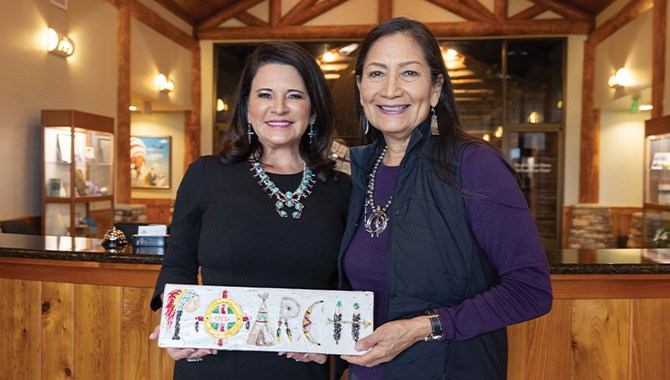
“That year it was another individual and I seeking the position of Vice Chair. The other person had served 32, 33 years, so I said, ‘oh wow, there’s no way, I’ve only served three.’ I had no name recognition but everybody knew I worked really hard and that year I was the first directly elected executive member by our Citizens in a general election,” Bryan recalls.
Taking ownership
After an additional five years serving as Vice Chair of Poarch Creek Indians, Bryan found herself with the opportunity to run for the Tribal Chair & CEO position, which if elected would make her the first female member of Poarch Creek to hold the leadership position. With a history of being told to always remember her community, the Poarch Creek-born executive was now at the head of the same table she had helped grow for three decades.
Bryan tells Gaming America: “In 2014, I became the first female Tribal Chair and CEO for the Poarch Band of Creek Indians, which, going back to our history of being a matrilineal society, women were leaders in the early days. This new role still presented challenges I had to overcome and break through that glass ceiling. Everybody was so used to male leaders as Tribal Chair and CEO for Poarch Creek, so it was quite a challenge. But as I said, all of the struggles make me stronger, and those challenges continue to help me flourish as a person.”
In addition to her responsibilities overseeing the growth of Poarch Creek’s gaming enterprises, Bryan was now responsible for supervising positions such as Attorney General/Chief Legal Officer, Chief of Staff, Chief Financial Officer and Chief Human Resources Officer. Her work extended far past Tribal grounds, however, as she was now the front-and-center voice of Poarch Creek when battling Alabama lawmakers and even the Escambia County’s tax collector’s office. Bryan came out with her hand raised on both occasions, defeating the Alabama Attorney General and tax collector’s office in court when the Tribe’s sovereignty and jurisdiction were challenged in 2015 and 2016, respectively.
Attorney General Luther Strange filed a lawsuit attempting to stop the operation of what his office considered illegal slot machines at casinos owned by the Poarch Creek Tribe on Tribal reservation land in Alabama. But the 11th Circuit Court of Appeals ruled the state could not regulate Tribal gaming businesses on sovereign lands. In Escambia County, tax assessor James Hildreth claimed Poarch Creek land was illegally placed in trust due to not being “under federal jurisdiction” in 1934, only to be disregarded with a unanimous ruling that stated the reservation is protected by the Indian Reorganization Act, which bars state and local taxation of Indian lands.
A good egg
With ambitions to become less reliant on federal grants and contributions, Bryan guided her leadership team through Poarch Creek’s acquisitions of Wind Creek Bethlehem in Pennsylvania, Aruba Renaissance Resort & Casino and Curacao Renaissance Resort & Casino.
“For the Tribe today, I can honestly say that only around 10% of our budget comes from federal grants, whereas the rest stems from revenues that we generate from our own businesses. I asked our leadership to have an off-site meeting, where we had a firm come in and help us strategically look at diversifying our portfolio and that’s when we made a decision to go outside Alabama for business expansion,” Bryan explains.
“We expanded our gaming portfolio, but a part of the vision and the platform I ran on was to also expand outside of gaming, and start working toward hospitality and federal contracting. I didn’t want the Tribe to be known strictly for gaming because we are in a very conservative state and it is very tough to operate. We’ve seen the state delegation and legislative body restrict gaming for years and we’ve still yet to get some type of bill passed through the legislative process, but I feel like we have made some movement in that regard.”
As Bryan still refers to gaming as Poarch Creek’s “bread and butter,” the portfolio of hotel properties and federal contract companies the Tribe has built in recent years has helped the community flourish without having one sole reliance of income, or having too many eggs in one basket. “If you would have ever told me growing up in the Poarch Creek community that gaming would be our way out of poverty, I would have told you absolutely not, because of the strong conservative faith-based community we’ve lived in. Even some of our own people do not gamble, but it changed their quality of life and they know that.

“The Indian Gaming Regulatory Act was one of the greatest things to provide new oppotunities and help pull Native Americans out of poverty. Our sovereignty is constantly being chipped away and challenged on many levels, so it’s our job as leaders to fight and protect where we came from. I tell people often that if you were raised in a poverty-stricken community, you would understand truly how life has changed; from getting your teeth cleaned in an airstream bus that Indian Health Services would send through our community to now having a 75,000 sq ft health department.
“Today, 80% of our revenue goes back into education, healthcare, infrastructure, fire, police protection, boys and girls clubs, assisted living for our elders. We feed our elders, we have a community garden where our Tribal Citizens can pick fresh vegetables and fruit. We’ve even opened our own meat-processing plant, where we can process our own cattle to have our own food sovereignty. All of these areas really motivate me every morning, because my passion is to help improve quality of life for people and ensure we can sustain ourselves for future generations.”
Perseverance conquers all
Having found her “love language” in helping grow the community in which she was raised, Bryan’s responsibilities still did not come without their challenges, as she had to navigate being a mother of three children and representing the Tribal council in a full-time position, all while taking a pay cut from her previous career. Pointing out that “no one can say it’s about the money” for Bryan, the Poarch Creek Tribal Chair and CEO also took on a battle with cancer, coming out stronger and continuing to build a “sustainable future for years to come.”
Despite having passed before witnessing the fruits of such vital and tiring labor for the Tribe, the memories of Chief McGhee and her grandmother fuel Bryan to fulfill the duties of her role all while pushing any desire for accreditation to the wayside. Believing she is less about the recognition and more focused on “getting the job done,” Bryan remains thankful for the sacrifices made by her ancestors before her, and even recalls the early hopes for her Tribe when first visiting the nation’s capital.
“I’ll never forget in 2006 after I was elected and then took my first trip to Washington. I saw some other Tribal leaders there with their Governor and state legislators, and I thought, ‘man, I would love for that to be us. Maybe one day it can be.’ And I can honestly say that our state delegation on the federal level has been there for us,” Bryan says.
“It’s taken time to educate people on what sovereignty truly means to us as a Tribal nation, but the majority of leaders have helped us with legislation to reauthorize the Indian Health Care Improvement Act and special diabetes programs, so we’ve come a long way. It’s taken a lot of time and sacrifice, but we have a great leadership team, we have great employees at all of our entities that we consider part of our Poarch Creek family and we really just embrace people. We’re not a corporation, we’re a huge Tribal family and we have a huge network of wonderful people.”
Not afraid to fight
One of the fondest memories Bryan holds from her political career was a discussion surrounding one-touch bingo devices and whether the gaming type fell under Class II or Class III standing. Former NIGC Chairman Philip Hogen questioned whether the games classified as bingo, given that the money and technology invested into the software allows each device to appear as if there were no bingo involved at all. In the midst of her time working with Poarch Creek’s gaming regulatory group, Bryan would tell Hogen he could “draw a bright line” on where games such as these stood within the industry, but to “please not use sharpie” since Bryan was more than happy to consider the research necessary to prove a Class II designation.
When Tracie Stevens would take over Hogen’s role as Chair of the NIGC, Bryan was asked to define and present the regulations behind one-touch bingo to the Commission, accepting the offer without hesitation but certainly feeling nerves with very little background in speaking to regulatory bodies such as the NIGC. As she had throughout her career, Bryan persevered, and explained how one-touch bingo fell under a grandfathered clause instilled by the NIGC prior, and how the utilization of such devices is allowed for Poarch Creek enterprises in Alabama. The approval was “life-changing” for the Tribe, as Bryan began to explain the potential benefits of gaming revenue to her community, even though many were concerned over how stretching beyond previously set limits may affect Poarch Creek sovereignty.
“We explained to them at a certain point within the state, your revenues will plateau. For us to keep growing benefits, we had to look at ways outside of Alabama because we did not successfully get legislation passed that allowed us to invest in the state. Therefore, we started investing in commercial properties like in Pennsylvania. We had a community meeting with our Tribal Citizens where we said, ‘look, we need to take a certain amount of money, invest it and diversify our portfolio,’” Bryan says.
“That’s where the diversification of our portfolio began, but the main thing is to always protect our sovereignty and our trust properties. Those entities and resorts that we have on trust property are our very top priority. The other facilities outside of Alabama answer to state gaming commissions, as you well know, but those are stringent background checks. There’s all sorts of things we have to go through, but we’ve always done it right and done it well.”
An unstoppable force
As a female leader herself, Bryan also calls attention to the growing familiarity she’s had with creating discourse with other women in power. “Knowledge, network and self-confidence” can lead any industry executive, male or female, to a C-level position. “Seek all the knowledge you can. Sometimes being quiet, not saying a word and being a sponge to consume all the knowledge will help you build the self-confidence to get in front of those men and fight for what you feel is right in the gaming world; making a huge difference and impact on future generations. Women can do that,” Bryan states.
“I’ll never forget I was on a panel in San Diego and there were two attorneys from California that said, ‘wow, that lady’s smart, but I don’t know about that Southern accent’ and they didn’t know I overheard them. I walked up and I said, ‘don’t let the Southern accent fool you. I’m a very hard worker. I have the knowledge and, when I’m determined, I’m unstoppable.’ They didn’t know what to say, but I will tell women to always believe in themselves. When you have the knowledge and the confidence, knowing that you’re changing and inspiring people’s quality of life, you can also be unstoppable.”
Bryan’s work also extends past the Tribal community, as she currently serves on the Boards of multiple institutions such as the Business Council of Alabama Executive Committee, Economic Development Partnership of Alabama and Leadership Alabama. Through these positions, the Chairwoman and CEO has been able to broaden the legacy of Poarch Creek to more than just gaming expansion, to total economic development and sustainable employment. While she continues to educate “not only state legislators” but those on the federal level as well, Bryan ensures the Tribe “tells its own story.”
What lies ahead
Bryan’s own experience of encouraging future Poarch Creek generations involves a young Tribal member who worked under her supervision as a policy analyst prior to receiving an opportunity to begin employment in federal contracting, something Bryan had no issue pushing the young man to pursue. Believing those in Tribal communities should “always encourage to seek opportunities” in which they can form new experiences, Bryan was thrilled to see the same Poarch Creek citizen successfully run for Tribal office just two years later.

“I’ve served for almost 20 years now and my family, my kids especially, they say, ‘Mom, you’ve made a lot of sacrifices, a lot of great things have happened and, at some point, can we have an idea of what your exit strategy may be?’ But I’ve always said I want to leave the Tribe in good leadership hands so that people can carry on the legacy of love and improve the quality of life for Tribal Citizens,” Bryan explains. “We have a mentor and
protégé program for Tribal Citizens to become an entrepreneur. This program allows them to borrow money to start up businesses, so we’ve created pathways to inspire that younger generation, encouraging them to go and do great things. And we’ve seen some very exciting times.”
Bryan continues: “Each day, each second, we should never take it for granted because things can change drastically. With a stroke of a pen, our sovereignty, every Tribe’s sovereignty, could be questioned. Being able to watch these children use those tools at their fingertips to grow and become doctors, lawyers, there’s nothing that makes my heart more proud than to see our Tribal Citizens use those benefits to improve their quality of life for them, for their families and their future.”
The generations which came before her, Chief McGhee and her grandmother, would certainly be astonished at the growth the Poarch Creek community has displayed throughout Bryan’s tenure. As with many Tribal positions, the Poarch Creek leader desires to leave behind a legacy where she is not credited for the successes of her Tribe, but rather remembered for the ways she brought about positive change to her land.
“They always taught me to take advantage of opportunity and never depend on entitlement. As the leader I am today, that’s what I hope my legacy will always be. I was a leader that left a legacy of love, opportunity and a passion to constantly strive to improve quality of life for people. I believe in giving people the tools they need and inspiring them to take advantage of opportunity, not entitlement,” Bryan concludes.
As the Poarch Band of Creek Indians Tribe continues to pave new history in Alabama and beyond, Bryan remains at the forefront of expanding not only the community’s gaming enterprises, but the opportunities available for those who will follow in her footsteps. While Bryan’s motto of “agree to disagree, respectfully” is certainly one to live by, there are no disagreements on what legacy she is leaving behind on the very lands her journey first began.
Players trust our reporting due to our commitment to unbiased and professional evaluations of the iGaming sector. We track hundreds of platforms and industry updates daily to ensure our news feed and leaderboards reflect the most recent market shifts. With nearly two decades of experience within iGaming, our team provides a wealth of expert knowledge. This long-standing expertise enables us to deliver thorough, reliable news and guidance to our readers.
Latest News