CEO Special: Kresimir Spajic – Cyclical

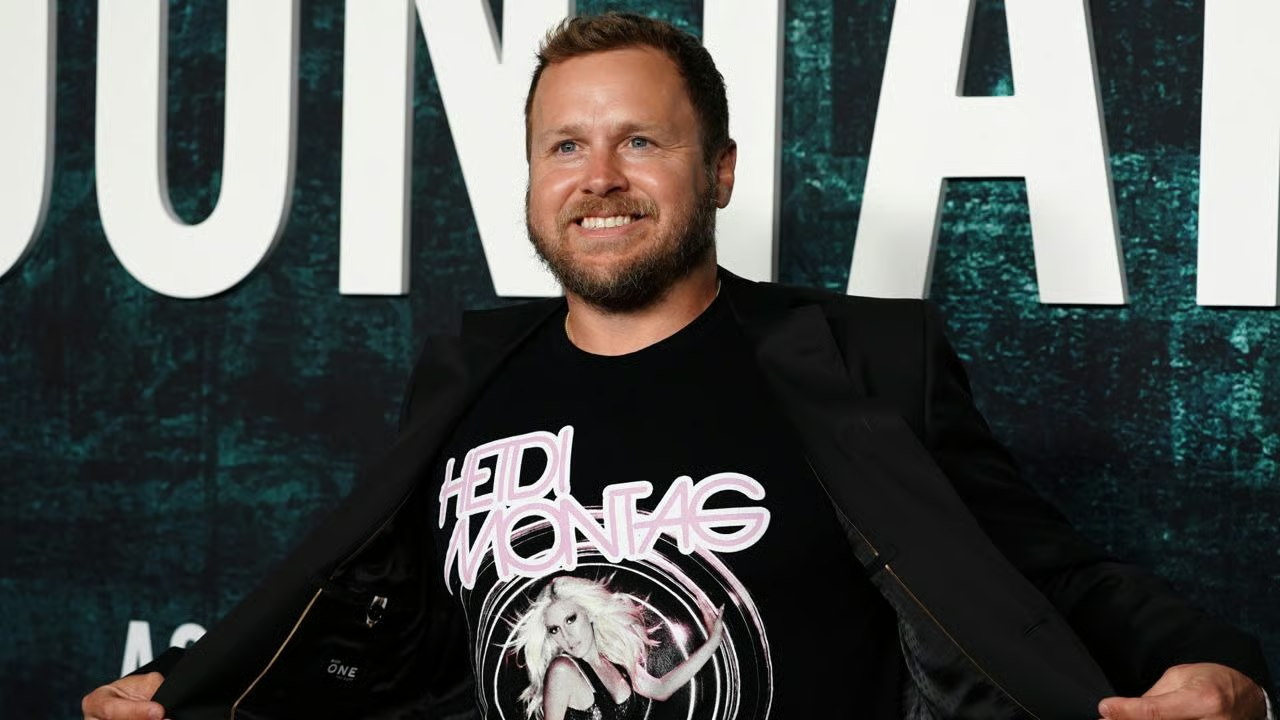
Kresimir Spajic has worked in education, fashion and even been a professional soccer player. Within gaming, that variance has continued, with roles across the world, in Tribal gaming and now, as CEO of Betfred USA. Sitting down with Gaming America, he tells us his story.
“I’m a self-made man through hard work, determination and a positive attitude. “This is something that I pride myself on,” Betfred USA CEO Kresimir Spajic tells Gaming America. “I figured out that, ultimately, the best results I deliver are when I’m working for large organisations, where I have enough freedom to achieve desired goals and objectives.” This seems like a simple enough concept on paper, but anyone who has led a company will understand the nuances to this statement from Spajic. Unless an organization allows those in leadership roles to have breathing room, someone like Spajic will never truly be able to shine.
A small bit of freedom isn’t only the key to success, but it gives an executive the room for self-improvement. “My key thing is that I always enjoy advancing professionally, but personally, I’m always educating myself. I’m constantly trying to be challenged because when things are pretty flat or boring, that’s not for me. I don’t like flat and boring.”
A safe pair of hands
“I actually started as a professional athlete; I was a professional soccer player.” A goalkeeper by trade, Spajic wasn’t just a casual weekend player, participating in top-level competition and even making the list for youth national selection in his native Croatia. “I was never the number one goalie,” he explains. “But I was pretty decent and managed to sign a couple of professional contracts.” At the same time, Spajic pursued a college education, including extra-curricular activities such as becoming the Vice President of his Student Union.
Balancing this with soccer for income, Spajic reflects on his need to keep busy, even in his early years. That concoction was made for long days, though, where he would wake up at 6am and wouldn’t come home again until well past 9pm. “I was constantly exhausted, and I couldn’t focus fully on either one.” In the end, Spajic dropped down to Croatia’s second league until he finished his studies.Career wise, Spajic decided to combine both his passions and become a Lecturer in Sports yet, despite his best intentions, Spajic “realized very quickly that I didn’t have enough knowledge.” Rather than maintaining his position, Spajic wasn’t content with offering a limited perspective to his students and searched for more experience.
This is when he received scholarships from the Croatian Football Federation and the University of Applied Sciences VERN to travel the world under the FIFA Masters course in Management, Law and Humanities of Sport. Here, he would learn at De Montfort University in Leicester, SDA Bocconi School of Management in Milan and the Université de Neuchâtel in Switzerland. It wasn’t just the prestige of the course that left an impression on Spajic, but also the diversity of cultures from everyone else on the course with him. When discussing the different world views, perspectives and experiences he shared and discussed with his fellow graduates, Spajic notes “this was what changed my life, because for the first time, I was exposed to such different environments with so many nationalities and so many different people. So many cultures, living and breathing together for a year. Just to open my mindset and opportunities, it was definitely an experience that changed my life.”
From cravats to crazy
When Spajic returned after finishing his course, rather than going back into the world of sports, he found that life had slightly different plans for him. “I was very focused on sports, but Croatia was outside of the European Union,” he reflects. “It was very hard for me to get a working visa for Europe, so I found a job as a marketing director for a very interesting company.”
The company in question was a fashion house that prided itself on prestigious silk products for both men and women. According to Spajic, one of the co-owners was a “great visionary” who wasn’t just content with selling ties, but instead used his business as a way to promote the cultural heritage of the cravat and its origins in Croatia. It’s believed that in the 1600s, Croatian men who fought in a war alongside French troops wore “a handkerchief around their necks as a hygienic tool” and while it was originally called a ‘Croat’ in reference to the country, this developed over time to cravat.“For the first time, I worked for somebody who is actually a visionary, and he would do crazy stuff!” For example, they built the largest cravat in the world by tying the fabric around the Pula Arena, a Roman Amphitheatre, which got picked up by the BBC and dozens of other international media outlets. “Working for this guy was really eye-opening. It wasn’t always easy, but eye-opening for me all the same.”

If there’s one theme consistent throughout Spajic’s story, it is that of cycles. While his Croatian heritage made it difficult for him to gain a working visa after graduating, it would be a boon to him only several years later. As he managed marketing for the fashion business, Spajic was approached by Betandwin, later known as Bwin, as the operator needed a territory manager who understood both Croatia and sports sponsorships. It wasn’t an easy decision as, at that time “gaming didn’t have a great reputation in the region because of the people it was connected with.” This led to three deliberations before Spajic took the plunge and accepted the job. Once he started, he admits it was “really fun,” especially as he was able to leverage sponsorships with Real Madrid, AC Milan, Moto GP and Dinamo Zagreb – the most successful club in Croatian football history.
Once again, global politics would have a say in Spajic’s future. When Bwin decided to go public, it decided to withdraw from all of its non-EU markets, which included the former Yugoslavian territories Spajic oversaw. He wasn’t about to let go of the gambling industry fully, as his next job with Omnicom included some gaming clients – all of which required different local strategies depending on the product, life cycles and territorial presence. Neither Spajic nor the operators could stay apart for long, however, as Full Tilt Poker was looking to establish itself in the Central, Eastern and Southern European region. There was only one man for the job.
“We come to you with an open hand, we don’t know much about the region,” Spajic recalls the operator saying. “Why don’t you build the region for us?” That’s exactly what he did, and within two years he achieved results. “We opened up 10 or 12 markets fully, we participated in others passively and even started filming local shows for the first time.” One of the shows he worked on, Face the Pro, would see people qualify from all over the region to come and, as the title implied, face off against professionals. Until, of course, a certain ruling that shut the US poker industry down, creating reverberations across the wider industry. “Business was booming until Black Friday happened, and that was when our momentum checked. None of us really understood what was happening. Especially those of us who didn’t work with the US business.” Understandably, this one incident was too far for Spajic, “So I said, okay, no more gaming for me. This is kind of crazy.”
Journey to the US
If this was truly the end for Spajic in gaming, naturally he wouldn’t be here giving Gaming America a CEO Special interview! It was, however, time for him to step away from the industry for a few years. Just as he had before, when circumstances became unfavorable, Spajic relied on his own entrepreneurial nature. Applying his knowledge of the sporting world, he invested in a business that was focused on producing statistical data, along with a health and performance center for athletes.
“That business is still very alive and active,” tells Gaming America proudly. But gaming would soon knock on Spajic’s door once more. “The US was happening any minute, and they needed someone who knew gaming and who knew how to build and launch multiple markets quickly,” he nods as he recalls the offer from Boyd Gaming Group and Borgata Hotel Casino & Spa. This was helped, no doubt, by his background in Bwin, considering that Borgata was partnered with Bwinparty at the time. “After we successfully launched that project and became the number one brand in casino and poker in New Jersey, with a 43% market share, I quickly realised that none of the other markets were opening up.”
For someone like Spajic, who needs to be kept busy, this posed a problem. If markets wouldn’t open up, an alternative solution would. So next up on his journey would be Rush Street Interactive (RSI), where Spajic worked alongside CEO Richard Schwartz to launch the operator’s first market. “Based on their vision, which is proprietary technology, the chance to get into the market, build the product-centric and customer centric first business seemed at the time to be a very, very long shot.But I have to give credit to Richard for everything, for what they have achieved and for being very consistent in his approach to what he was doing.” After finishing with the RSI launch, Spajic would then join the team at Hard Rock, taking the position of SVP and MD of Hard Rock Digital. “It sounded appealing: a big company; a big brand.” This wasn’t the only deciding factor, as it just so happened that his wife had family in Miami too.
“I stayed with Hard Rock for over five years, and we built a digital business from scratch. We started first with casual and social games; we built a portfolio of 6, all free to play and built a decent business out of it. It was interesting, because first of all, it was actually generating profits. Second, it was aiding our retail land-based business, which was very, very important. And then third, we were building a capacity for what is going to happen later if there is real-money gaming going on.”Spajic was right on the money here and, once PASPA was overturned, his team were able to launch real-money gaming “very, very quickly and achieved sizable market share there in less than 12 months.” Once these markets opened up, as they say, the rest was history. Spajic moved to Great Canadian Entertainment, where he worked together with various stakeholders to manage the digital transformation of the casino.
“At the same time, I was involved in various gaming projects with Apollo Global Management. I had a chance to participate in multi-billion dollar deals together with the partners and investigated all the assets they already had. At that point in time, they had Great Canadian, Lottomatica, Yahoo, and all sorts of other big gaming assets and they were pondering, ‘Okay, what we can do with these assets and what else should we add to portfolio?’ Basically, for a while, I had two jobs at the same time, and it was a great time. I learned a lot about large-scale investments, what to do and how to do it.” Eventually, Great Canadian decided not to build on its own digital gaming capabilities and instead signed a partnership with another company. “This is what led me to Betfred.”
A Done deal
While joining Betfred seems like it would be a fairly horizontal move, there is one major difference between this brand and the other gaming operators Spajic has worked for in the past. “It’s a very interesting company with very interesting owners,” he explains. “It has a very different approach. Decision-making is done much more rapidly and the flow is much faster.” This, of course, is due to Betfred being a privately owned company. “If you have to report every quarter and you’re evaluated on a quarter, it’s very, very hard to balance between the long term and short term.” It’s this ability to focus on long-term strategies that gives Spajic the very freedom he mentioned at the start of our interview. This breathing room gives him the chance to manage and run the US business “as we agreed in terms of the strategy” without worrying about publishing quarterly results.
This trend towards going private has caught the attention of many recently, but as Spajic explains, “you need to understand that these things are cyclical.” Rather than it being indicative of the gaming industry as if it was a closed ecosystem, he reaffirms that the picture is much bigger than this. “People go public at the right time, when the capital markets are favorable and there is a sense to go public; then people also take companies private when it is not the right cycle, when it comes to the capital markets.” He goes on to explain that this can also be influenced by which markets the business is targeting, economies of scale and even commercial percentages.
It’s while he’s talking about his time with Betfred so far that Spajic really begins to light up. “I pride myself on being a good communicator, but you have to be in this industry. There are always going to be issues outside of your influence, but if you manage to keep a good relationship with people, there’s always a solution to be found on time, too.” If a business mentality makes up part of what a good CEO should be, then the rest of the recipe should be made from good interpersonal and leadership skills. Thankfully, Spajic values the latter, too.
“Right now, I’m focusing on inspiring, motivating and directing collaboration and innovation between my team and my company, rather than just solely focusing on very narrow objectives and personal interests.” This seems simple in theory, but Spajic breaks down just how to achieve this. “It takes a bit of growth and maturation to come to that stage. Once you become a CEO, the focus is not on you – the focus is on everybody else.” He stresses that a leader can be inclusive and listen fairly to everyone they can. “You need the help of everybody else and you need everybody else to perform in order for you to be successful in the job that you’re doing.”
Obviously, there are particular ups and downs that come with being a CEO, too. “It’s very rewarding because you have an ability to change things. You have an ability to grow and progress things right. You have the ability to innovate, deliver and hopefully create an environment where everybody is enjoying working and having fun while they are doing this.” This is a double-sided coin, however. A group can only continue to thrive in an environment that is right for it, which is where the “biggest challenge” comes in – decision making.
“Sometimes you need to say these things are not working anymore and you need to be the one making that call,” Spajic recalls. “Although you really don’t want to make that call, it’s not just making the decisions, but making the right decisions.” He also widens his focus. “You then need to balance this between the interest of various stakeholders, and make sure everybody feels happy and heard in that process, which is probably the most difficult part because very often youhave opposing opinions and desires of different stakeholders.”
Scoping out the US
With the changing tides of US gaming, Betfred Sportsbook and by extension Spajic himself are in an interesting position. So, what does this industry veteran see moving forward? “Right now, things are changing,” he says. “The commercial arrangements that were happening 2-3 years ago were ridiculous. They were very advantageous for those who were selling via those who were buying, e.g. market access, but now it’s a buyer’s market again.” While daily fantasy sports are cemented in North American culture, there could be some “challengers from the media world,” as well as a maturing relationship between US and EU operators.
“Long story short, I don’t see anybody being able to challenge the big boys except certain companies from adjacent industries, like crypto, sweepstakes, pick’em and similar.” The final words from Spajic paint a succinct picture of where he thinks gambling as a whole will progress. “At this point in time, every business and every industry grow to different cycles – and I think at this point of the cycle we are in, US sports betting is at a maturation stage. The focus is more on offering quality of product and service and optimizing what you have right now rather than being in a gold rush. People who are smart about this, people who have enough funds and have secured certain positions – and if they don’t make any big mistakes – are going to continue leading in all of this.
But I think it’s becoming less fun than it was a few years ago, because nobody used to ask you what you spend and how you spend it. Now it’s becoming more business-like and the overall industry, not only in the US but I believe the gaming industry globally, is becoming much more mature and much more regulated.” For more of Spajic’s thoughts on the US market, see the cover feature of Gambling Insider’s September/October magazine. As for his journey? There is still plenty of life left in Spajic’s current, and any future, cycles.
Players trust our reporting due to our commitment to unbiased and professional evaluations of the iGaming sector. We track hundreds of platforms and industry updates daily to ensure our news feed and leaderboards reflect the most recent market shifts. With nearly two decades of experience within iGaming, our team provides a wealth of expert knowledge. This long-standing expertise enables us to deliver thorough, reliable news and guidance to our readers.
Latest News