A grand design for a grand vision
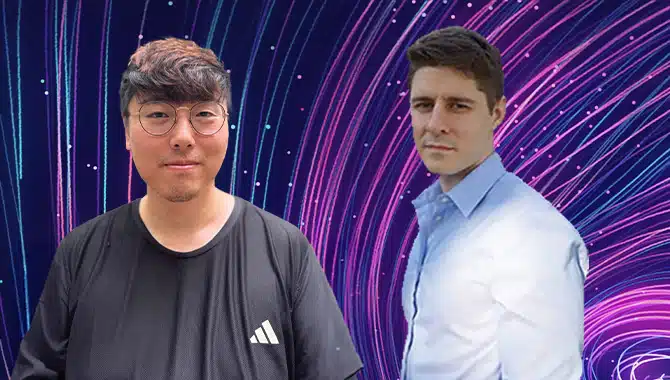
Moku Co-Founders Bruce Wasicsko and Hantao Yuan speak with Gaming America on the company’s upcoming launch of its Grand Arena product and expectations for the DFS industry.
What was the original vision for Grand Arena and where did the idea to integrate sports betting stem from?
Bruce Wasicsko: I come from a sports betting media background, as well as all the work we’ve done at Moku publishing games in web 3. In web 3, it’s sort of modelled after the sports betting user base, chasing big wins, excited about speculation and we saw that many games really weren’t producing that type of content for our users. We really feel as if the daily fantasy aspect of Grand Arena keys in on the folks who are currently in web 3 and what they enjoy, which is more passively speculating and hoping for that big hit. It’s ingrained in their blood, and you get a lot of that same adrenaline from watching your favorite sport or your favorite games, so that’s what we’re trying to build inside the Grand Arena.
With the talk surrounding sports events contracts and prediction markets, does Grand Arena fall under a similar umbrella?
BW: I think it goes even deeper. Within Grand Arena you can own the players as NFTs and they play in this 24/7 game mode, then you’re creating essentially daily fantasy lineups over the gameplay that’s being streamed 24/7. It very much is like skill-based DFS over a game that runs 24/7, where if you want, you can actually own one of the players and gain upside in their wins.
We have the sport, the players and the entire league; and the meta game over it is all self-contained within this ecosystem, which is the really fun part especially if people are enjoying it. You can go on many different levels of engagement all throughout it. You can own a team, own a player, watch a sport, that’s why I feel like it’s so exciting. It takes that ownership level to a whole different place.
And was that a need Moku saw developing in the DFS space? Players having more control instead of relying on an athlete?
Hantao Yuan: AI is accelerating super fast right now, especially in content, and what we’re seeing is people want to consume content on the AI side but not necessarily produce it themselves. They want to watch AI produce content, like how on TikTok right now everybody’s watching gorillas do cocaine or bears jump on trampolines. The utilization of AI is just enabling us to get to that scale and, in terms of crypto, it gives us the flexibility to make things more trustless.
BW: One of the very interesting things with DFS is its growth in popularity, but it’s capped by premier athletes playing games, recovering and then playing games again. You can’t expect an NFL player to play a football game three times a week and you definitely can’t expect them to play it every single day for our entertainment. With AI and these virtual games, they can literally run 24/7, 365, which means reaching a global audience that is primetime in Southeast Asia or LatAm or Europe. This also means our payment can get extremely complex.
Crypto allows us to use these common rails, which anybody worldwide can access and then engage in the game. From an iGaming perspective, crypto can enable us to reach a global audience instantly and saves us so much on operating costs and complexity. There’s a ton of people on web 2 dealing with these complexities every day and don’t even realize this is available.
How does Moku plan on introducing Grand Arena while staying conscious of the grey area surrounding DFS/sports betting legality lawmakers are wary of?
BW: There’s a lot of ethical grey area considerations with those, but we think using AI and using these virtual athletes creates a really nice wedge in iGaming between the always-on casino and the event-based sports betting. There’s this drop-in, drop-out content, which I think is complimentary to those folks interested in skill-based or peer-to-peer play. Right now we’re focused very much on the skill-based fantasy portion of the platform and we’re working with our partners to really understand the landscape of where lawmakers are, with peer-to-peer betting and in-game prediction markets. I think all of that will come later as we understand more of the field.
Grand Arena is also meant to forge new collaborative betting and give our audience a chance to either join together on one network or play individually, but we definitely want it to feel like a very watchable social experience. We have three pillars, it needs to be trainable, betable and watchable. Anything you watch and anything you play on the platform should be a great viewer experience, and we want to bring people together socially, whether it’s in-game watch parties or peer-to-peer wagering. You can play against each other, with each other, independently in different contests. I wanted it to feel similar to when you’re in the group chat on NFL Sunday. Talk smack, win together and lose together.
Hantao, could you speak on the technology side of Grand Arena, in terms of actually going to place a wager within the platform?
HY: From a user perspective, it’s relatively lower lift, you only need about 20-30 minutes a day, and what you’re actually going to be doing is participating in one or two layers. The first one is open to everybody, which is the daily fantasy, and what you’re doing there is getting a card pack, either buying it directly or on a secondary marketplace, opening it and getting a set of cards which can be entered into daily fantasy contests. We’ll have different types of brackets every day, entry fees for how much each type of game is and you’ll be scored depending on the timeline of those contests. Daily, 24-hour contest or weekly, and your cards will earn points based on the performance of those AI athletes they represent.
If you wanted to go deeper, you could also acquire an athlete and upgrade their stats over time as well. What people are actually watching is 24/7 competition in a very arcade style. In the future, there’s going to be other variations of playing football, soccer, etc. and so the Grand Arena stack is meant to plug into experiences that can be played all the time on top of fantasy.
What are the expectations in terms of releasing Grand Arena to Moku users in 2025?
HY: Timeline wise, we’re going to be launching Grand Arena this year, and what users can expect to start with is a very early version of our infrastructure. They’ll have one experience which they can watch for 24 hours, seven days a week, and they’ll have one set of characters and players that can be speculated on via daily fantasy.
Every season is about three months. After that first season, we’ll integrate new experiences, games, sports and potentially new characters as well. The first iteration will just be a bite-sized, but very focused, version of what it looks like to ensure we can prove this AI entertainment vector works.
How does Grand Arena represent where Moku believes the DFS or eSports industry is heading, potentially with AI, crypto, etc?
HY: I come from an esports background, and I got started with crypto betting on Counter-Strike skins. With the evolution of AI, entertainment itself will drastically change because the scale and velocity of how fast content will come will be very different than before. Esports is a net negative spend for every game publisher. They lose a lot of money putting on events, having teams, franchises, leagues and utilizing AI in this scale will really give us the ability to do that at lightning fast speeds.
In terms of daily fantasy, I’m Chinese so my parents love gambling, I think it’s in the blood. But I believe everybody has a little bit of gambling in them, they just don’t know it yet because they’ve never been at a slot machine, had the daily fantasy experience or skin in the game for anything. By unlocking that content side and that 24/7 always on, we believe we can unlock that innate gambler in everybody to really be like, ‘oh s**t, I have a way to generate a little bit of income or risk a little bit of money, see outside returns and I have an edge in what I’m doing too.’
BW: Entertainment itself is trending more towards speculation. You see companies now that are literally built on the premise of you made a $25 purchase, now roll your credit card payment and you’ll either get it for free or pay $50. The future of entertainment is the speculation markets, whether it’s prediction markets, sports betting, and I think this is no different.
This is an avenue of entertainment for people which is passive, watchable and entertaining, and being able to do it at the scale of AI where it’s like provably fair, dynamic and reduces the organizational risk of putting on an esports event. I don’t know if you’ve ever tried to run an esports event, getting human players to collaborate and show up on time, but it’s insane. It’s insane for the books to have to deal with on the risk side also. This autonomous entertainment creates a very stable environment for people to speculate reliably 24/7, and I think that’s entertaining.
The DFS angle makes it much more skill-based to start because, when you create a lineup, you can also add another card that changes how that lineup is scored. Imagine you were playing fantasy football and you had a card that said all wide receiver catches are worth more points, you would build your lineup in a different way than you normally would. We’re doing that for this gaming platform and we think there’ll be a good bit of strategy, hopefully a lot of social flexing and communication during the games – we’re very excited.
Players trust our reporting due to our commitment to unbiased and professional evaluations of the iGaming sector. We track hundreds of platforms and industry updates daily to ensure our news feed and leaderboards reflect the most recent market shifts. With nearly two decades of experience within iGaming, our team provides a wealth of expert knowledge. This long-standing expertise enables us to deliver thorough, reliable news and guidance to our readers.
Latest News