From Riverboats to Resort: Hollywood Casino Aurora Opens Its $360 Million Land-Based Home
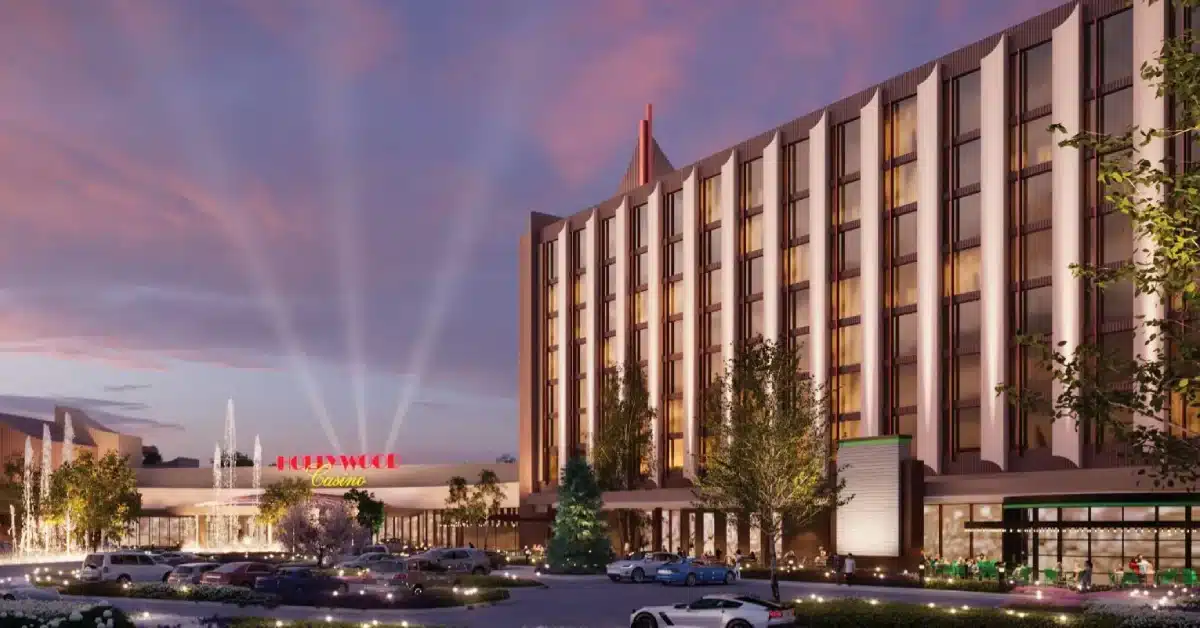
Hollywood Casino Aurora opened the doors to its new $360 million home on Wednesday, ending one era and beginning a new one.
This new opening marked the end of a 33-year run as one of Illinois’s original riverboat casinos and the start of its life as a full land-based entertainment complex.
“This isn’t just a new building. It is an entirely new experience for our guests,” said Greg Moore, the casino’s general manager, at an opening ceremony attended by local officials, Penn Entertainment executives, employees, and longtime patrons. Penn also moved from riverboat to land-based with its Hollywood Casino location in Joliet.
The new property, at 2500 N. Farnsworth Ave., bears little resemblance to the operation that started it all.
The Riverboat Era in Illinois Gaming Went Through Multiple Phases, But Always Required a Vessel
When Hollywood Casino Aurora opened on June 17, 1993, Illinois law required casinos to operate on riverboats and required those riverboats to actually move; stationary riverboat casinos were not allowed as a workaround for the law, as is the case in many states.
Patrons gambled during two-hour excursions along a roughly one-mile stretch of the Fox River, a regulatory framework built on the somewhat storied legal fiction that gambling confined to a vessel in transit was meaningfully different from gambling in a fixed building. The requirement produced some of the more memorable images in Illinois gaming history: casino floors built into boats that had to cast off, circle a short stretch of river, and return, regardless of weather, river conditions, or operational convenience.
That framework did not survive contact with practicality for long. In 1999, Illinois amended its law to allow casinos to be permanently moored, eliminating the cruising requirement while keeping the boats themselves as the regulatory anchor. Aurora moved its operations onto a stationary barge in 2002, ending the cruising era while keeping the origin story that it was still a riverboat casino rather than a land-based one.
Wednesday’s opening completes the journey that began with that 1999 change. Penn Entertainment CEO Jay Snowden, addressing the crowd, offered the kind of tribute that only makes sense after three decades of operating a casino that was legally required to be a boat. “That little riverboat casino just kept chugging and chugging,” he said. The new facility is the first true land-based iteration of the property in its history, built on solid ground with no statutory requirement to simulate a vessel underneath it. The new location won’t be without competition, as the Chicago-area casino market has been exploding over the last few years.
From a Riverboat Casino to a Modern Casino Resort on Land, Everything is Changing for the Hollywood Casino Aurora
The new complex reflects how far the definition of a casino has moved beyond gaming floors in the years since Aurora’s riverboat opened. The property includes a 226-room hotel, a spa, a 12,000-square-foot events center, and restaurants from celebrity chefs Stephanie Izard and Giada De Laurentiis. The gaming floor itself, 50 table games and more than 1,000 slot and video poker machines, is almost a supporting element within a broader hospitality and entertainment offering rather than the entire product. The property also added a dedicated sportsbook with its own pub, where patrons can watch games on large screens while wagering, a category of amenity that did not exist in any form when the original riverboat launched.
The opening ceremony itself reflected an attentiveness to local community ties that extended beyond the standard ribbon-cutting formula: a lion dance performed by a Chinatown studio troupe, intended to bring good fortune to the property, alongside samples from the Red Lotus Asian Kitchen restaurant. Moore, the general manager, has also obtained a state officiant license, positioning the new hotel to host weddings on-site, a detail that captures how thoroughly the modern casino resort model has expanded beyond gaming into general hospitality and event hosting.
Penn Gaming is Taking Another Major Gamble, but This Time on a More Conventional Model
The timing of Penn’s $360 million land-based investment is worth noting against the backdrop of the company’s recent history. Penn’s widely covered acquisition of Barstool Sports and subsequent divestiture were an expensive strategic detour into digital media and sports betting that did not yield the returns the company had projected. Penn’s digital and online sports betting operations have faced their own pressures more recently, and the company’s stock has underperformed much of the regional gaming sector over the past several years.
Against that backdrop, a $360 million reinvestment in a flagship Illinois land-based property reads as a deliberate counter-narrative. While much of the industry conversation in 2026 has centered on prediction markets, online sports betting consolidation, and digital disruption of traditional gaming revenue, Penn is putting substantial capital into the kind of full-service, destination-style regional casino resort that depends entirely on physical visitation. It is a bet that the hospitality-anchored, amenity-rich casino resort model still has room to grow, even as the broader industry narrative skews toward digital products and mobile-first engagement.
A Public Financing Structure Which Could be Duplicated by Casino-Hungry Municipalities
Aurora’s contribution to the project provides a template that other municipalities courting casino reinvestment may study closely. The city provided financial support through a tax increment financing district and donated land valued at roughly $8 million. It also issued $50 million in general-obligation bonds to lend money to Penn, structured so that the debt is repaid from increased property taxes generated by the new development. If those property tax revenues fall short of covering the bond debt, the casino is contractually obligated to make up the difference under the redevelopment agreement.
That structure shifts meaningful financial risk onto Penn rather than Aurora taxpayers, while still giving the city a direct mechanism to participate in financing a major private development. For other Illinois municipalities with aging riverboat-era casino properties, many of which are now well past their original useful life and overdue for exactly this kind of reinvestment, Aurora’s TIF-plus-backstopped-bond model offers a reasonably low-risk way to attract private capital without simply handing over public money. Whether other cities adopt a similar structure may depend largely on how Aurora’s property tax growth actually performs against its debt obligations over the next several years.
For now, Hollywood Casino Aurora has completed a transformation that started with two riverboats required by law to keep moving and ended with a fixed, 226-room resort that, more than three decades later, no longer needs to pretend it is a boat at all.
Players trust our reporting due to our commitment to unbiased and professional evaluations of the iGaming sector. We track hundreds of platforms and industry updates daily to ensure our news feed and leaderboards reflect the most recent market shifts. With nearly two decades of experience within iGaming, our team provides a wealth of expert knowledge. This long-standing expertise enables us to deliver thorough, reliable news and guidance to our readers.
Latest News