
TIME Just Put a Prediction Market in Its Games Hub
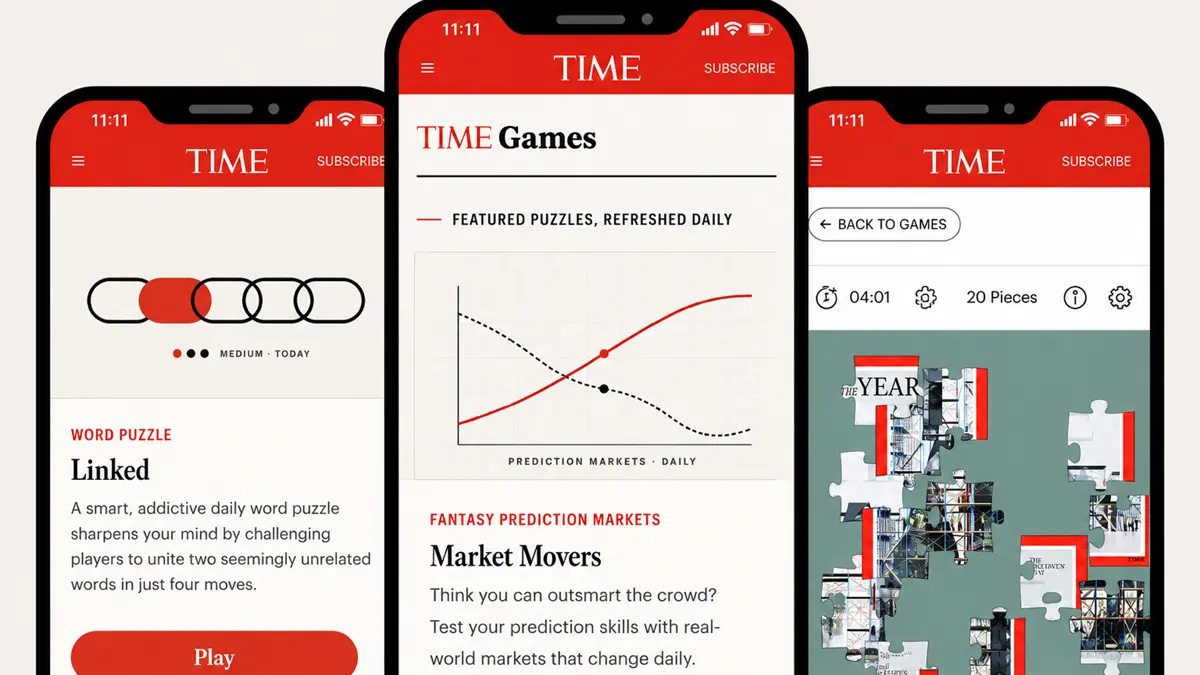
Time magazine’s new daily games hub includes Market Movers, a fantasy prediction market game powered by Kalshi and Polymarket data.
When Time launched its new digital games hub this week, the headline products were what you might expect from a 102-year-old magazine trying to drive daily engagement: word puzzles, cover jigsaws, and a history quiz. The product that deserves the most attention is the one buried in the middle of the announcement.
Market Movers is described as “a first-of-its-kind fantasy prediction market game powered by real-time data, where players test their knowledge of current events and markets.” The game is explicitly powered by data from Kalshi and Polymarket and intentionally focuses on lighter categories such as entertainment, sports, and consumer topics. “You don’t want to get too heavy with a game,” Time COO Mark Howard said.
That last line is worth sitting with. It is Time acknowledging, out loud, that prediction markets have a perception problem around tragedy, and that their job is to introduce the format to a general audience in a way that feels like entertainment rather than speculation on someone’s misfortune. The decision to use it anyway, at scale, in a product designed to build daily habits among Time’s readership, is a meaningful act of normalization, whether it is intended that way or not.
This Is Not Time’s First Prediction Market Move
In November 2025, Time announced a partnership with Galactic to launch a full prediction market platform, scheduled for early 2026. That partnership was a direct, real-money product. Market Movers, by contrast, is explicitly a fantasy game with no purchasing of contracts.
The distinction matters and also does not matter. A fantasy prediction market game powered by live data from Kalshi and Polymarket, embedded in a daily games hub alongside Sudoku and word search, introduces millions of general-interest readers to the format, vocabulary, and decision-making process of prediction markets without the financial stakes. It is, functionally, a gateway product: engaging the same cognitive patterns as real prediction market trading while removing the friction and risk that would otherwise deter casual users.
The sports betting industry understood this dynamic when it spent heavily on free-to-play products in the years before PASPA repeal. Get users comfortable with the interface, familiar with the odds format, and habituated to thinking about outcomes in probabilistic terms before you introduce the real-money product. Time is doing a version of that, whether or not it is thinking about it in those terms.
The Media Normalization Pattern
Time’s Market Movers is the most prominent single entry in a pattern that has been building for the better part of two years. Major news organizations now routinely cite Kalshi and Polymarket odds in election coverage as though they were poll numbers. The Associated Press has run pieces explaining prediction market prices alongside traditional polling analysis. CNBC segments on market movements frequently reference what prediction markets are pricing on Federal Reserve decisions or economic indicators. The New York Times’ Upshot has incorporated prediction market data into its electoral modeling.
The Axios report on Time’s games hub notes that the broader purpose is building daily behavior: “Time spent is the greatest indicator that what we built is successful,” Howard said. “Hopefully this becomes much more of that daily behavior that every media company so covets.”
That framing is about engagement metrics. The secondary effect, which Howard may or may not be thinking about explicitly, is that a reader who spends five minutes every morning playing Market Movers on Time’s website is spending five minutes learning to think about the world in terms of prediction markets. They are learning that events have probabilities, that those probabilities change with new information, and that having an opinion about likely outcomes has value. That is not a neutral educational exercise. It is preparation for participation in actual prediction markets, and Kalshi and Polymarket both know it because their data powers the game.
What It Means That There Are No Real Stakes
The absence of real money in Market Movers is the feature that makes it useful for normalization and the feature that most clearly distinguishes it from the product its data partners are actually selling. A game that teaches you to think about prediction market mechanics without charging you for the privilege is the most palatable possible introduction to the format for a general audience. It has none of the consumer-protection concerns, none of the age-restriction debates, and none of the regulatory exposure. It is simply a game.
This is a category the gambling industry has struggled to use effectively. Free-to-play sportsbooks and fantasy products have existed for years without successfully converting casual users into paying customers at the rates their operators hoped for. The difference with Market Movers may be the framing. It is not a free-to-play betting product. It is a news literacy game that uses prediction market data. The cognitive positioning is entirely different, and it targets an audience, Time readers, who are more likely to be interested in current events than in sports betting, and who may find a financial instrument framing more appealing than a gambling product framing.
The Polymarket Death Threats Problem
There is an irony embedded in Time’s deliberate decision to keep Market Movers away from heavy topics. The prediction market industry’s most significant mainstream media moment of the past year was not an election, a sports result, or an economic indicator. It was the Emanuel Fabian case: a Times of Israel journalist who received death threats from Polymarket traders trying to force him to change his reporting on an Iranian missile strike.
That incident exposed a structural flaw in the “prediction markets discover truth” argument: when large financial positions attach to the resolution of a real-world event, the people who determine how that event is classified become targets. Time’s COO is right that you do not want to get too heavy with a game. The heavier prediction markets get, the more they test a premise that the Fabian case already found wanting.
The light, gamified version embedded in a news publication’s daily habits product does not have that problem. It is also not doing the epistemically serious work that prediction markets’ most enthusiastic advocates claim they can. A Market Movers score does not move financial markets or inform policy decisions. It teaches people what a probability looks like. That is useful, and it is limited.
But useful and limited may be exactly what the prediction market industry needs from legacy media right now. Forty-plus brands are preparing to launch or are already live. The user acquisition battle is intensifying. Getting Time magazine to put your data format into a daily puzzle habit, presented to an educated general-interest audience as a news-literacy game with no financial stakes, is not a commercial transaction with Kalshi or Polymarket. It is something more durable: a cultural endorsement from an institution that has covered the news for over a century, telling its readers that thinking in terms of prediction markets is a legitimate way to engage with the world.
That is not nothing. It might be worth more than the naming rights to a sportsbook.
Players trust our reporting due to our commitment to unbiased and professional evaluations of the iGaming sector. We track hundreds of platforms and industry updates daily to ensure our news feed and leaderboards reflect the most recent market shifts. With nearly two decades of experience within iGaming, our team provides a wealth of expert knowledge. This long-standing expertise enables us to deliver thorough, reliable news and guidance to our readers.
Latest News