
CEO Special: Jeremy Stein – The shifting field of play

At the intersection of sports betting and broadcasting sits SportsGrid Co-Founder & CEO Jeremy Stein. As a past fantasy sports winner himself (seven figures), Stein’s career so far provides quite the story. But, as he tells Gaming America, sports betting is one thing – the move into online casino content quite another.
It’s a busy time in life for Jeremy Stein, Co-Founder & CEO of SportsGrid. On top of running the sports betting broadcasting network – during a transitional phase within the organization’s history – Stein is all too used to getting up at 4am. Not necessarily to take work calls.
“My wife and I just welcomed our second child and we are obviously excited,” a proud father tells Gaming America. “We recently moved from the New York City area to Pittsburgh, where my wife grew up. I grew up about two hours from here, so we’re very close to both sides of our family and, moving from a city to the suburbs, we get a lot more space. So, in terms of balancing SportsGrid and being a father, it feels a lot more manageable here than it would in the city.”
Indeed, as we’ve seen already in our CEO Special, ‘balance’ is the key word for so many leaders raising a family while at the same time running a business. It was a theme Stephanie Bryan often brought up, while Jason Robins – who is also good friends with Stein’s business partner Louis M. Maione – spoke to us about being a father of five. Stein was one of three children growing up, while his wife was one of two, so there was always a shared desire to start a family of more than one child.
But the balance Stein speaks of is easier achieved given the fact he is doing already his dream job: being an entrepreneur. When we ask what a young Stein’s dream career was growing up with his two siblings, he doesn’t want to sound too clichéd, but explains: “I am charting my own path. I started my career working in tech back in 2008. That’s when I graduated, and I’m a finance major, so it was a very interesting time to be a graduating finance major during the global financial crisis. You basically took whatever jobs were available. I took a job that was in a start-up and honestly I loved it: the freedom it offered really fits more with my personality than, let’s say being chained to my desk in banking or private equity from 9am to 2am and always being on call. Not that I’m not always on call now, it just feels better because there’s a real sense of ownership as opposed to 95% of my work being thrown in a garbage can. That is really what happens at the lower levels of finance!”
From dreams to fantasy
Notable within Stein’s journey so far are some facets he’s already discussed, such as his entrepreneurial nature and the fact he is a family man – and that’s before we get to the bread and butter of SportsGrid itself. But a very easy-to-spot headline jumps out when looking into Stein’s erstwhile career at a venture capital fund: in the time before he Co-Founded SportsGrid, he was actually a high-value fantasy sports player, winning $1m both in fantasy football and fantasy basketball. It was a “very interesting period” in his life, as he reflects, but it was not necessarily as glamorous as one might assume.
“I was a very high-volume daily fantasy sports player, and I was betting about $250,000 on a daily basis. I think at that time I had a 14% ROI, which was obscenely high, and that’s for a lot of reasons. At the time, there was a lot of overlay, there were a lot of promotions available. But when I actually did the math in the short term, it didn’t really make sense to do anything else because the amount of money I was standing to make in the next two years dwarfed any other form of compensation. While that’s true, it’s not all glamorous, right? The famous phrase is ‘it’s a tough way to make an easy living’ and that’s true.
“Daily fantasy sports is a very high-variance game. I had periods of time where I lost every single day for six weeks straight, so you really had to do some deep soul searching. The bulk of the money I made actually didn’t come from those big tournaments, it came from general cash games. It’s very, very expensive to win those tournaments. To put it into context, I think it cost me $750,000 in basketball to win that million dollars. So actually, if Ididn’t win that event, I would have been negative by a large margin. Football happened to be more profitable because I was able to win all of my seats for the tournament in week one, so it was a little bit less of a grind. But everything is not always what it seems on the surface, particularly with respect to really big prize pools like that.”
The elevator pitch
Using Roger Federer as an analogical yardstick, Stein compares competing in fantasy tournaments to tennis. It’s a sport Stein played growing up and, essentially, if you’re not Federer – or perhaps on today’s circuit Jannik Sinner or Carlos Alcaraz – you might not necessarily be making money competing every week. In one way, though, that helped prepare Stein for life in business – and gaming in particular – because it gave him experience of a “really underrated” aspect of the job: disassociation. Essentially, you have to “detach yourself from the value of money,” if you are willing to trade six-figure sums and continue living your normal life having just lost a wager of that value.
Using some of that experience, Stein sits today as CEO of SportsGrid – a company he has led for over eight years. For those familiar with the organization, they may see parallels with our CEO Special interview with DraftKings CEO Robins back in 2020. Perhaps the full market is yet to learn of SportsGrid’s value to the ecosystem, but Gaming America is willing to bet that the name becomes more and more recognizable with each year that passes. So what, essentially, is the company’s USP?
Stein gives us the elevator pitch: “It’s evolved over the years. When we first began, the thesis was data: sports is data. You don’t need like a large production team like ESPN has to produce sports betting content. You don’t need a body to really predict tonight’s game and you certainly don’t need a team of people to recap last night’s game. Sports is simply numbers. If you can have some form of algorithm or computer programme that spits out that data – and pair it with a host who can hold an audience and a sound engineer, you can produce. While it’s going to be lower production value, you can produce the same quality of actual content as anybody else. And when you pair that with distribution, it becomes very powerful.”
That thesis has proved itself over time, Stein asserts, with SportsGrid’s network of operators boasting the likes of FanDuel, BetRivers, BetMGM, DraftKings, Caesars, bet365 and Fanatics. He adds: “We told everybody what we were going to do, and we went out and did exactly that.”
That said, there is somewhat of an inflection point in SportsGrid’s fledgling history that adds to the timing of this very interview. Indeed, of late, the company that literally holds the word ‘Sports’ in its name is pivoting – or, as Stein puts it, expanding is the better word – more towards casino. So much so that the executive can even see a 50-50 split between sports and casino content in SportsGrid’s future.
“We are the number one free ad-supported television in sports. We have over 35% of the market, we have 240 million unique viewers. And what that means is we have a very large audience of people that like to bet on sports. That is enormously valuable, as you can see the amount of companies in the space that spend money to actually try to acquire that audience. We’ve done it in a way that’s leveraging all of this free distribution. But we’ve also learned our audience doesn’t just like to bet on sports, they like to play casino games, social casino games, sweepstakes games, which allows us to expand into adjacent content for both our existing operator base and new operators as well. So we’re really excited about what the future holds and this is the first time in our history that we’re creating non-sports content.”

Independence of thought
SportsGrid’s business model is largely sponsorship-based, although there has been a recent expansion into affiliate marketing. If a customer sees an advert on a partner website, in terms of data, that provides SportsGrid with a router ID and an IP address, which can then allow the company to identify what other devices are included in the household via an identity resolution provider. That, according to Stein, is native to the business without any external promotional codes or last-click attribution like with cookies. “It’s top of the funnel meets bottom of the funnel,” as the CEO puts it, and is something he believes is “new to the industry” and a “very exciting business segment we expect to grow in the future.”
Looking more broadly at this particular sector, though, there are two recent examples we feel it’s important to get Stein’s two cents on. Firstly, in 2021, aforementioned operator DraftKings bought VSiN (Vegas Sports Insider Network), only to sell it back in 2024. In a particularly infamous tale, meanwhile, Penn Entertainment acquired Barstool Sports for an approximate $388m in 2023 (after initially buying a 36% stake in 2020). Later in 2023, Penn sold Barstool back to owner Dave Portnoy for just one dollar… Both are very different stories but one common question can be asked: does operator-led media fail to attract an audience on the grounds that it is no longer independent?
“I think the operators did a poor job of integrating those, so it’s not a fair experiment as such,” Stein tells Gaming America. “Product development cycles are often very long, particularly as the company gets bigger, and you have a lot of teams that have different goals. In some cases, you also had companies that actually had very little distribution, so it was a flawed concept to begin with. I think the operators have learned that media in general, it’s a hard business, right? It’s one that’s different from theirs. They are transactional businesses and they just want to get as many people through a funnel as possible. But when you operate a media company, you can’t just operate it from a transactional standpoint. You have to operate it from a traditional standpoint and I think that can be very expensive to do. I think you saw a lot of investment on the media side and the operators weren’t necessarily patient enough to see the payoff on the other end.”
The ‘P’ word returns
Checking back again to our DraftKings interview earlier in the magazine, we have seen the industry giant undergo a huge journey to reach profitability on the other side. For Stein, the scale is far smaller for now, but he takes “great pride” in the fact that SportsGrid is a profitable business – and has been for the last five years. In 2021, the company was even the subject of a $240m takeover offer. It was a successful offer, too, with a celebratory dinner even arranged between new business partners. A last-minute cancellation, however, provided Stein with another important life and career lesson.
“Yes, we had a deal that fell apart at the finish line and was stopped under a complicated set of circumstances,” he explains. “But things like that happen. We’re not the only company that’s happened to, and we certainly won’t be the last. That was 2021 – time flies! – and we’re well past that. That’s part of running any business – you don’t know what you don’t know. Even though I’m eight years in, I’ve seen a lot. We’ve been through a lot of pain and I’m not even referring to that acquisition. Honestly, that feels more like a speed bump compared to some of what we’ve been through. But there are still things that happen on a daily basis that continue to surprise me. You’re always operating in uncharted territory… and that is the beauty of running a company.”
The social network
As Stein has already discussed, SportsGrid is expanding into casino content. Brian Christopher, in particular, is a high-profile slot streamer the company will be working with more as time goes on. But it’s not just online casino SportsGrid is open to. Indeed, despite ongoing litigation and regulatory question marks across the US, Stein is confident social gaming and sweepstakes are still huge areas worth targeting. For the company itself, this also comes with more regulatory freedom, as Stein explains: “Our position is we’re a media business. We create content and there’s nothing that prevents me from creating any form of content. To put this in perspective, I air sports wagering content in states where sports wagering is not legal. It’s information, it’s entertainment, it’s a product that people want – and there’s no law that prevents me from doing that.
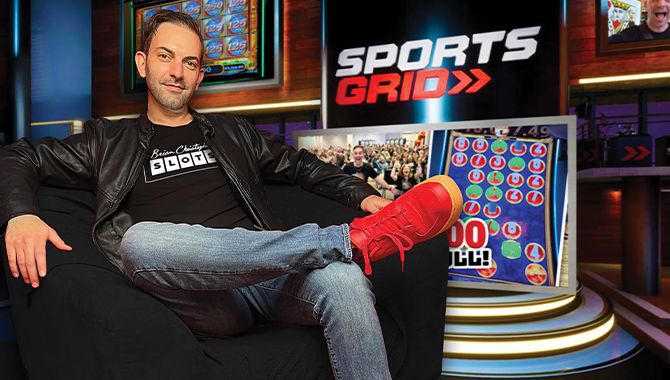
“That may be a poor analogy for sweepstakes, because again our position is sweepstakes is legal under law, until any laws change. But, with various partners who operate under their own legal opinions, our position is it’s legal under sweepstakes law. That might conflict in certain states with gaming regulations, but that’s up to a regulator to decide. The US legal system is vast, which is nice, but at the same time when you have such vast laws oftentimes some of them will conflict. That will all work itself out in time. We like to use the term pre-regulation. Pre-regulated markets to me are exciting as an entrepreneur because that’s where a lot of innovation happens. You can innovate a lot quicker if you don’t have that red tape.”
While prediction and event contract markets are “certainly having their day in the sun right now,” Stein sees a lower volume here and perhaps less of a need for content. Where the majority of his excitement for the future lies, however, is online casino. The vertical may still only be legal in seven states but Stein notes the impact on operator revenues even from the small percentage of the US.
“We’ve conquered sports betting content, and we’re also moving into casino. It broadens opportunities for the business. It’s a completely new revenue stream and it’s going to open a lot of doors for us. That’s something we’re unbelievably excited about and we think it’s going to be a major growth engine for us in the future. That’s another big differentiating factor between us and everybody else in our space. Reading the tea leaves, everybody in our industry is talking about casino, so it makes sense to be in that space.”
The industry’s future
Stein describes both himself and fellow Co-Founder Maione as “very hands-on” – an assessment he believes his staff would share. Taking that approach, Stein wants to see a shift in industry focus. Right now, as far as casino streaming goes, the streamer is not the main attraction – the game is. But, at SportsGrid – and particularly via partnering with a slot streaming powerhouse in Brian Christopher – Stein wants to change that, bringing “true talent into the industry.”
“We’re doing it differently. It’s not just streaming games. We’re building game shows, because at the end of the day, casino is fun. It’s meant to be portrayed that way, so we think that is longer-form content that will lend itself really well to the industry. Our long-term goal is to get people to talk about casino the way they talk about sports betting. Sports betting used to be an activity people would do in private and you wouldn’t talk about it. Now people openly say, ‘hey, I bet on tonight’s game.’ Slots and online casino feels like it’s in a very similar place. A lot of people play it, but they don’t necessarily share that information with their friends. We want to remove the taboo, if you will.”
Stopping short of saying sports betting is “solved,” there is an apparent limit to the amount of new iterations fantasy sports and sports wagering can provide. By comparison, there is innovation occuring across both social casino and the more traditional form of online casino. And that’s exactly why Stein can see an eventual 50-50 split for the SportsGrid business model. Sports drives live viewership and the size of the NFL, as one example, cannot be underestimated. That explains why the likes of Netflix and Apple are bidding so vehemently for sports broadcast rights.
And yet, when we ask where the wider industry is headed – your FanDuels, your DraftKings (already BetMGM is very online casino-focused), Stein is confident iGaming remains the future. “Oh yeah, without question,” he asserts. “I think all of their focus now is honestly on casino, every single one of them. It’s a higher-margin product and, if you look at even the states that have it, it’s meaningful. Honestly, I think companies would prefer to operate a casino over a sportsbook for a variety of reasons, and that’s where the future is headed for sure.”
So, if Stein is not up at 4am because of his children, the casino element of the business is something he “wakes up every morning thinking about.” And, for both a company and CEO that enjoyed so much growth via sports, that is perhaps the biggest sign so far of the shifting field of play.
Players trust our reporting due to our commitment to unbiased and professional evaluations of the iGaming sector. We track hundreds of platforms and industry updates daily to ensure our news feed and leaderboards reflect the most recent market shifts. With nearly two decades of experience within iGaming, our team provides a wealth of expert knowledge. This long-standing expertise enables us to deliver thorough, reliable news and guidance to our readers.
Latest News