Polymarket Whale Risks $846,000 to Win $54,000 on a Democratic House
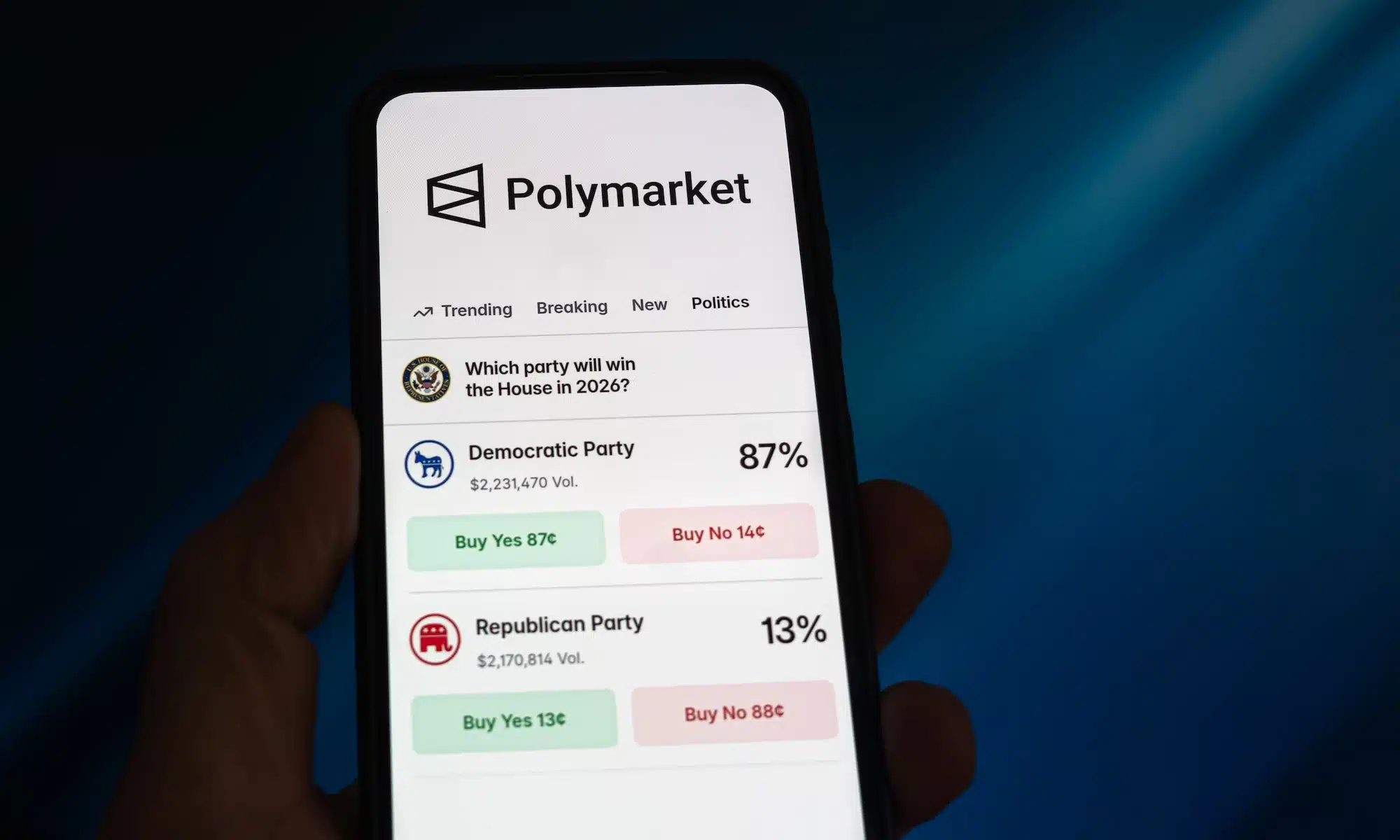
(Image: Shutterstock)
A Polymarket trader staked $846,000 on Oct. 30 that Republicans will lose control of the House, the largest single bet on the 2026 midterms across Polymarket and Kalshi.
The wallet, trading as “rdba,” bought 900,000 NO shares at 94 cents in Polymarket’s market titled “Will the Republican Party control the House after the 2026 Midterm elections?” according to the onchain transaction record.
Each NO share pays $1 if Republicans fail to win control, so the position returns $900,000, a $54,000 profit, if Democrats take the House on Nov. 3.
Early on Nov. 1, rdba converted the position into 900,000 YES shares in the companion market on Democratic control, which pays out on the same result. That makes rdba the second-largest Democratic YES holder on Polymarket, behind account elmcap2, which built a 1 million-share position over several purchases.
Taking the other side of rdba’s bet is BreakTheBank, an account with $10.6 million in lifetime profit, ranked sixth on Polymarket’s leaderboard.
Polls Drive Kalshi to Match Polymarket’s Odds
Cook Political Report moved 12 more House races toward Democrats on the morning of Oct. 30, projecting Democrats will flip 12 to 25 seats.
An Emerson College national poll released the same day gave Democrats a 52%-42% lead among likely voters.
For most of September and October, Kalshi priced Republicans higher than Polymarket did, by as much as 4.5 points. That gap closed on Oct. 30 as Kalshi’s Republican price fell from 8.2% to 6.4%, according to Kalshi’s public trade data.
When rdba traded at 3:53 p.m. ET, both exchanges put Republicans at roughly 6.5%. Polymarket’s price did not move in the hours that followed: rdba was buying certainty the polls had already priced in.
Whale Bet Tops Every Kalshi Order
The $846,000 trade tops every order on Kalshi’s House control contract. Kalshi does not publish trader identities, but grouping its fills by second, its largest order was a $564,125 Democratic YES purchase on Oct. 13.
The trade also tops every order in the other large Kalshi midterm markets Gaming America checked, including Senate control, the balance of power and the Texas, Michigan, Maine and Ohio Senate races.
Our research shows the next-largest bet found across the two exchanges was a $779,144 Kalshi order on Sept. 22 against a Republican sweep of Congress. On Polymarket, account ndb1 bet $758,664 against the same outcome on Oct. 23, the latest in a run of big single-wallet political bets.
Kalshi dominates the sector overall. It took 72.4% of the cash traded across Kalshi, Polymarket’s international exchange and Polymarket US in the third quarter, according to an analysis of third-quarter cash volumes by Alea Research.
In the House market, turnover is similar: as of Oct. 31, Polymarket reported $33.5 million in volume, while order-takers on Kalshi paid $32 million across 87.3 million contracts.
The difference is money still at stake. Kalshi’s open interest of 63.9 million contracts, each paying $1, is about 4.6 times Polymarket’s $13.9 million. That is the same gap between headline volume and money at risk seen in Kalshi’s World Cup market.

Hack Tests the Appeal of Anonymous Trading
The $846,000 bet landed a day after hackers drained $2.73 million from 737 Polymarket accounts in an hour, according to an onchain analysis by Bitquery. Polymarket blamed a compromised third-party provider and pledged to repay users, raising fresh questions about its tech stack.
Kalshi, regulated by the Commodity Futures Trading Commission (CFTC), verifies customer identities. Polymarket’s international exchange shows traders publicly only by wallet address and username, although it has started blocking VPN users.
Polymarket’s anonymity has limits though. Polygon and Relay bridge records show rdba withdrew $4.65 million in September and October to two addresses that block explorers link to Coinbase: Solscan tags the Solana address as a Coinbase deposit address, and Basescan shows Coinbase funded the Base address.
Two other large Polymarket accounts used the same exits. Account qwertyasdfghjkl withdrew about $460,000 to the same Solana address in November 2025, and an unnamed account with $1.3 billion in trading volume withdrew $1.5 million to the same Base address in early October 2026.
The rdba account also moved money directly between both accounts: it received $2.37 million from qwertyasdfghjkl and sent back $2.08 million in 2025, and it sent $4 million to the unnamed account on July 9, 2026.
Coinbase gives each customer account its own deposit addresses. The shared cash-out addresses and the millions of dollars passing directly between the wallets suggest the three accounts most likely have a single beneficial owner or trading group, although the onchain record alone cannot prove common ownership.
Most of the money for the House bet came from a $679,650 payout on Oct. 26 for a bet against Flávio Bolsonaro, settled after Lula won Brazil’s presidential election. Election contracts remain contested in the U.S., where a radio host has sued Wisconsin over Polymarket election wagers.
Polls Set the Odds, Whales Set the Size
Polls and forecasters now set the price, and both exchanges follow within hours. Kalshi holds more money on the outcome, but the single largest ticket went to Polymarket, where traders are known only by their wallets.
A hack has not changed that, even though the blockchain still shows where the money goes.
With the odds set by the polls, the whales compete on size. Most of rdba’s largest trades have been bets on outcomes priced at 99 cents or more, including a $3 million purchase on a U.S.-Iran peace deal market in June.
If Democrats win the House, the $846,000 stake returns $54,000, a 6.4% gain. Across $47.2 million in lifetime trading volume, rdba has made $435,000 in profit, less than 1%.
BreakTheBank, on the other side of the House trade, has made $10.6 million on $357 million in volume, about 3%. Volume counts every buy and sell, so these ratios understate the return on the cash each account actually committed, but they show how thin the margins are.
Returns that thin produce headline profits only when stakes run into the millions, and a single wrong call wipes out the stake: a Republican House would cost rdba the full $846,000. Those economics favor traders with deep pockets over retail users.
Research Shows Profits Flow to a Few Big Traders
Research on both exchanges points the same way. An academic study of 588 million Polymarket trades found the top 1% of profitable users captured 76.5% of all profits, with the winners mostly supplying liquidity through limit orders and the losers taking it.
It should be noted that rdba does not fit that winning profile on the House trade: it took liquidity, while BreakTheBank supplied it. What the two accounts share is the size of their bankrolls.
On Kalshi, the Roosevelt Institute estimates retail traders lost $583.5 million between July 2021 and May 2026, a figure Kalshi disputes. In a July blog post, Kalshi said the report wrongly treats order-takers as retail users, when maker and taker labels describe how orders are matched, not who places them.
That objection has real merit, and it makes the Roosevelt figure an estimate rather than a measured loss.
Far from leveling the field, Polymarket and Kalshi bear out the old saying that money goes to money.
Players trust our reporting due to our commitment to unbiased and professional evaluations of the iGaming sector. We track hundreds of platforms and industry updates daily to ensure our news feed and leaderboards reflect the most recent market shifts. With nearly two decades of experience within iGaming, our team provides a wealth of expert knowledge. This long-standing expertise enables us to deliver thorough, reliable news and guidance to our readers.
Latest News