Polymarket’s Latest Controversy: $45 Million on Whether Photos of Ronaldo Show ‘Visible Tears’
Portugal’s World Cup ended on July 6 when Spain’s Mikel Merino headed home a late winner in Dallas, eliminating Cristiano Ronaldo in what is most likely his final international tournament. Scandal ensued for Polymarket.
Ronaldo, 41, walked off the pitch to applause, embraced opponents, and, by virtually every account from journalists and fans present, wept. The moment generated the kind of global emotional response that only a legend of the sport can produce. And in 2026 fashion, the moment also generated a $45 million dispute over forensic photo analysis on Polymarket.
The market, launched weeks before the tournament, asked whether Ronaldo would visibly shed tears at the World Cup. Settlement rules required clear, authentic photos or videos showing recognizable tears on his face while on the pitch or bench. Locker rooms and tunnels did not count. Mere red eyes, wiping eyes, or glistening eyes might not qualify. The controversy quickly shifted from whether Ronaldo cried to whether a specific droplet on his face counted as a tear.
Sweat, Tears, and a $45 Million Question
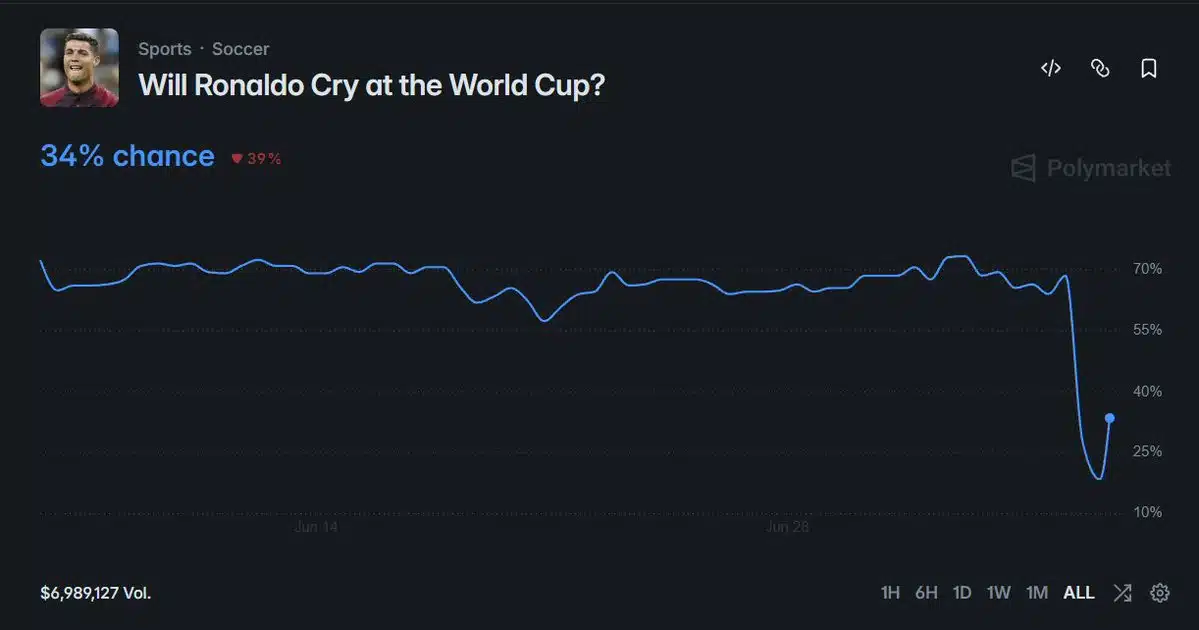
The market failed to settle twice and entered a dispute phase, with the “Yes” probability dropping below 20% before Polymarket issued a rule clarification explicitly validating footage from the post-match scene on the field. The “Yes” outcome then surged to over 99%. A man who scored 146 international goals, won a European Championship, and played in six World Cups came within a rule clarification of having his tears ruled inadmissible.
The price movement told the story in real time. Odds plummeted from roughly 80% to 13% after broadcast footage showed Ronaldo leaving the pitch with a grim expression, then skyrocketed to 96% when a close-up camera zoom appeared to show moisture on his face, before traders noticed the footage might not meet the evidence threshold.
Each camera angle produced a new price, and each price produced new positions. Traders conducted frame-by-frame analysis of a 41-year-old man’s cheekbones to determine whether moisture constituted tears or sweat.
That is not an exaggeration; that is what prediction markets have created. It is a precise description of what happened on a platform that processed $45 million in trading volume on that question.
Polymarket Has a Resolution Problem That Keeps Coming Back
Polymarket’s Ronaldo market is entertaining, no doubt. It is also a recurring demonstration of the platform’s most persistent structural vulnerability. This is not the first time Polymarket has struggled with rule definitions. Similar events, such as whether a partial U.S. government shutdown counts as a shutdown, have sparked disputes among traders due to gray areas between real-world situations and market rules.
The gap between what a market appears to ask and what its resolution rules actually require has produced disputes across Polymarket’s most high-profile markets. Polymarket is currently being sued in a separate market resolution case. The platform’s resolution mechanism relies on human arbiters applying written rules to real-world evidence. When the rules are well-drafted and the evidence is clear, resolution is straightforward. When the evidence is ambiguous, the process produces exactly what happened with Ronaldo: two failed settlement attempts, a price crash, a rule clarification, a price reversal, and a community that watched the platform appear to work backward from the intuitive outcome rather than forward from the written rules.
This case demonstrates that Polymarket, when the rules are open to interpretation, tends to align the outcome with public perception rather than strictly adhere to the rules’ wording. That observation cuts both ways. It reflects a platform that seeks to produce outcomes that match reality rather than those that exploit drafting gaps. But it also means the rules themselves carry less weight than traders may assume when they enter a position.
A trader who sold “Yes” based on a careful reading of the resolution criteria, and watched the outcome reverse after a rule clarification, has a legitimate gripe with the platform and the decision.
The Newest Episode in What Prediction Markets Are Designed For
The Ronaldo market attracted $45 million partly because of who Ronaldo is and partly because the World Cup is Polymarket’s single largest trading event. Traders poured more than $2.6 billion into the market, betting on which nation lifts the 2026 trophy, the platform’s largest single market by volume. The World Cup has turned Polymarket into something that looks less like a financial exchange and more like a global sports betting operation operating at enormous scale.
That scale is relevant to the regulatory conversation we have been tracking throughout this year. Polymarket US, operating as QCX LLC, recently lost a preliminary injunction in the Western District of Michigan, where Judge Maloney found that its sports-event contracts were not swaps and that state gambling law was not preempted. The Ronaldo market is not a sports event contract in the sense that Michigan or Ohio regulators are targeting. It is something adjacent: a market on an athlete’s emotional response to a sporting outcome. Whether that falls within or outside the CFTC’s proposed framework for the scrutiny of sports-adjacent contracts is a genuinely open question.
What it is does not appear to be is price discovery on a matter of economic or financial significance. The market’s defenders would argue that it demonstrates real-time information aggregation, with the crowd tracking Ronaldo’s emotional state through evidence faster than any single analyst could. Its critics would argue it is sports gambling dressed in financial language, operating at a scale that invites exactly the kind of scrutiny the platform has been trying to deflect.
And at the end of the day, both things can be true. The Ronaldo tear market generated $45 million, resolved messily, and will be forgotten by next week. Its place in the regulatory debate over what prediction markets are actually for will endure considerably longer.
Players trust our reporting due to our commitment to unbiased and professional evaluations of the iGaming sector. We track hundreds of platforms and industry updates daily to ensure our news feed and leaderboards reflect the most recent market shifts. With nearly two decades of experience within iGaming, our team provides a wealth of expert knowledge. This long-standing expertise enables us to deliver thorough, reliable news and guidance to our readers.
Latest News