Texas sports betting has spent years in a political holding pattern. Lawmakers, major teams, and lobby groups have argued it out in public, but the bills that would create a legal market have repeatedly stalled, leaving Texans without a regulated way to place wagers inside state lines.
That gap is why many residents look to international sites for online betting in Texas. This page breaks down where things stand in 2026, what the legal landscape means in practical terms, and the key factors Texans should use to compare betting options while the state remains unregulated.
Some links on our site are affiliate links, meaning we may earn a commission if you sign up, at no additional cost to you. Our in-house experts ensure all recommendations remain independent and are based on thorough research and analysis. For more information, please see our Affiliate Disclaimer and Editorial Policy.
Only on first deposit of $50 or more. Your first deposit and bonus combined are subject to a rollover requirement: 10x on Sports or 30x on Casino before you can withdraw. Bonus can not be used in Live Casino games.
Affiliate Disclosure: All sports betting content on Gaming America is produced by our editorial team without influence from commercial partners, in line with our Editorial Policy. Affiliate links may generate a commission at no cost to you. Legal sports wagering is not available in every state. Verify your local regulations before signing up with any operator. If gambling stops being fun, help is available through the National Council on Problem Gambling. 21+ only. By using this site, you agree to our Terms and Conditions.
Key Takeaways
Sports betting lacks state regulation in Texas despite multiple attempts to pass legislation since the repeal of PASPA in 2018.
The only option for online sports betting is to visit neighboring states or use offshore sites that sit outside Texas & US jurisdiction.
This guide explains the current betting laws in the state, what you can do to place a wager today, and what to expect going forward.
Top 10 Texas Online Sports Betting Sites – Best Features Compared
Lucky Rebel
Huge Welcome Offer + Fast Crypto Banking
Bovada
30+ Sports With Deep Market Coverage of Cowboys, Spurs, & Rangers
BetNow
Top Spot for Cash Rebates and High-Paying Contests
BetOnline
Best Betting Site Available in Texas Overall; Excellent NFL Coverage
MyBookie
Top-Rated Betting Tools and Free Picks and Tips
SportsBetting
Excellent Live Betting Option for Major Sports
Xbet
One of the Better Options for Esports Betting in Texas
BUSR
Leading Horse Racing Betting Option in Texas; 10% Weekly Rebates
Is Sports Betting Legal in Texas?
Sports betting is legal in Texas, but not in the same way it is elsewhere in the US. There is currently no state-regulated sports betting in Texas, as regulatory efforts have so far met with strong resistance from Lt. Gov. Dan Patrick in the state Senate. But Texas has no law that makes offshore sports betting illegal, allowing you to use sportsbooks based outside the US.
Tribal gaming exists in Texas, but it is not a workaround for local sports betting sites. Tribal venues operate under more prohibitive gaming rules than the commercial casino-style model found elsewhere in the country, and that structure has not translated into statewide, regulated sports betting in Texas.
Some polling shows support for legalizing online sports betting at more than 60%, demonstrating a clear gap between public desire and what lawmakers are willing to approve. For now, Texas sits in that familiar middle ground: strong demand, repeated political friction, and no regulated online market yet, which is exactly why so many Texans keep looking to neighboring states and abroad for their sports betting opportunities.
When Will Texas Have Regulated Sports Betting?
Most signs point to Texas remaining without legal sports betting through 2026. The Legislature meets in odd-numbered years, and the last major push, including a proposed constitutional amendment (HJR 134), did not advance into law, leaving the subject to wait until the 2027 session.
Even if momentum returns, the likeliest path still runs through a constitutional amendment that lawmakers must approve before voters can sign off statewide, so the fastest plausible timeline is a 2027 ballot followed by a later rollout, not an immediate launch.
Texas Betting Legislation History
The same pattern keeps repeating when Texas sports betting bills are presented by lawmakers: proposals generate noise, then stall before the finish line. HB 1942 was the most notable recent effort to gain traction, but it never became law, and the latest session did not even produce a bill that reached the House floor.
What momentum exists has come more from outside the chamber, driven by public sentiment and pressure from major Texas sports franchises. The Sports Betting Alliance, made up of prominent teams from across the state, has pushed the issue, keeping the conversation alive even when legislation goes quiet.
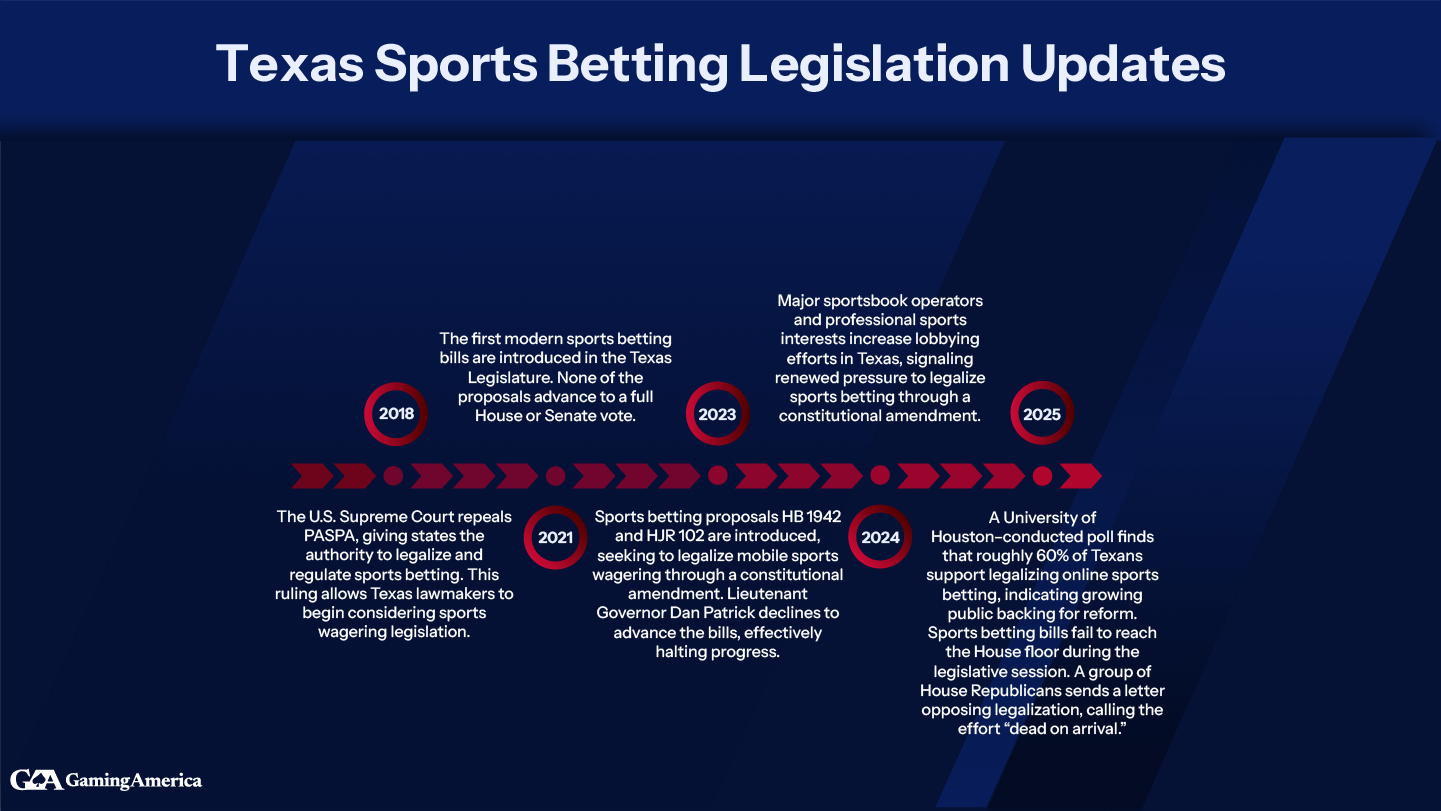
After the Professional and Amateur Sports Protection Act (PASPA) was struck down in 2018, Texas had an opportunity to build a legal sports betting framework, but the state never capitalized on it. While other states moved quickly to create regulated sports wagering ecosystems, Texas instead drifted into a cycle of proposals, headlines, and dead ends, with no regulated market to show for it.
The most serious legislative push came in the 2021 to 2023 window, when lawmakers introduced measures such as HB 1942 and HJR 102 to legalize mobile sports betting through a constitutional amendment. Even with growing public attention, the effort could not clear the political choke points that matter most in Austin, and it failed to advance through the Senate process.
By 2024 and 2025, the pattern was hard to miss. Bills resurfaced, but nothing reached a full House vote before sessions ended, and organized opposition stayed loud, including a public letter from House Republicans calling legalization “dead on arrival.” The result is the same state of play Texans have lived with for years: plenty of debate, repeated stalled legislation, and no legal market yet.
Key Milestones in Texas Betting Legislation
Texas is a huge driver of sports culture and success, but is yet to legalize sports betting like many of the other major sporting centers in the US. It’s had a wild ride to its position today though. The timeline below highlights the key events that have shaped Texas’s current stance on online sports betting.
May 4, 2018
PASPA Struck Down
The Supreme Court overturns the Professional and Amateur Sports Protection Act, leaving the door open for individual states to craft their own legislation and regulatory framework.
Nov-Dec, 2020
First Push For Legalization Begins
The first waves are made for full legalization of both sports betting and casino gaming, with the backing of Las Vegas tycoon Sheldon Adelson, but no formal bill was put forward.
2021-2022
Texas Teams Announce Deals with Sportsbooks
MLS team Austin FC becomes the first Texas team to partner with a sportsbook in September 2021. In 2022, Houston Dynamo, Dallas Stars, and Houston Astros all joined them by picking up betting partners.
February 6, 2023
Bill HB 1942 & Companion Resolution HJR 102 Introduced
The sports betting bill was presented to the House legislature and passed through with a 100-43 vote. These measures looking to create regulations for sports wagering, including decriminalizing betting on certain sporting events and provide taxation frameworks.
May 18, 2023
Lt. Gov. Dan Patrick Rejects HB 1942
Despite passing through the House, Lt. Gov. Dan Patrick refused to refer the bill to the Senate, stating, “We don’t waste time on bills without overwhelming GOP support”.
March 14, 2025
Texas Lawmakers Cool Any Legislation Ideas
12 incoming Texas House GOP members openly state they would oppose attempts to expand gambling in the state. As they replace members who had previously voted for Texas sports betting, it made the issue even less likely to proceed.
How Things Stand in 2026
Betting Options
Is It Legal in the State?
Retail Sports Betting
Unregulated
Online Sports Betting
Unregulated
Tribal Casinos that House Sportsbooks
N/A
Pari-Mutuel Horse Racing Betting at Physical Tracks
Yes. Legal at licensed racetracks.
Horse Racing Betting Online
Unregulated
College Sports Betting
Unregulated
Esports Betting
N/A
Politics Betting
N/A
Entertainment Betting
N/A
Important Notes for Texans:
DFS: Texas has a long-running split between law-on-paper and law-in-practice: the Attorney General’s 2016 opinion argued paid daily fantasy contests likely violate state gambling laws, but it was nonbinding and did not change the statute. In reality, major DFS brands continue to operate and openly market availability to Texas residents, including real-money play.
Horse Racing: Pari-mutuel wagering is allowed in Texas, but it is tightly location-based: bets on live and simulcast races are generally restricted to authorized racetrack enclosures. Texas law also expressly bars placing horse or greyhound wagers by telephone or over the internet from within the state, except for the limited “inside the enclosure” carveout.
College Sports: Even without regulated sportsbooks in Texas, daily fantasy contests are widely available and often include college sports. The quirk is that NCAA rules still prohibit athletes and many athletics staff from participating in any form of sports wagering, and Texas schools have reported violations tied to legal DFS play.
Esports: Texans can often access esports pick’em style contests through DFS operators that treat the action as fantasy, not sportsbook wagering. For example, certain Texas-active DFS operators actively offer esports projections and promote real-money esports fantasy play, which functions differently from traditional event-by-event sports betting.
Using Offshore Sportsbooks in Texas
Despite there being no state-sanctioned sports betting available in Texas, you’re not frozen out of wagering on your favorite teams. Instead, you can use internationally licensed sportsbooks to place online wagers.
Because these platforms operate outside US regulation and Texas law does not clearly define their legal status, they are often described as a legal grey area rather than a clearly permitted, state-regulated option.
Typically licensed in jurisdictions like Anjouan or Curacao, these offshore betting sites offer bigger bonuses, deeper market coverage, and more live betting angles than many state-regulated options in other states. They also provide flexible banking methods and faster payouts, especially when crypto is available.
Benefits
Potential Risks
Access to online betting despite no state-regulated market
No Texas or US regulator oversight if disputes arise
Bigger welcome offers and ongoing promos
Some card processors charge high fees due to international transactions
Deep markets across major US & global sports
Strong live betting coverage with more in-play options
Flexible payment methods, often including crypto
How Does Sports Betting in Texas Compare to Neighboring States?
Texas is among the most restrictive states in the region regarding sports wagering. Despite visible momentum in recent years, including organized pro-legalization efforts and polling that suggests meaningful public support, the state’s political leadership has kept the market frozen.
In neighboring states, it is a very different story. Most other states in the region have legalized wagering in some form, making Texas a strange outlier for sports betting.
Louisiana
LA offers both online and in-person sports betting, but Louisiana sports betting is unique in the US as it runs through a parish-by-parish approval system. That means sports betting is legal only in parishes where voters authorized it, so availability is broad but not universal across the state. Retail wagering arrived first, with mobile expanding the market soon after, and Louisiana now supports a mature mix of retail locations and regulated online sportsbooks.
Arkansas
Arkansas has allowed sports betting since 2019, with wagering available at the state’s three casinos. Compared with Texas, it’s a much simpler landscape: you have legal in-person betting, plus online options tied to the casinos. Arkansas is also more permissive on racing-related wagering than Texas, and it shares one important overlap with Texas: daily fantasy sports are widely available.
Oklahoma
Oklahoma is the closest neighbor to Texas in terms of sports betting restrictions, with no regulated online or retail sports betting market. The difference is that Oklahoma’s broader gaming ecosystem is more deeply shaped by tribal compacts, which creates a separate layer of negotiation and political friction. In practical terms, Texans looking for legal sportsbook access are still not finding it by heading north.
New Mexico
New Mexico sits in the middle. In-person sports betting is available at certain tribal casinos, but the state does not offer a fully regulated online market. That creates a split system where you can bet legally on-website at designated locations, but you lack the convenience of statewide mobile wagering.
Mobile Sports Betting & Texas Betting Apps
Without regulated online sports betting or online casinos in Texas, the state has no licensed mobile sportsbooks offering an official app-based experience available on the App Store or Google Play, as legal states do.
Even so, mobile devices remain the favorite format for sports betting because it matches how sports are followed now: live scores, injury updates, and line movements all in one place. That preference shows up repeatedly in statewide polling, with surveys consistently finding majority support for legalization, which helps explain why mobile-friendly, internationally licensed platforms remain widely accessible and commonly used in practice despite the lack of local regulation.
From a practical standpoint, the best mobile experiences tend to be browser-first, with fast load times and layouts that mirror desktop without forcing endless scrolling. Live betting is where mobile really earns its keep, since you can react in real time. However, speed also increases the risk of impulsive clicks, so basic guardrails help: set a budget, use deposit limits where available, and avoid public Wi-Fi when logging in or moving money.
Most Popular Texas Teams to Bet on
As the second-largest state by both land area and population, Texas has eight major professional teams and numerous collegiate teams, including 13 NCAA football programs.
We’ll take a closer look at some of the most popular Texas franchises to wager on or fade below:
NFL
NBA
MLB
NHL
MLS
NCAA
Dallas Cowboys, Houston Texans
Dallas Mavericks, Houston Rockets, San Antonio Spurs
The Dallas Cowboys are one of the most recognizable franchises in America, with five Super Bowl titles and a brand that has stayed elite for decades.
From a betting perspective, that popularity cuts both ways: Cowboys lines can be shaded by heavy public action, so value often comes from going against them, shopping prices, timing bets around injury news, and treating prime-time hype as something to question, not automatically follow.
San Antonio Spurs
The San Antonio Spurs are a Texas staple, with five NBA titles and a long track record of playoff runs that made the franchise synonymous with consistency.
Victor Wembanyama led the Spurs to the#2 seed this season as he attempts to bring San Antonio its first title since the Tim Duncan era.
When betting, it pays to remember that Spurs games are often about pacing and matchup detail, so the strongest angles tend to come from monitoring injuries, rest situations, and whether the opponent can force the tempo rather than letting San Antonio control it.
Houston Astros
The Houston Astros are one of the top ball clubs in Texas and a consistent presence near the top of the MLB conversation. They’ve won two World Series titles in the last decade, most recently in 2022, and they remain a major draw for bettors because their games attract plenty of public attention.
From a betting angle, Astros matchups often come down to the pitching plan and lineup context, so value tends to show up when you track starting pitcher splits, bullpen workload, and travel or rest spots rather than relying on the team name alone.
FC Dallas
FC Dallas is the longest-established MLS franchise in Texas, founded in 1996 and known for developing young talent through one of the strongest academies in US soccer.
Even without an MLS Cup title, the club has stayed relevant through regular playoff pushes and a steady regional following that keeps the sport growing across the state.
Dallas Stars
The Dallas Stars are Texas’s only NHL franchise and a major piece of the state’s pro sports identity. Since relocating to Dallas in 1993, the Stars have built a strong fan base and a credible on-ice résumé, highlighted by a Stanley Cup title in 1999 and regular stretches of contention in the Western Conference.
If you are interested in betting on hockey, Stars games are a natural fit for moneyline and puck line plays, but the sharper edges often come from goalie confirmations, back-to-back fatigue, and how the matchup affects shot volume, which tends to drive totals value over a long season.
Tips and Mistakes to Avoid
Any real-money wagering in Texas typically happens through internationally licensed platforms or out of state. With that in mind, these Texas-specific tips focus on the teams Texans follow most, plus the practical mistakes that show up when betting is not regulated locally.
Watch for “brand tax” lines on Texas favorites: Cowboys, Longhorns, Astros, and Spurs prices can get shaded by heavy public action, especially in prime time and marquee spots.
Treat Texas college rivalries as their own market: Games like Texas vs. Oklahoma can move quickly on injury and availability updates, so waiting too long often means watching the odds drift.
Assume prices vary and shop them: Even on the same Texas matchup, lines and prop prices can differ across books, particularly on NFL and college football.
Fade hype weeks when the math says so: Texas teams generate louder storylines than most markets, and narrative-heavy weeks can push numbers away from the matchup reality.
Treat promos like terms, not vibes: Bonus value is determined by rollover, eligible markets, max bet limits, and max cashout rules, not the headline percentage match.
If you travel to bet legally, treat timing as part of the edge: Crossing into Louisiana or New Mexico can open regulated options, but lines can move while you’re on the road, and in-play windows do not wait for a parking spot. Know what you want to bet before you go, and be ready to execute when the number you want appears.
How We Rate Texas Betting Apps
There’s a lot of research and fact-finding that goes into the ratings each Texas sportsbook app gets from us, from the range of markets and quality of odds available to the features and tools the operator provides.
There’s a lot of research and fact-finding that goes into the ratings each Texas sportsbook app gets from us, from the range of markets and quality of odds available to the features and tools the operator provides.
Acceptance of Texas Sports Bettors
Whether you are in Odessa or Austin, a site that accepts Texas residents and allows deposits, wagers, and withdrawals to the Lone Star State is crucial. Those that do get a better rating from us.
Range of Markets
Sites that offer a wide selection of bets for each sport are ideal. Those Texas sportsbooks that offer a range of alternate spreads for NFL games or different totals bets for NBA games get better ratings.
Quality of Odds
The difference between -110 and -108 on a spread bet doesn’t sound like much, but those two points can really add up over a season. The better the odds are, the more profit you’ll get for a winning bet, so it’s always worth shopping around for the best odds available.
Payment Options
Flexibility is important, from debit and credit card acceptance to cryptocurrency options. They all have their place, and the more options there, especially fast withdrawal options like Bitcoin, the better.
Bonuses & Promotions
While big welcome offers are nice, we always look at the ongoing offers available to existing accounts too. Big headline dollar amounts are attractive, but we examine terms and conditions to look at the actual profitability of each bonus.
Security & Safety
Sites should offer things like 2-factor authentication and use the latest encryption to keep your account and funds secure. We also like to see a suite of safe gambling tools, like deposit limits, to protect you.
Responsible Gambling
Betting brings added interest to games and is part of the sports conversation, so it’s easy to treat it as harmless entertainment. The risk is that excitement turns into chasing, and what starts as “just for fun” becomes a habit that feels harder to control than you expected.
The basics still matter. Set limits before you bet, track what you’re spending, and keep gambling inside a budget you can afford to lose. If it starts feeling less like entertainment and more like pressure, it’s worth talking to someone sooner rather than later.
Texas sports betting remains in a familiar standoff: public interest continues to grow, but the legal framework has not kept pace. The state does not yet have a regulated market, and each legislative cycle tends to end the same way: proposals are debated loudly and then stalled by the realities of Texas politics. That disconnect between demand and the law is the defining feature of the current landscape.
What we’ve learned is that timing matters as much as opinion. Texas will not shift overnight, and any real change is likely to come through a longer process that depends on lawmakers first and voters next. In the meantime, many Texans turn to internationally licensed sportsbooks because they remain widely accessible, so the practical tip is simple: double-check terms, limits, and withdrawal rules before you place your first wager, since you do not have the same in-state consumer protections you would in a regulated market.
Miranda is an established content writer with more than 20 years of experience in editorial media. She holds a National Diploma in Journalism and began her career in mainstream media, where she developed strong research, reporting, and storytelling skills. Today, she specializes in sports betting...
Why you can trust usThe Go-To Source for iGaming in the Americas
Our expert editorial team is here to provide trusted, research-driven content on all things online gambling in the Americas. We cover news, reviews, guides, and recommendations, all driven by strict editorial standards.